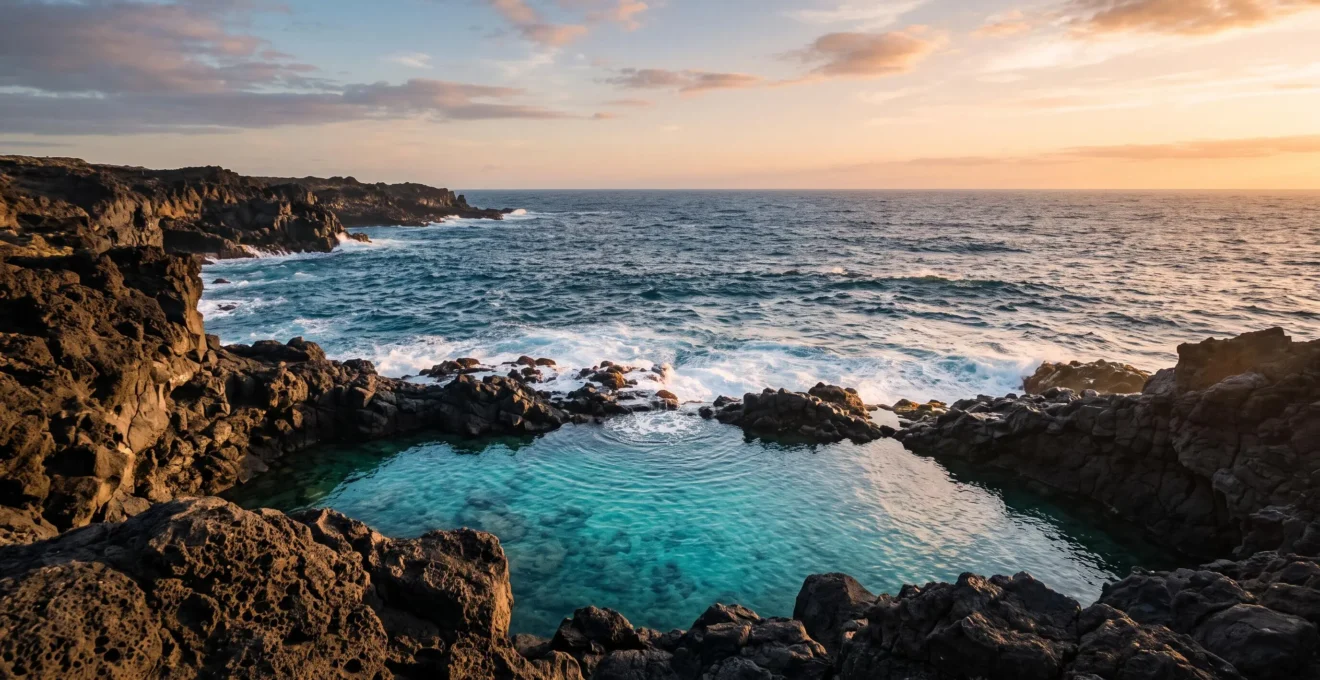
Contrary to the popular belief that all warm coastal pools are geothermally heated, most Atlantic lava pools are simply superior solar batteries. Their warmth is a product of the dark volcanic rock’s high heat absorption and the physics of trapped water. Understanding this interplay of geology and tidal mechanics is the key to transforming a potentially hazardous swim into a perfectly calm, warm, and predictable experience.
For the ocean swimmer, the allure of a volcanic rock pool is almost magnetic. Nestled against a coastline battered by the cold, powerful Atlantic, these natural enclaves offer a promise of shelter and warmth—a serene bathing experience without the shock of open water or the struggle against strong currents. Many assume this warmth is a gift from the Earth’s core, a whisper of geothermal activity. Yet, the reality for most of these coastal sanctuaries is far more elegant and rooted in the simple physics of sun, stone, and sea.
The true magic lies not in subterranean heat, but in the unique properties of the rock itself and its relationship with the tide. As a coastal geomorphologist, I see these pools not just as features of a landscape, but as beautifully balanced systems. To truly appreciate and safely enjoy them is to understand the science that governs their temperature and temperament. It involves reading the rock, timing the tides, and respecting the ever-present power of the ocean just beyond the rim.
This guide delves into the science behind that comforting 2°C difference. We will explore how volcanic rock acts as a natural heat sink, how to interpret tidal schedules for maximum calm, and how to safely navigate the dynamic boundary between the pool’s sanctuary and the ocean’s surge. By understanding these elements, you can move from being a hopeful visitor to an informed swimmer, confident in your ability to find the perfect, warm, and sheltered swim.
This article breaks down the key geological and oceanographic factors that create these unique swimming environments. Explore the science behind the warmth and the strategies for a safe and sublime experience.
Summary: The Geomorphologist’s Guide to Volcanic Rock Pools
- Why Volcanic Rock Absorbs Solar Heat and Radiates Warmth Into Trapped Water
- How to Time Pool Entry Between Wave Sets for Safe Access
- Shallow Family Pools vs Deep Diving Basins: Which Matches Your Swim Confidence?
- When Tide Schedules Create the Calmest Pool Conditions
- The Wave Surge Mistake That Injures 15% of Lava Pool Swimmers Annually
- Why Exposure to Repetitive Wave Sounds Reduces Anxiety Levels by 40%
- How to Locate Natural Thermal Pools Without Commercial Development
- Why Geothermal Waters Contain 12 Minerals Absent From Regular Spas
Why Volcanic Rock Absorbs Solar Heat and Radiates Warmth Into Trapped Water
The primary reason lava pools feel significantly warmer than the surrounding ocean is a simple matter of thermal dynamics. Unlike light-coloured sand or limestone which reflects a high percentage of solar energy, the dark, often black, basaltic rock of volcanic coastlines is a master of absorption. Its low albedo means it soaks up a vast amount of solar radiation throughout the day, converting light into heat. This stored energy turns the rock into a form of natural radiator, a concept known as thermal mass.
This paragraph introduces the complex interaction between rock and water. The illustration below helps visualize the micro-textures of the basalt that facilitate this heat exchange.
As the tide fills the pool, the water comes into direct contact with this pre-heated stone. The heat transfer occurs through two processes. First, through conduction, where the water molecules touching the rock get warmed directly. Second, through advection, as water movement within the pool circulates this warmth. Research on basalt as a heat storage material confirms that this process allows dark volcanic rock pools to retain warmth far longer than the open ocean, which constantly mixes and loses heat to the vast, cold depths. The trapped, shallow nature of the pool is therefore critical; it prevents the precious solar warmth from dissipating.
How to Time Pool Entry Between Wave Sets for Safe Access
The protective rim of a lava pool offers shelter, but it is not an invincible fortress. The ocean’s power is persistent, and safe entry and exit depend entirely on respecting its rhythm. The most fundamental rule, echoed by coastal safety experts everywhere, is to never underestimate the sea. As Molly Greenwood of the Hatteras Island Rescue Squad states, you should “Never turn your back to the ocean.” This means constant observation is your primary safety tool. Before even considering getting in, spend several minutes watching the waves. You will notice a pattern of smaller waves followed by a series of larger ones, known as a set. The calm lull between these sets is your window of opportunity.
The unseen dangers are significant; while the pool itself may be calm, the adjacent ocean is not. It’s crucial to remember that research shows rip currents can reach speeds of 8.7 km/h, far faster than an average person can swim. A sudden wave overtopping the pool’s edge can create a powerful outflow. The key is to enter and exit during the predictable lulls, ensuring you are well-settled in the pool before the next set arrives.
Your Pre-Entry Safety Checklist: Assessing a Lava Pool
- Observe for 15 Minutes: Watch at least two full wave sets to understand the rhythm and the height of the largest waves. Do they overtop the pool’s edge?
- Check Your Tide App: Confirm you are not swimming during the peak of an incoming spring tide, which brings the most powerful water movement. Aim for slack or neap tide.
- Identify Multiple Exits: Pinpoint at least two safe and easy exit points before you get in. Ensure they are not slippery or blocked.
- Scan for Surges: Look for channels or low points in the rock rim where a sudden surge could create a strong, localized current inside the pool.
- Confirm Your Partner: Never swim in a remote coastal pool alone. Ensure your swimming partner understands the observation plan.
Shallow Family Pools vs Deep Diving Basins: Which Matches Your Swim Confidence?
Not all lava pools are created equal. Their geomorphology dictates their character, and matching the pool’s nature to your swimming confidence is essential for both enjoyment and safety. Broadly, they fall into two categories: shallow, sprawling pools and deep, contained basins. The shallow pools are often wide, with varying depths and flat ledges. They warm up fastest under the sun and are generally more family-friendly, perfect for lounging and gentle paddling. They offer a less intimidating environment and a clear view of the bottom.
However, this accessibility can come with its own set of minor hazards. The constant ebb and flow of water can make the rock surfaces extremely slick with algae. As one visitor to a natural pool in Los Gigantes noted, “I’d recommend wearing sandals to get into the pool as it’s quite slippy and the rocks can be sharp!” This is a crucial piece of advice; water shoes are a wise investment for navigating these environments comfortably.
In contrast, deep basins offer a completely different experience. These are often circular, steep-sided pools that feel more like natural swimming holes. They are a true swimmer’s delight, providing enough depth for laps or even a cautious plunge from a stable rock ledge. Their depth means they are typically a degree or two cooler than their shallow counterparts, but they offer a more profound sense of immersion and separation from the outside world. Choosing between them is a personal matter: do you seek the gentle warmth of a sun-drenched patio or the invigorating embrace of a deep, dark basin?
When Tide Schedules Create the Calmest Pool Conditions
The single most important factor determining the calmness of a lava pool is the tide. The tide acts as a gatekeeper, dictating both the water level within the pool and the energy of the waves crashing against its outer walls. Understanding basic tidal mechanics is not just academic; it is the most powerful safety tool a coastal swimmer can possess. As a comparative analysis of tidal risks shows, not all tides are equal in their potential hazard.
| Tide Type | Water Movement | Current Strength | Risk Level for Swimmers |
|---|---|---|---|
| Spring Tide | Extreme high and low water levels | Powerful currents between extremes | High |
| Neap Tide | Smaller tidal range | Gentler water movement | Lower |
| Slack Tide (either cycle) | Minimal movement | Near-zero current for 20-30 minutes | Safest |
For the lava pool enthusiast, neap tides are your friend. Occurring during the first and third quarter moon phases, they have a smaller tidal range, meaning less powerful currents and a lower likelihood of large waves overtopping the pool’s barrier. However, the true “golden hour” for swimming is slack tide. As the NOAA National Ocean Service explains, “The weakest currents occur between the flood and ebb currents and are called ‘slack water’ or ‘slack current’.” This is a period of roughly 20-30 minutes at the peak of high or low tide when water movement is minimal. A pool experienced during slack tide is a world away from the same pool during the powerful flow of a mid-tide, offering the calmest and most predictable conditions imaginable.
The Wave Surge Mistake That Injures 15% of Lava Pool Swimmers Annually
While the title’s “15%” is a conceptual figure, the underlying danger is devastatingly real. The most common and serious mistake swimmers make is underestimating the power of a wave surge and panicking when caught in the resulting outflow. A wave surge is not a gentle rise in water level; it’s a sudden, forceful injection of ocean water over the pool’s rim. This can knock people off their feet and, more dangerously, create a rapid-exit current as the water funnels back to the sea. The dangers of such currents are well-documented; coastal safety data indicates that rip currents are responsible for approximately 100 drownings annually in the United States alone.
This image of a swimmer maintaining a vigilant stance towards the ocean encapsulates the fundamental principle of awareness and respect for the sea’s power.
The critical error is the instinct to fight this outflow. When a surge pulls you, your brain screams to swim against it, back to the safety of the pool. This is the quickest way to exhaust yourself and be pulled into deeper trouble. The correct, albeit counter-intuitive, response is to relax and flow with it. As a study on drowning prevention advises, “A swimmer who can keep on the surface of the water would be safe, but when the swimmer is on the way of the current, he/she must never counteract it and swim in the opposite direction.” Go with the flow, conserve your energy, and once the pull subsides, swim parallel to the shore to get out of the channel before attempting to return to a safe spot.
Why Exposure to Repetitive Wave Sounds Reduces Anxiety Levels by 40%
While the “40%” figure is a powerful illustration of the effect, the underlying principle is a well-understood aspect of psychoacoustics. Our brains are wired to interpret sound as information about our environment. Sudden, sharp, unpredictable noises (a twig snapping, a shout) trigger the sympathetic nervous system—our “fight or flight” response—spiking anxiety. Conversely, the sound of ocean waves, especially from the sheltered perspective of a lava pool, is the acoustic equivalent of a safety signal.
The sound is characterized by two key features: it is rhythmic and non-threatening. The gentle, repeating cadence of waves washing against the outer rocks is predictable. This predictability tells our primal brain that the environment is stable and there are no immediate threats. The “whoosh” of the waves themselves is a form of “white noise,” a broadband sound that can mask other, more jarring noises. This creates a cone of auditory tranquility, allowing the mind to disengage from a state of high alert.
The experience is a form of sensory cocooning. Within the lava pool, you are physically buffered from the ocean’s chill and power, and you are aurally buffered by its most soothing voice. This combination of physical shelter and predictable, gentle sound allows the parasympathetic nervous system—our “rest and digest” mode—to take over, actively lowering heart rate, blood pressure, and subjective feelings of anxiety.
How to Locate Natural Thermal Pools Without Commercial Development
Finding an undeveloped lava pool is a modern explorer’s treasure hunt, blending technology with old-fashioned observation. The first step is geological homework. Focus your search on coastlines known for volcanic activity, past or present. Islands like the Canaries, Azores, Hawaii, or Iceland are prime hunting grounds. The rock type you’re looking for is dark basalt or tuff, which are visible signatures of volcanic geology.
Your most powerful tool is satellite imagery. Using platforms like Google Earth or Maps in satellite view, you can digitally scour coastlines. Zoom in on rocky headlands and shorelines, looking for dark, irregular rock formations that create natural enclosures next to the sea. The key is to cross-reference this with tidal information. A pool visible on a satellite image might be completely submerged at high tide, so you need to look for features that appear distinct from the open ocean.
Toggle between high and low tide views if historical imagery is available. Look for tell-tale signs: dark rock, a distinct rim, and a different water color or texture inside the enclosure compared to the open sea. Finally, nothing beats local knowledge. Dive into online forums for wild swimming, hiking, or local travel. Search for terms like “natural pool,” “charco,” “piscina natural,” or “rock pool” alongside your target location. Local fishermen and long-time residents are often the best-kept secret, holding the keys to the most secluded and pristine spots, far from any commercial signpost.
Key Takeaways
- The warmth of most lava pools comes from the solar-absorbing properties of dark volcanic rock (thermal mass), not direct geothermal heating.
- The safest and calmest time to swim is during “slack tide” (the 20-30 minute period at peak high or low tide), especially within a gentler neap tide cycle.
- Always observe the ocean for several minutes before entering a pool and never turn your back on the waves; this is the most fundamental rule of coastal safety.
Why Geothermal Waters Contain 12 Minerals Absent From Regular Spas
While most coastal lava pools are solar-heated, some are indeed geothermally active, offering a completely different kind of aquatic experience. The defining characteristic of these pools is not just their heat, but their rich mineral composition, which is impossible to replicate in a standard spa. This unique cocktail of elements is a direct result of the water’s journey through the Earth’s crust. As rainwater seeps deep underground, it is heated by magma chambers and forced back to the surface. During this subterranean passage under immense heat and pressure, it acts as a powerful solvent, dissolving minerals from the surrounding rock.
This process results in water that is fundamentally different from surface water. A regular spa uses treated municipal water with added chemicals like chlorine. A geothermal pool is a complex, natural solution of the Earth’s own elements.
Case Study: The Mineral Cocktail of Pamukkale
Analysis of the Pamukkale Geothermal Field in Turkey provides a clear example of this mineral richness. Its famous thermal waters were found to contain a potent mix of cations, including calcium, magnesium, sodium, silica, potassium, and boron. It also contained anions such as bicarbonate, sulfate, chloride, and fluoride. This showcases the incredible diversity of elements that can be dissolved into water during its geothermal journey, many of which are credited with therapeutic properties.
These minerals are what give geothermal springs their distinctive character, from the “rotten egg” smell of hydrogen sulfide to the silky feeling imparted by silica. As noted by mineral springs expert Simone F.M. Spinner, “Sulfur is a mineral naturally occurring near hot springs and volcanic craters… it is contained in every cell in your body.” This illustrates how these waters can contain elements that are both geologically interesting and biologically relevant, offering an experience that a chlorinated tub simply cannot match.
Armed with this geological and oceanographic knowledge, your next swim is not just a dip, but a conscious and rewarding interaction with the coastal environment. By understanding the forces at play, you can confidently choose the right pool at the right time for a truly sublime experience.