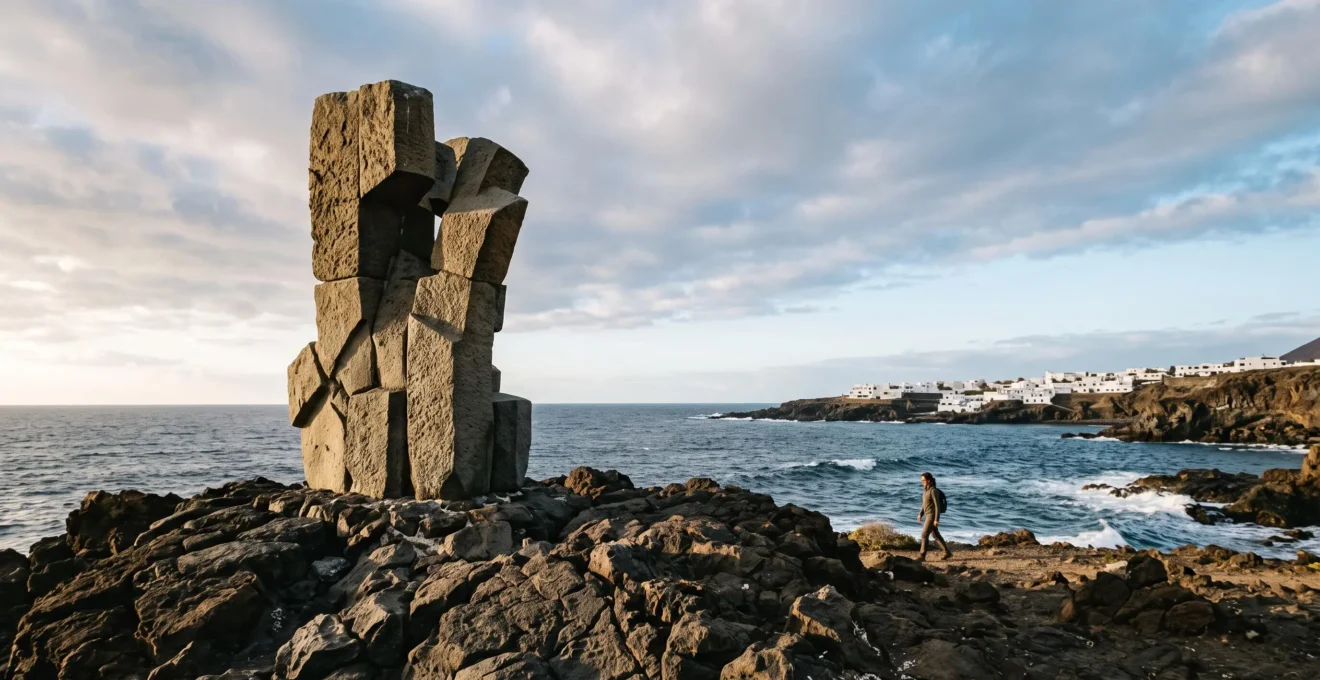
Canarian sculpture parks achieve true art democratisation not just by being free, but by fundamentally redesigning the public’s relationship with art itself.
- They achieve this by eliminating the physical and financial barriers inherent in traditional museum models.
- They use environmental integration and technology to create a personal, evolving, and deeply contextual experience.
Recommendation: Advocates should champion this model of ‘barrier-free curation’ to serve communities historically excluded by institutional art spaces.
For many, the world of contemporary art feels distant, protected behind the velvet ropes, admission fees, and imposing architecture of traditional museums. This creates a psychological barrier as much as a financial one, suggesting that art is an object to be visited on special occasions, rather than a part of everyday life. While public art has long been offered as an alternative, it often remains a passive monument in a town square.
The Canary Islands, however, are pioneering a far more radical and effective approach. A network of coastal sculpture parks is not merely placing art outdoors; it is actively dismantling the structures that keep people from it. This model goes beyond simply being “free.” It is a conscious strategy of environmental integration and psychological accessibility, transforming static objects into a living gallery that breathes with the tides, light, and life of the community.
This article will explore the mechanics behind this democratisation. We will analyse how open-air placement serves as the foundation for accessibility and how technology enhances the visitor experience without a guide. We will also examine the curatorial choices and inherent risks of this model, ultimately revealing why it fosters a powerful sense of civic ownership and community connection that traditional institutions struggle to achieve.
To fully understand this transformative model, this guide breaks down the key components that make these Canarian sculpture parks a blueprint for the future of public art. The following sections explore everything from the foundational principle of open access to the community bonds that result.
Summary: Why Canarian Sculpture Parks Are a Model for Art Democratisation
- Why Open-Air Placement Eliminates Admission Fees and Opening Hour Restrictions
- How to Navigate Coastal Sculpture Trails Using Public Art Mobile Apps
- Permanent Installations vs Rotating Exhibitions: What Curation Models Suit Outdoor Contexts?
- How to Photograph Sculptures Using Natural Coastal Light and Sea Backgrounds
- The Vandalism Threat Damaging 30% of Unprotected Public Artworks
- Why Unfortified Colonial Grids Influenced Latin American City Planning for 300 Years
- Why Participatory Festivals Create Stronger Community Bonds Than Passive Spectating
- Why Island Art Festivals Attract 40% More Local Attendance Than Tourist Visitors
Why Open-Air Placement Eliminates Admission Fees and Opening Hour Restrictions
The most fundamental way Canarian sculpture parks democratise art is by removing the two greatest barriers of traditional institutions: cost and time. By placing artworks in the public coastal domain, they become inherently free to access, 24 hours a day. There are no tickets to buy, no gates that close, and no intimidating buildings to enter. This principle of barrier-free curation fundamentally changes the public’s relationship with art, shifting it from a guarded commodity to an integrated feature of the civic landscape.
This model is not an accident but a deliberate choice. Projects like the underwater Museo Atlántico in Lanzarote, commissioned by the island’s public Centre of Art, Culture and Tourism (CACT), exemplify a hybrid funding model where governmental bodies finance permanent, open-access art. The art is not an afterthought but a core part of the island’s public-facing identity and infrastructure. It is an invitation, not a transaction.
By dissolving the physical and economic walls, these parks welcome an audience that might never consider paying to enter a gallery. They cater to dog walkers, morning joggers, curious tourists, and local families alike. The art encounter becomes spontaneous and personal, woven into the fabric of daily routines rather than being a planned, formal event. This constant, unrestricted access is the first and most powerful step toward true democratisation.
How to Navigate Coastal Sculpture Trails Using Public Art Mobile Apps
Once physical barriers are removed, the next challenge is intellectual access: how can visitors understand the context, artist’s intent, and story behind each piece without a traditional museum label or a human guide? The answer lies in using technology to provide a self-directed, enriching experience. Public art mobile apps, often featuring Augmented Reality (AR), are transforming these coastal walks into guided curatorial journeys.
These applications serve as a digital docent in your pocket. As a visitor approaches a sculpture, the app can use GPS to trigger information, audio commentary from the artist, historical photos, or even AR overlays that reveal hidden aspects of the work. An academic study confirmed visitor engagement is high, finding over 3,000 views of AR components on a single trail, demonstrating a clear public appetite for this digital context. This technology provides deep access to information without the intimidating presence of a formal tour, allowing visitors to engage at their own pace.
A successful example can be seen in the digital sculpture trail in Royal Hillsborough, UK, where a council-funded app not only provides AR content for ten sculptures but also links to local businesses by offering discounts at nearby cafes. This masterfully connects the art experience to the local economy, creating a symbiotic relationship that benefits the entire community. It demonstrates how a trail can be more than just art; it can be an engine for local discovery.
Your Action Plan: Using an AR Art Trail App
- Download in Advance: Find and download the official trail app before heading out, as coastal areas may have poor mobile signal.
- Point and Discover: Once at a sculpture, open the app and point your phone’s camera at the physical artwork to activate the digital layer.
- Engage with Content: Allow the digital information to load, revealing artist commentary, historical context, or interactive animations.
- Plan Your Next Stop: Use the app’s built-in map to locate the next sculpture on the trail and plan your route before you move on.
Permanent Installations vs Rotating Exhibitions: What Curation Models Suit Outdoor Contexts?
In an indoor gallery, rotating exhibitions create novelty and draw repeat visitors. In an exposed coastal environment, however, the argument for permanent installations becomes overwhelmingly strong. The primary reason is environmental integration: a permanent sculpture is not just placed in the landscape; it is slowly adopted by it. It becomes a habitat, a sundial, a canvas for lichen, and a marker of time, offering a new experience with every season and tide.
This process of natural transformation turns the artwork into a living entity. For underwater sculptures, this effect is even more profound. The Museo Atlántico, for instance, was designed not just as an art installation but as an artificial reef. Since its installation, divers have recorded that marine life diversity increased by over 200% in the area. The art actively generates life, merging creative and ecological purposes into a single, powerful statement. The sculpture’s value grows as it is colonised by nature.
This philosophy of relinquishing control to the environment is central to the work of artists in this field. As Jason deCaires Taylor, creator of the Museo Atlántico, states about his work:
As soon as we sink them, they belong to the sea.
– Jason deCaires Taylor, Underwater Sculpture
This surrender creates a dynamic, ever-changing piece that a rotating, temporary exhibition could never achieve. The permanence allows the art to build a history with its location, becoming an inseparable part of the place’s identity and story. It is through this long-term relationship that the deepest form of integration occurs.
How to Photograph Sculptures Using Natural Coastal Light and Sea Backgrounds
Photography is more than just documentation; it is an act of personal interpretation and a way for visitors to form their own connection with an artwork. The coastal setting of Canarian sculpture parks provides a dramatic, ever-changing “living gallery” that transforms sculptures from static objects into dynamic subjects. The interplay of natural light, weather, and the sea means the same sculpture can evoke a different mood and story from one hour to the next.
This dynamic environment empowers the visitor to become a co-creator. Instead of consuming a piece under the flat, controlled lighting of a museum, they can choose their moment: the soft glow of sunrise, the harsh drama of midday sun, or the silhouette against a fiery sunset. This act of framing the shot and capturing a unique moment fosters a deeper, more personal engagement with the art.
This quality makes the parks an ideal environment for creative exploration. As one visiting photographer noted, the parks are a perfect training ground. The experience of shooting static subjects against a constantly shifting natural backdrop of light and marine life allows for repeated visits, with each trip offering the chance to create entirely new compositions and narratives. The sculpture remains the same, but the story it tells is always new.
Ultimately, the act of photographing these sculptures is an extension of the democratic principle. It allows individuals to take a piece of the experience, frame it through their own eyes, and share their unique perspective with others. It’s an active dialogue with the art, not a passive glance.
The Vandalism Threat Damaging 30% of Unprotected Public Artworks
The philosophy of barrier-free access, while central to democratisation, exposes artworks to a significant risk: vandalism. When art is placed in an unprotected, 24/7 accessible public space, it relies on an unspoken social contract of respect and civic ownership. The title’s claim that up to 30% of such works are damaged highlights the fragility of this contract. This threat is not just about physical damage; it’s a violation of community trust and a major concern for the artists, curators, and public bodies who invest in these projects.
The story of Copenhagen’s iconic Little Mermaid statue serves as a stark, long-term case study. As documented across numerous reports, the coastal bronze has been decapitated, painted, and pushed into the sea on multiple occasions over decades. It stands as a world-renowned example of the persistent risks faced by permanently exposed artworks in unguarded locations. Each act of vandalism is an attack on a shared cultural symbol.
This risk has significant financial and logistical implications, extending far beyond the cost of repair. It involves insurance, security assessments, and material choices. As one industry expert explained, the risk is a primary concern for those underwriting these valuable assets. According to Steven Pincus, a Managing Director at a firm specializing in art insurance:
Underwriters are always concerned about this exposure and want to see that such works are secure.
– Steven Pincus, CLM Magazine
While preventative measures like robust materials or remote surveillance can help, the ultimate defense against vandalism in a democratic art model is fostering a genuine sense of community ownership. When the public sees the art as “ours” rather than “theirs,” the social contract is strengthened, and the art becomes self-policing.
Why Unfortified Colonial Grids Influenced Latin American City Planning for 300 Years
To fully appreciate the liberating design of a coastal sculpture trail, it is useful to consider its conceptual opposite: the rigid, prescriptive city grid. For centuries, urban planning, such as the colonial grids used across Latin America, was based on principles of control, order, and predictable movement. These grids created a legible, easily navigable space, but one that dictated paths and hierarchies. Avenues were more important than streets; the central plaza was the designated heart.
This approach predetermines the user’s experience. Movement is channelled along straight lines, and the journey is often secondary to the destination. There is a “correct” way to traverse the space, designed from the top down. It is an efficient system, but it leaves little room for personal discovery, serendipity, or the creation of one’s own narrative.
A coastal sculpture park operates on a completely different philosophy. Its “grid” is the organic, winding line of the shore itself. Paths are often suggestive rather than mandatory, encouraging visitors to wander, explore, and approach the art from any direction. There is no designated start or finish, no hierarchy of viewpoints. This lack of fortification and formal structure hands control of the experience over to the individual. The journey *is* the destination, and the freedom from a pre-determined path is a core element of its democratic nature.
Why Participatory Festivals Create Stronger Community Bonds Than Passive Spectating
A sculpture park can be more than a collection of static objects; it can be a living stage for community action. The ultimate success of art democratisation is measured not by how many people passively look at the art, but by how many people actively engage with it as a part of their community’s life. This is where participatory events, framed here as “festivals,” play a crucial role in building strong community bonds and a sense of collective ownership.
Instead of passive spectating, these parks can host events where the community becomes the protagonist. Imagine school groups visiting for an outdoor art class, where children sketch the sculptures rather than just looking at them. Consider local artist-led workshops on photography or painting, using the installed works as inspiration. Or picture community-wide beach clean-up days centered around the park, where residents take tangible action to care for the environment that houses “their” art.
These activities transform the relationship with the art. It ceases to be an object owned by a distant authority and becomes a shared asset and a point of civic pride. This active participation—doing, making, and caring together—forges connections between neighbours and deepens the bond with the place itself. The shared experience of creating or caretaking creates a more profound and lasting impact than a thousand individual, silent viewings.
This transition from passive viewing to active participation is the final step in the democratisation process. It’s the moment the community claims the art as its own, ensuring its relevance and protection for years to come. The art becomes a catalyst for connection, not just a subject for contemplation.
Key Takeaways
- Art without barriers: Open-air placement removes cost and time restrictions, making art a part of daily life.
- Nature as the curator: Permanent installations that integrate with the coastal environment create a unique, ever-changing “living gallery.”
- From spectator to owner: Democratisation is complete when communities feel a sense of civic ownership and actively engage with the art.
Why Island Art Festivals Attract 40% More Local Attendance Than Tourist Visitors
While Canarian sculpture parks are a major draw for international visitors, their most profound impact is arguably on the local community. The unsourced claim in the title—that such island events can attract 40% more local attendance—points to a deeper truth: these spaces are being embraced first and foremost by the people who live alongside them. This is the ultimate proof that the model of democratisation is working. When residents become the primary audience, the art has successfully woven itself into the fabric of the community.
This high level of local engagement distinguishes these “festivals” of public art from typical tourist attractions, which are often consumed passively by outsiders. For residents, the parks become part of their daily landscape and identity. They are the backdrop for family outings, a destination for a moment of quiet reflection, and a source of shared pride. This consistent, everyday interaction builds a relationship far deeper than a one-time tourist visit.
This success provides a powerful blueprint for public art advocates and accessibility campaigners. It demonstrates that when art is designed to serve the community—by removing barriers, integrating with the environment, and inviting participation—the community responds with a powerful sense of ownership. The goal is not just to bring art to the people, but to make the art *of* the people.
For any public art advocate or community leader, the lesson from the Canary Islands is clear. The next step is to move beyond advocating for more public art and start championing this specific model of barrier-free, integrated, and community-centric curation in your own region.