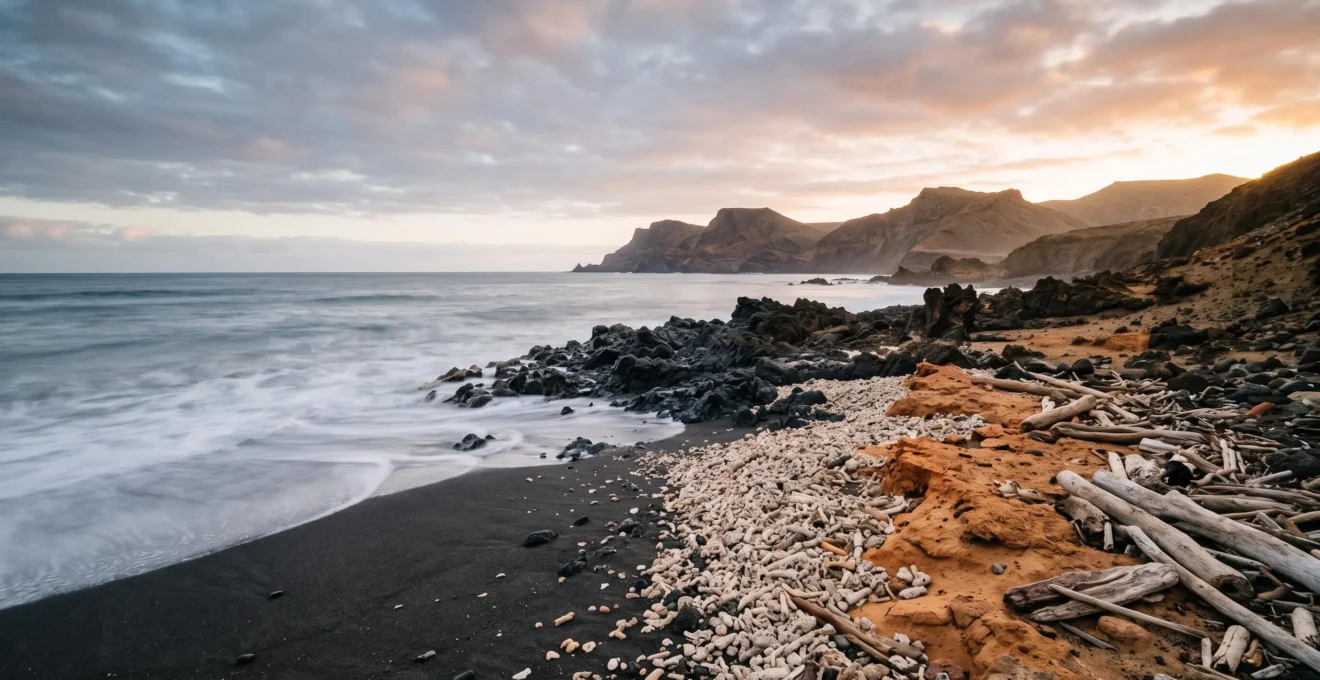
Canarian identity is not a blended “melting pot” but a complex cultural stratigraphy where distinct historical layers remain visible and active.
- Indigenous Berber (Guanche) and North African foundations persist in genetics and place names, forming the bedrock of the islands’ identity.
- Secular spaces like Carnival provided a sanctuary for African and later marginalized cultural expressions to thrive outside of restrictive religious contexts.
- The “ida y vuelta” (round-trip) migration with Latin America created a continuous cultural exchange, embedding Caribbean influences deep within the local dialect and traditions.
Recommendation: To understand this hybridity, cultural analysts should trace these influences not as separate ingredients, but as interacting layers that resurface in language, festivals, and even DNA.
To the casual observer, Canarian culture presents a deceptively simple façade: a vibrant offshoot of mainland Spain, seasoned with Atlantic breezes and a tourist-friendly disposition. This surface-level reading, however, misses the profound complexity churning just beneath. Cultural anthropologists and educators often encounter this simplified narrative, one that acknowledges a vague mix of Spanish, Indigenous, and African roots but fails to explain the dynamic, often contentious, process of their interaction. The story of the Canary Islands is not one of gentle blending, but of conquest, suppression, survival, and resurgence.
The common models of “melting pot” or “mosaic” fall short here. They don’t account for why some cultural forms vanished while others went underground, only to re-emerge centuries later in new, syncretic forms. But what if the key isn’t to see Canarian identity as a mixture, but as a form of cultural stratigraphy? This perspective, borrowed from geology, allows us to see the islands’ identity as layers of sedimented history—a Guanche bedrock, a Castilian conquest layer, deposits of African slave trade, and currents of Latin American migration. The most fascinating part is not the layers themselves, but the fault lines—the cultural fissures through which older, submerged layers constantly push to the surface.
This analysis will trace the five principal tributaries that form this unique cultural geology. We will explore the specific mechanisms of survival, the “secular sanctuaries” that protected marginalized traditions, and the linguistic archaeology that reveals a history the official narratives often forget. By digging into these layers, we can construct a far more accurate and dynamic model of how this complex hybrid identity was, and continues to be, forged.
To navigate this exploration of Canarian cultural geology, the following sections will delve into the specific layers and forces that have shaped the archipelago’s unique identity. This structure allows us to move from broad cultural phenomena to the specific scientific and linguistic evidence that supports a more nuanced understanding.
Summary: Uncovering the Layers of Canarian Cultural Identity
- Why African Musical Traditions Survived Through Secular Carnival Rather Than Religious Ritual
- How to Experience Living Cultural Fusion Through Neighbourhood Festivals
- Melting Pot vs Mosaic Models: What Integration Pattern Fits Canarian Reality?
- How to Trace Cultural Influences Through Linguistic Borrowings in Local Dialect
- The Simplified Narrative That Erases 80% of African and Indigenous Contributions
- Why Genetic Studies Reveal North African Berber Origins of Island Populations
- Why Carnival Provided Safe Cultural Expression Space for Marginalised Communities
- Why Canarian Carnival Ranks Among Europe’s Three Largest Street Festivals
Why African Musical Traditions Survived Through Secular Carnival Rather Than Religious Ritual
The persistence of African cultural elements within the Canary Islands is a direct testament to the power of secular spaces as cultural archives. Following the Castilian conquest, the dominant socio-religious framework was aggressively Catholic, leaving little room for the preservation of non-Christian rituals or spiritual music. African traditions, brought to the islands through the slave trade, faced suppression. However, the institution of Carnival provided an unexpected and vital loophole—a secular sanctuary where social norms were temporarily suspended and cultural expressions, particularly rhythmic and performative ones, could flourish.
Unlike religious ceremonies with strict liturgical rules, Carnival was a civic event focused on parody, revelry, and competition. This environment was fertile ground for the survival of African-derived polyrhythms and call-and-response musical structures. These elements were not framed as “African” or “pagan” but were instead integrated into the very fabric of the festival’s performance groups. As the Hello Canary Islands editorial team notes, this is visible in “the competitions to select the best carnival group, which are called ‘murgas’ and ‘comparsas’.” It is within the DNA of these groups’ music that the African influence is most audible today.
Case Study: Carnival of Santa Cruz de Tenerife as an Institutionalised Secular Outlet
The evolution of the Santa Cruz de Tenerife Carnival is a prime example of this mechanism. After being designated a ‘Fiesta of International Tourist Interest’ in 1980, it became a fully sanctioned, secular civic institution. This official status provided a protected arena for performative traditions that might have been marginalized within a stricter Afro-Catholic religious context. As a result, African-derived rhythmic and dance traditions were able to be preserved and celebrated openly within the formal structures of murgas and comparsas, rather than being pushed into secrecy or extinguished entirely.
This institutionalization of a secular festival created a pathway for cultural continuity that religious syncretism alone could not have provided. The beat survived not by blending into the Mass, but by becoming the heart of the parade.
How to Experience Living Cultural Fusion Through Neighbourhood Festivals
While large-scale Carnivals showcase the grand spectacle of cultural syncretism, it is often in smaller, neighbourhood-level festivals that one can witness the most intimate forms of living cultural fusion. These events are not just celebrations; they are often a form of performative re-enactment, where communities physically embody and retell the stories of their layered heritage. These festivals offer a tangible way to experience the back-and-forth cultural exchange—the ‘ida y vuelta’—that defines the Canarian experience, particularly the profound connection with Latin America.
This layering is not just historical but is visible in the material culture itself, from architecture to craft. The fusion of Indigenous ceramic techniques with Spanish glazing methods, or the incorporation of Latin American motifs into traditional embroidery, all tell a story of contact and adaptation. Observing these festivals and crafts allows an analyst to move beyond abstract theories of hybridity and see the process in action, where distinct traditions coexist and create something new without completely erasing the originals.
Case Study: Fiesta de Los Indianos, La Palma
The Fiesta de Los Indianos in Santa Cruz de La Palma is a perfect illustration of this performative dynamic. The entire festival re-enacts the return of “Indianos”—emigrants who made their fortunes in the Caribbean (especially Cuba) and came back to the islands. Participants don white colonial-era suits and parade to vibrant Latin American music. The climax is the “Batalla de Polvos de Talco,” a massive, communal talcum-powder battle that blankets the entire city in white. This ritual powerfully symbolizes the ‘ida y vuelta’ journey, the wealth (represented by the white powder, a stand-in for flour or riches), and the cultural baggage brought back from the Americas, all condensed into a single, immersive afternoon.
By participating or observing, one doesn’t just learn about the history of emigration; they experience its cultural echo in a living, breathing ritual that unites past and present.
Melting Pot vs Mosaic Models: What Integration Pattern Fits Canarian Reality?
For decades, cultural theorists have relied on two primary models to describe cultural integration: the “melting pot,” where distinct cultures fuse into a new, homogeneous whole, and the “mosaic,” where cultures coexist side-by-side while retaining their distinct characteristics. Neither of these, however, adequately captures the Canarian reality. The island identity is not a seamless blend, nor is it a tidy collection of separate tiles. A more accurate model is that of cultural stratigraphy, where historical influences have been laid down in successive layers, much like geological strata.
In this model, the foundational layer is the Indigenous Guanche (Berber) culture. The subsequent Castilian conquest forms a thick, dominant stratum on top. Later, layers of African influence and the continuous back-and-forth with Latin America were deposited. Crucially, these layers are not inert. Tectonic pressures—social, political, and economic—create fissures, allowing elements of the lower, submerged layers to erupt and re-emerge on the surface. This explains why Indigenous words persist in place names and why African rhythms drive Carnival music, pushing through the dominant Castilian cultural surface.
This “geological” model acknowledges both the overwhelming dominance of one layer (Castilian) and the persistent, un-melted survival of others. Genetic data provides strong evidence for this stratified reality. For instance, a mitogenome study found that 42% of modern Canarian maternal DNA lineages are of Indigenous origin, proving that the foundational human bedrock was not erased but absorbed and carried forward, even as the overt culture was transformed.
This stratigraphic view provides a more dynamic and accurate framework for analysis, accounting for both historical power imbalances and the remarkable resilience of submerged cultural forms.
How to Trace Cultural Influences Through Linguistic Borrowings in Local Dialect
Language is one of the most powerful tools for cultural stratigraphy. The Canarian Spanish dialect (habla canaria) is a living archive, a linguistic bedrock where the successive layers of the islands’ history can be excavated. For a cultural anthropologist, engaging in this linguistic archaeology means listening for the words, phrases, and phonetic traits that betray origins other than Castilian Spanish. This process reveals a complex tapestry woven from Indigenous remnants, maritime jargon, and, most significantly, a constant dialogue with the Caribbean.
The layers are remarkably distinct. The deepest stratum is the Guanche substrate, a Berber-derived language spoken before the conquest. While the language itself is extinct, it survives in hundreds of place names (toponymy) and in the local vocabulary for endemic flora and fauna. Above this is a thick layer of Andalusian and nautical Spanish, brought by the first settlers and sailors. The most dynamic layer, however, is the deposit of Latin Americanisms, a direct result of the ‘ida y vuelta’ migration. Words for everyday items, food, and social concepts were carried back from Cuba, Venezuela, and Puerto Rico, becoming so ingrained that many Canarians are unaware of their “foreign” origin.
The following table, based on linguistic analysis, breaks down these layers, providing a clear map for this archaeological dig. As noted by Wikipedia contributors, the exchange was a two-way street, as “Canarian Spanish heavily influenced the development of Caribbean Spanish and other Latin American Spanish vernaculars,” making the islands a crucial node in the Atlantic linguistic network.
| Layer | Example words | Semantic field | Origin |
|---|---|---|---|
| Guanche substrate | Place names, flora/fauna terms | Toponymy, agriculture, shepherding | Indigenous Berber-derived Guanche language |
| Latin Americanisms (ida y vuelta) | guagua, machango, rasca | Transport, everyday social life | Cuban and Caribbean Spanish, carried back by returning emigrants |
| Andalusian/nautical layer | jalar, seseo pronunciation | Maritime vocabulary, phonetics | Andalusian settlers and medieval Spanish sailors |
Action Plan: Auditing a Culture for Stratigraphic Influence
- Map the Toponymy: List local place names (mountains, villages) that do not have clear Spanish roots. Cross-reference them with databases of Indigenous (Guanche) vocabulary to identify the foundational linguistic layer.
- Inventory Everyday Vocabulary: Collect a sample of 50-100 local slang or colloquial terms for food, transport, and social interactions. Compare them against standard Castilian Spanish and Caribbean Spanish dictionaries to isolate the ‘ida y vuelta’ influence.
- Analyze Phonetics: Record and analyze local speech patterns. Note specific phonetic traits like the ‘seseo’ (pronouncing ‘c’/’z’ as ‘s’) and trace their origins to specific regional influences from southern Spain or the Americas.
- Document Performative Language: Attend a local festival or market and transcribe the language used in songs, chants, and vendor calls. Identify archaic terms or ritualistic phrases that may represent preserved linguistic forms.
- Synthesize the Layers: Create a summary chart, similar to the table above, that categorizes your findings by origin (Indigenous, Andalusian, Latin American, etc.) to visualize the linguistic stratigraphy of the specific community.
The Simplified Narrative That Erases 80% of African and Indigenous Contributions
The dominant historical narrative of the Canary Islands often presents a story of successful and near-total Hispanization. In this simplified version, the Indigenous Guanche population was quickly assimilated or disappeared after the conquest, and the African presence is treated as a minor footnote in the formation of a primarily European society. This narrative, while convenient, is a form of historical erasure that flattens the complex cultural stratigraphy and dismisses the resilience of the submerged layers.
This simplification serves a clear purpose: it centers the Castilian conquest as the sole genesis of modern Canarian identity, creating a linear and uncomplicated history. It ignores the violent processes of cultural suppression and marginalizes the foundational contributions of the islands’ non-European inhabitants. The reality, as evidenced by genetics and linguistics, is that these contributions were not erased but were absorbed, transformed, or pushed into specific cultural niches where they could survive.
The survival of the Guanche language is a prime example. While the language ceased to be spoken, its ghost lives on. Grokipedia contributors point to “including around 120 retained terms, mainly in toponymy, flora, and fauna.” This statistic is telling: the Indigenous language was relegated to naming the landscape and its unique species—things for which the conquerors had no words. It was allowed to survive only where it was practically necessary, while its role in social and spiritual life was extinguished. Similarly, African contributions are often only acknowledged in the “exotic” and “festive” context of Carnival, ignoring their deeper impact on the archipelago’s social and economic history.
Recognizing this simplified narrative is the first step for any cultural analyst. The real work lies in challenging it by actively seeking out and highlighting the evidence of the submerged 80%—the inconvenient but essential contributions that make Canarian identity so uniquely layered.
Why Genetic Studies Reveal North African Berber Origins of Island Populations
While linguistic and cultural analysis can reveal much about the islands’ stratified history, modern genetic science provides the most definitive evidence of the archipelago’s foundational layer. For centuries, the precise origin of the Indigenous Guanches was a subject of speculation. However, recent genomic studies have provided a clear answer, anchoring the Canary Islands’ story firmly in the context of North Africa. As a landmark 2019 study in PLOS ONE concluded, analysis points to “a most probable North African Berber source” for the islands’ first inhabitants.
This confirmation is crucial for cultural anthropologists because it establishes the Guanche heritage not as an isolated or mythical phenomenon, but as part of a wider Amazigh (Berber) cultural world that stretches across North Africa. It provides a concrete geographical and cultural starting point for the islands’ entire human history, forming the absolute bedrock of its cultural stratigraphy. These studies effectively prove that before any European or subsequent African contact, the islands were an extension of the North African mainland.
Furthermore, genetic analysis tells a nuanced story of the conquest itself. It reveals a stark asymmetry in the genetic contributions of the European settlers and the Indigenous population. For example, a detailed admixture analysis showed that the Indigenous contribution to the modern Canarian gene pool is dramatically skewed. The maternal lineage (mtDNA) is estimated to be around 33-42% Indigenous, while the paternal lineage (Y-chromosome) is only around 7% Indigenous. This pattern is a clear genetic signature of a conquest society: primarily European men procreating with Indigenous women. It is a stark, scientific confirmation of the power dynamics that shaped the formation of this new hybrid population.
This genetic data moves the conversation from cultural theory to biological fact, providing an irrefutable map of the first layers of Canarian identity.
Why Carnival Provided Safe Cultural Expression Space for Marginalised Communities
The function of Carnival as a “secular sanctuary” did not end with the preservation of historical African traditions. In the modern era, it has evolved to become a crucial safe space for the expression of new and contemporary marginalized identities, most notably the LGBTQ+ community. Just as it once provided a loophole for non-Catholic rhythms, it now offers a platform for gender-bending performance and queer celebration in a society that was, until relatively recently, highly conservative.
The most spectacular manifestation of this is the Drag Queen Gala of Las Palmas de Gran Canaria. What began as a subversive, niche event has exploded into a central pillar of the Carnival, broadcast live on national television. Its longevity is a testament to its cultural significance; celebrating its 25th anniversary in 2023, the gala has institutionalized drag performance as a celebrated art form. This evolution showcases Carnival’s unique capacity to absorb and legitimize counter-cultural expressions.
Case Study: RuPaul’s 2008 Appearance and International Recognition
A pivotal moment in the gala’s history occurred in 2008 when the global drag icon RuPaul travelled to Gran Canaria to participate in the event’s 10th anniversary. This was more than a celebrity appearance; it symbolized the transition of the Drag Queen Gala from a local, once-marginalized expression into an internationally recognized phenomenon. RuPaul’s participation bestowed global legitimacy on the event, affirming its status as a world-class celebration of queer artistry and cementing Carnival’s role as a powerful platform for visibility.
The gala’s importance has been formally recognized, with the State Federation of Lesbians, Gays, Trans and Bisexuals (FELGTB) praising it for “being an international symbol of diversity and revindication in terms of festive celebration and of freedom.” This demonstrates how the historical function of Carnival—to provide a temporary space of liberation—has been adapted to serve the needs of new communities seeking visibility and acceptance.
Key Takeaways
- Canarian identity is best understood as a “cultural stratigraphy,” with layers of Indigenous, Spanish, African, and Latin American influence.
- Secular festivals like Carnival acted as “sanctuaries” that allowed suppressed African and later LGBTQ+ cultural forms to survive and flourish.
- Genetic evidence confirms the Indigenous Guanche population’s North African Berber origins and reveals a conquest pattern of European fathers and Indigenous mothers.
Why Canarian Carnival Ranks Among Europe’s Three Largest Street Festivals
The culmination of these diverse cultural streams finds its most spectacular expression in the sheer scale of the modern Canary Islands Carnival. Festivals in Santa Cruz de Tenerife and Las Palmas de Gran Canaria are not minor local events; they are massive, internationally renowned spectacles, often cited alongside Venice and Notting Hill as Europe’s largest street festivals. This scale is not just about numbers; it represents the ultimate success of the festival as a vessel for mass participation and cultural expression, a place where all the layers of Canarian identity are simultaneously celebrated.
The numbers themselves are staggering. The main parades and street parties in Las Palmas de Gran Canaria, for instance, can draw in excess of 500,000 attendees, transforming the entire city into a single, pulsating celebration. This mass participation is the ultimate expression of the festival’s civic and cultural importance. It is a time when the entire social fabric, from children to the elderly, engages in the shared rituals of costume, music, and dance.
This grand scale is also a result of a conscious and successful dialogue with other global Carnivals. As the GVI editorial team points out regarding Tenerife, “the influence of Brazil’s Carnaval can be seen in the elaborate floats and samba-inspired music.” This demonstrates that the ‘ida y vuelta’ dynamic is ongoing; the islands not only export their culture but actively import and reinterpret global festive traditions, particularly from Latin America. This makes the Canarian Carnival a key node in a global network of festive culture, a place where European, African, and American traditions meet and magnify one another.
Ultimately, the immense scale of the Carnival is the loudest and most vibrant evidence of the islands’ successful, if complex, cultural hybridity. It is the annual moment when the deep, stratified layers of history erupt onto the streets in a joyous, chaotic, and profoundly meaningful display of collective identity.
To truly understand the islands’ hybridity, the next step is to apply this stratigraphic analysis in your own observations, moving beyond surface-level descriptions to uncover the historical forces still at play in the culture today.