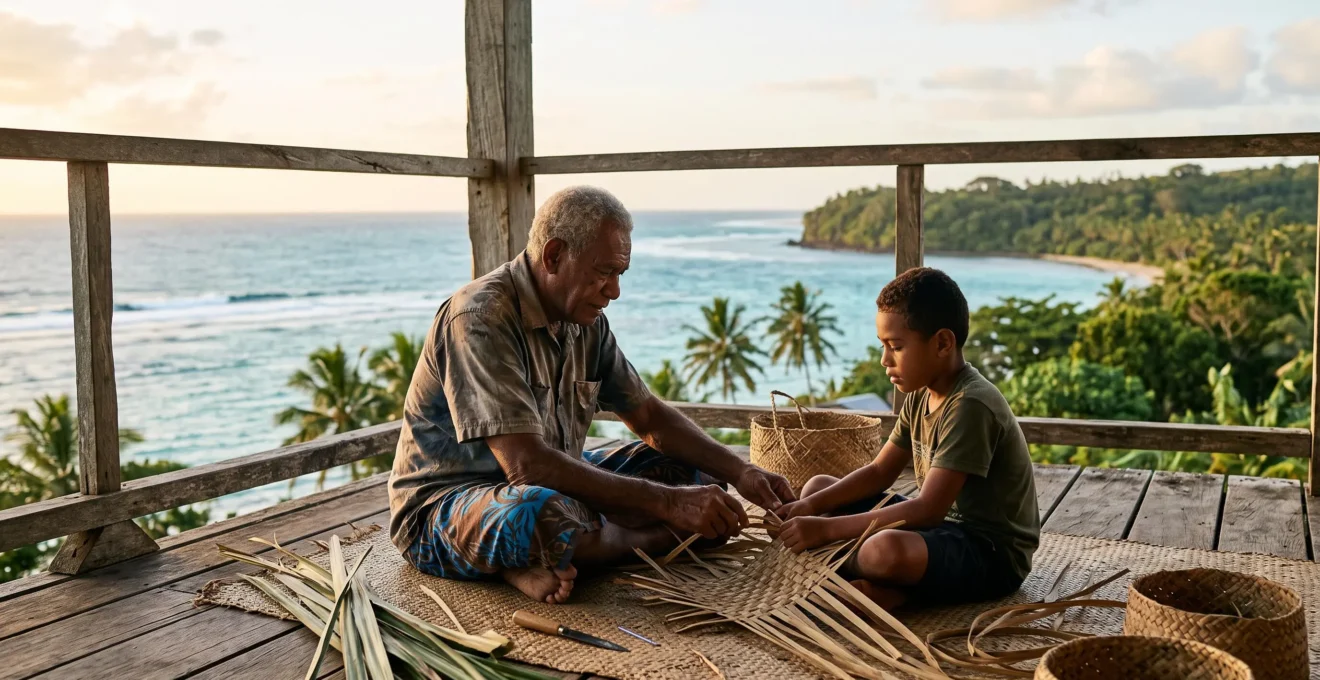
Preserving culture isn’t about building bigger museums or better tourist shows; it’s about protecting the unscripted, living practices from being archived into silence or commodified into extinction.
- Oral transmission ensures dynamic authenticity where written codification creates static, fragile artifacts.
- True engagement comes from community invitation and participation, not from a spectator’s ticket or a staged performance.
Recommendation: Focus support on the master-apprentice chains and community-led initiatives that keep traditions in active, daily use, treating communities as the sole custodians of their heritage.
For decades, the dominant approach to cultural preservation has been institutional. We collect, we catalogue, we codify. We build museums to house artifacts and digital archives to store recordings, believing that this act of documentation is synonymous with survival. In parallel, a global tourism industry packages cultural expressions into easily digestible performances—the “folklorisation trap”—promising travelers authenticity while often delivering a hollowed-out spectacle. This approach, while well-intentioned, fundamentally misunderstands the nature of intangible cultural heritage. It treats living traditions as relics to be frozen in time or commodities to be sold.
But what if the key to survival lies not in preservation, but in practice? This guide argues for a radical shift in perspective. It posits that true cultural resilience is an act of living resistance against the twin forces of sterile archiving and extractive folklorisation. It thrives not in the controlled environment of a museum or the script of a tourist show, but in the dynamic, often messy, reality of community life. It is passed through uninterrupted chains of oral transmission, witnessed through genuine human connection, and adapted by new generations who carry its core values forward. It is heritage that is lived, not merely observed.
This article will deconstruct the conventional wisdom surrounding cultural preservation. We will explore why the spoken word is a more robust vehicle for authenticity than the written one, and how to differentiate a genuine community invitation from a commercialized performance. By examining the critical difference between a living practice and a museum piece, we will build a case for supporting traditions where they belong: within the communities that act as their living custodians.
Summary: Deconstructing the Preservation Paradigm for Living Heritage
- Why Oral Transmission Preserves Folklore Authenticity Better Than Written Codification
- How to Witness Authentic Practice Through Community Invitations, Not Tourist Shows
- Preservation Through Practice vs Museum Archiving: What Ensures Tradition Survival?
- How Younger Generations Adapt Traditions Whilst Maintaining Core Cultural Values
- The Folklorisation Trap That Transforms Living Practice Into Tourist Commodity
- Why African Musical Traditions Survived Through Secular Carnival Rather Than Religious Ritual
- Organised Cultural Exchanges vs Spontaneous Encounters: Which Builds Deeper Bonds?
- Why Shared Language Ability Increases Authentic Interactions by 300%
Why Oral Transmission Preserves Folklore Authenticity Better Than Written Codification
The act of writing a story down feels like an act of preservation, but for living folklore, it is often the first step towards fossilisation. Written codification captures a single version at a single moment, freezing it and stripping it of its inherent dynamism. Oral transmission, by contrast, is a fluid and adaptive process. As UNESCO notes, because they are passed on by word of mouth, oral traditions often vary significantly in their telling. This variance is not a flaw; it is the very source of their vitality.
Because they are passed on by word of mouth, oral traditions and expressions often vary significantly in their telling… This combination makes them a vibrant and colourful form of expression, but also fragile, as their viability depends on an uninterrupted chain passing traditions from one generation of performers to the next.
– UNESCO, UNESCO Intangible Cultural Heritage — Oral traditions and expressions
This fragility is the central paradox. While vibrant, these traditions are acutely vulnerable to disruption. Recent research highlights this delicate balance, showing that the number of inscribed Intangible Cultural Heritage is 812 as of the end of 2024, with 863 identified threats associated with them. This data underscores how precarious purely oral practices remain. When the master-apprentice chain is broken for even one generation, the consequences can be irreversible. The case of Egypt’s Al-Sirah Al-Hilaliyyah Epic, a traditional oral narrative now facing a severe decline in both performers and audiences, serves as a stark warning of what happens when the living chain of transmission is severed. Authenticity is maintained not by a definitive text, but by the continuous, adaptive act of telling.
Therefore, our role is not to be scribes, but to be facilitators, ensuring the conditions exist for one generation of performers to pass their knowledge directly to the next.
How to Witness Authentic Practice Through Community Invitations, Not Tourist Shows
The line between a cultural experience and a cultural commodity is often blurry, but the distinction is critical. A tourist show is a performance *for* an audience; an authentic practice is an activity *by* a community, which an outsider may be invited to witness or join. The former is a product, the latter is a process. The demand for genuine connection is undeniable; a 2023 survey found that 75% of travelers seek authentic experiences representative of the local culture. This shows a market-driven desire to move beyond the stage.
This shift requires a new mode of engagement, one built on respect, participation, and earning access rather than purchasing a ticket. The community-based tourism model provides a powerful framework for this. Consider the initiatives near Angkor Wat in Cambodia, where visitors can learn traditional Khmer crafts or participate in rice harvesting alongside local families. This model is not about observing from a distance; it is about shared activity and knowledge exchange. It transforms the visitor from a passive spectator into an active, albeit temporary, participant. This is where, as Richard Peterson, President of the U.S. Cultural & Heritage Marketing Council, notes, the real connection happens on a “very personal level.”
Case Study: Community-Based Tourism in Cambodia
Cambodia’s community-based tourism focuses on helping rural communities near Angkor Wat by providing tourists with an authentic experience of daily life in the area. Visitors can learn traditional Khmer crafts, take part in rice harvesting, or visit temples with local guides who share deep knowledge of their culture. This model demonstrates how earning access through participation, not payment, opens doors that are closed to typical tourist shows, fostering mutual respect and direct economic benefit to the community custodians.
Action Plan: Preparing for Ethical Community Engagement
- Research and Respect Protocols: Before any contact, thoroughly research community leadership structures, communication protocols, and social customs. Identify who has the authority to grant access and how to approach them respectfully.
- Define Your “Offer”: Clearly articulate what you bring to the table beyond observation. Is it specialist knowledge, a platform for their stories, or support for a specific community project? Your presence should be mutually beneficial, not extractive.
- Establish Consent and Boundaries: Work with community leaders to define what is and is not open to outsiders. This includes sacred sites, private family moments, and knowledge that is not meant for public sharing. Consent is an ongoing dialogue, not a one-time permission slip.
- Prioritise Listening over Documenting: In initial encounters, your primary role is to listen and learn. Keep cameras and recorders away until explicit, contextual permission is granted. Building trust is more valuable than capturing content.
- Ensure Fair Compensation and Credit: If your work leads to publications or exhibitions, establish a clear agreement on how the community will be credited and compensated. This must go beyond simple acknowledgements to include direct financial or material benefit as defined by them.
Ultimately, a genuine invitation is earned through trust and a clear demonstration of respect for the community’s autonomy and cultural ownership.
Preservation Through Practice vs Museum Archiving: What Ensures Tradition Survival?
The institutional impulse is to archive. We record songs, film dances, and transcribe stories, placing them in the sterile safety of a museum or digital repository. While this creates a valuable record, it risks confusing the record with the tradition itself. The Austrian Commission for UNESCO states it plainly: intangible cultural heritage is living heritage. It is “borne by human knowledge and skills and passed on from one generation to the next.” An archive contains an echo of the practice, not the practice itself. The survival of a tradition depends on its continued use, not its documentation.
The scale of institutional archiving is vast; today, over 600 traditions from 140 countries are inscribed on UNESCO lists, a testament to the global effort to catalogue what is deemed precious. Yet, this very act can create a false sense of security. A tradition inscribed on a list is not a tradition saved. True preservation happens in the workshop, the kitchen, the festival, and the town square. It is the master weaver teaching an apprentice, not a photograph of the finished textile.
This image captures the essential tension between the two approaches. The archive and the living craft are not enemies, but they serve different functions. The archive is a reference, a memory bank. But the hands are the engine of survival.
As the visual suggests, the ideal relationship is symbiotic, where the archive can serve as a resource to inform and enrich living practice, but never replace it. When funding and focus shift from supporting practitioners to maintaining archives, we are essentially building beautiful mausoleums for traditions that could have been kept alive. The goal must be to keep the hands moving.
Therefore, resources should be directed first and foremost to the people and communities who are the living custodians, ensuring they have the means and autonomy to continue their practice.
How Younger Generations Adapt Traditions Whilst Maintaining Core Cultural Values
A common lament among preservationists is that younger generations are “losing their culture.” This perspective often mistakes adaptation for abandonment. It assumes tradition is a static, monolithic entity that must be replicated exactly or be considered lost. In reality, healthy traditions are not rigid; they are resilient frameworks of values that allow for new forms of expression. Younger generations are not passive recipients of heritage; they are active agents in its evolution.
They may use social media to organize a traditional festival, blend ancestral rhythms with electronic music, or reinterpret ancient myths through graphic novels. To an outsider, this might look like a corruption of the “pure” form. But to the community, it is often a necessary act of translation, making core cultural values relevant and resonant in a contemporary context. The key is whether the central ethos of the tradition remains intact. Does the new form still serve the same social function? Does it still transmit the same foundational story or worldview?
For example, a traditional oral epic might be adapted into a spoken-word poetry slam. The medium is new, but if the narrative, the characters, and the moral lessons are preserved and transmitted to a new audience, the tradition has not been lost. It has been successfully adapted. This process of dynamic adaptation is a sign of cultural health and confidence, not decay. It shows that the tradition is robust enough to absorb new influences without losing its soul. The real danger is not change, but irrelevance, which comes from a refusal to evolve.
The challenge for heritage specialists is to learn to see the continuity within the change, and to support the young innovators who are ensuring their culture has a future, not just a past.
The Folklorisation Trap That Transforms Living Practice Into Tourist Commodity
Folklorisation is the process by which living, contextualised cultural practices are simplified, standardised, and repackaged for tourist consumption. It is a trap that promises economic benefit but often results in cultural impoverishment. A ritual that takes three days and involves the whole community is shortened to a 20-minute stage show. A complex musical form is reduced to its most catchy, accessible melody. The meaning, the social function, and the nuance are stripped away, leaving a colourful but hollow shell.
This is not an exchange; it is an extraction. The community’s role shifts from being practitioners to being performers, and their heritage becomes a script they must repeat for paying customers. This creates a dangerous dual reality: the “authentic” version for themselves (if it survives) and the “tourist” version for outsiders. Over time, the economic pressure to perform the simplified version can erode the practice of the original, as younger generations see more value in the performance than the process.
The Transformation of Trinidad Carnival
The history of Trinidad’s Carnival provides a powerful, long-term case study of this dynamic. As scholars have documented, Carnival, once a clandestine folk celebration rooted in resistance and community expression, has been transformed into a major transnational festival. While this has brought global recognition and economic activity, it also illustrates the folklorisation trap perfectly. Elements of the celebration have been standardized for a global audience, the scale has shifted from local to industrial, and the focus has moved increasingly towards spectacle. The case highlights how even a powerful, resilient tradition can be reshaped by the forces of globalization and tourism into something fundamentally different from its origins.
Avoiding this trap requires a conscious effort by communities to retain control over their cultural narrative. It means establishing clear boundaries, prioritising cultural integrity over short-term profit, and developing tourism models where the visitor’s experience is secondary to the health of the tradition itself. It is the difference between inviting a guest to a family dinner and opening a restaurant.
The most powerful defense against folklorisation is a strong sense of cultural ownership and the confidence to say “no” to opportunities that compromise the soul of the practice.
Why African Musical Traditions Survived Through Secular Carnival Rather Than Religious Ritual
The resilience of a tradition often depends on its ability to find new, safe harbours for expression, especially under oppressive conditions. For enslaved Africans in the Caribbean, forbidden from practicing their own religious rituals, secular celebrations became a critical vessel for cultural survival. The Trinidad Carnival is a prime example. It became a space where memories of Africa could be preserved and passed on, not through sacred rites that would be suppressed, but through the more permissible languages of music, dance, and satire.
As scholars Dwaine Plaza and Jane DeCosmo point out, “African slaves never forgot about where they came from and passed along their memories to each subsequent generation through oral history and reminiscences.” This oral history was embedded in the music of Carnival. The evolution of the soundscape itself tells a story of creative adaptation and resistance. The tradition of drumming, central to West African musical identity, morphed in response to colonial bans. African skin drums gave way to the percussive sounds of tamboo bamboo, and ultimately, to the invention of the steel pan from discarded oil drums—an instrument born of industrial waste and cultural genius. This journey shows a tradition that refused to die, instead reinventing its voice with the materials at hand.
The call-and-response of the Chantwells, direct descendants of West African griot traditions, evolved into Calypso, a powerful tool for social and political commentary. The music was not a static relic; it was a living newspaper and a form of social resistance, disguised as entertainment.
The survival of these traditions through Carnival demonstrates a key principle: culture is not always preserved in its most “sacred” or “pure” form. It survives where it can find a space to be practiced, even if that space is secular, raucous, and constantly evolving. The disguise of revelry provided a crucial shield for the preservation of a deep cultural memory.
Adaptability, therefore, is not a weakness but a tradition’s most potent survival strategy, allowing its core to persist even when its outer forms must change.
Organised Cultural Exchanges vs Spontaneous Encounters: Which Builds Deeper Bonds?
The field of cultural diplomacy often relies on organised exchanges: curated tours, formal meetings, and structured workshops. While these events can be valuable for establishing initial contact, they rarely foster the deep, personal bonds that lead to genuine understanding. The structure itself—with its schedules, agendas, and defined roles—creates a barrier to the kind of unscripted interaction where true connection is forged. As the nonprofit Tourism Cares highlights, “What makes travel so memorable? It is the unique, personal connections made while visiting another area or community.”
A spontaneous encounter, by contrast, operates outside these formal structures. It is sharing a meal, getting unexpectedly invited to a family gathering, or simply having a long, unstructured conversation in a local market. These moments are powerful because they are not transactional. They are built on mutual curiosity and shared humanity, not on a pre-defined agenda. In an organised exchange, participants are often performing a role—the “host,” the “guest,” the “expert.” In a spontaneous encounter, people are simply themselves.
This is not to say that organised programmes have no value, but their goal should perhaps be re-conceived: instead of being the event itself, their purpose should be to create the conditions under which spontaneous encounters are more likely to happen. They can be a starting point, a way to break the ice and build the initial trust necessary for deeper, more organic connections to form later.
The most profound cross-cultural understanding doesn’t come from a lecture or a presentation. It comes from the quiet, shared moments where guards are down and human connection takes precedence over any formal programme. These are the moments that change perspectives and build lasting relationships.
Our focus, then, should be less on engineering perfect programmes and more on fostering environments of trust and openness where authentic, unplanned connections can flourish.
Key Takeaways
- Intangible cultural heritage is a living process, not a static artifact; its survival depends on active practice, not just archival.
- Authenticity thrives in the dynamic, variable nature of oral transmission, which allows for adaptation and relevance across generations.
- The greatest threats are sterile archiving that removes the “living” element and extractive folklorisation that turns practice into a hollow commodity.
Why Shared Language Ability Dramatically Increases Authentic Interactions
While many factors contribute to a deep cultural connection, none is more fundamental than shared language. It is the master key that unlocks a level of understanding and intimacy that is simply unattainable through a translator or gestures. While many claims are made about the quantitative impact, the qualitative evidence is undeniable. The ability to communicate directly, even imperfectly, in a host community’s language fundamentally changes the dynamic of an interaction from one of observation to one of participation.
Engaging in language learning signals a profound level of respect and genuine interest. It demonstrates a willingness to be vulnerable, to make mistakes, and to meet people on their own terms. This effort is almost always recognized and appreciated, opening doors that remain closed to the monolingual visitor. It allows for access to nuance, humour, and the informal stories that circulate within a community but are never shared in a formal setting or through a third party. It is the difference between reading a description of a meal and being able to taste it.
A qualitative study on the topic confirms this, finding that the pursuit of language skills directly influences the travel experience in two ways. Firstly, by the practical ability to communicate, and secondly, by the very process of trying to improve. This effort “frequently places them in environments where they could gain more contact with the locals, and a deeper understanding of local culture.” The effort itself, not just the fluency, is what builds the bridge.
For any heritage specialist serious about understanding a culture from the inside out, committing to learning the local language is not an optional skill; it is the most critical and rewarding investment one can make.