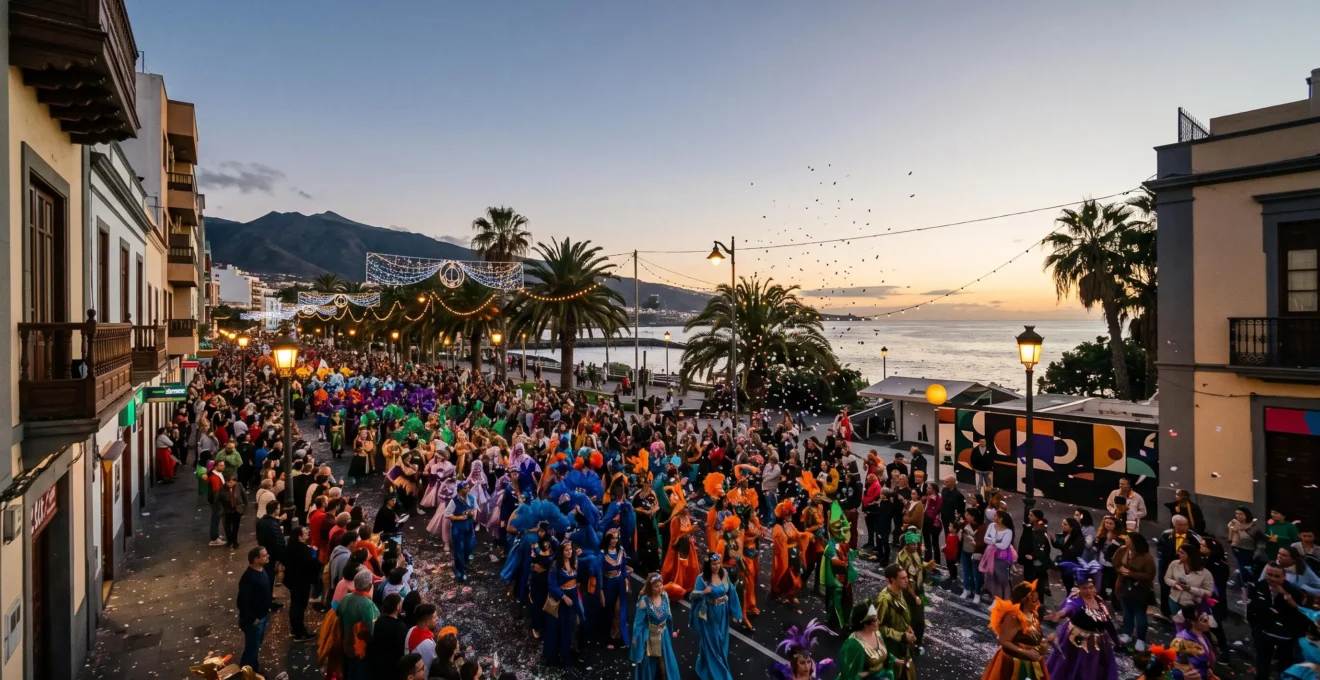
The Canarian Carnival’s immense scale is not just about spectacle; it’s the direct result of its function as a powerful social engine for participatory culture.
- It historically provided a crucial safe space for marginalised cultural expressions, from political satire to African rhythms and LGTBIQ+ visibility.
- This foundation fosters a culture of active co-creation, where year-round community rehearsals and hyper-local content make residents the primary artists, not just attendees.
Recommendation: To truly experience the Carnival, shift your mindset from a spectator to a participant. Choose a level of immersion that suits you, create a costume, and join the living tradition on the streets.
When thinking of the world’s great street carnivals, minds often drift to Rio or Notting Hill. Yet, the Canary Islands host a celebration that rivals them in scale and spirit, standing as one of Europe’s undisputed top three. The sheer energy, with hundreds of thousands of costumed revellers filling the streets of Santa Cruz de Tenerife and Las Palmas de Gran Canaria, is a spectacle in itself. Many guides will list the dates, describe the main events like the Queen’s Gala or the riotous Burial of the Sardine, and advise you to simply “wear a costume and have fun.”
But this descriptive approach misses the fundamental question: *why* has this festival grown into such a colossal, participatory phenomenon? The answer isn’t just in its colourful parades or its blend of Spanish, Caribbean, and African influences. The true power of the Canarian Carnival lies in its role as a living, breathing social engine. It has historically served as a sanctuary for cultural expressions that had no other outlet, transforming it from a mere party into a profound statement of identity and freedom.
This is not a festival you passively observe from a grandstand. It is an invitation to embody a tradition, to co-create the spectacle. But what if the key to understanding and joining this celebration isn’t about knowing the parade route, but understanding the cultural forces that fuel it? This guide moves beyond the what and when to explore the why and how. We will delve into the festival’s history as a space of resistance, the mechanisms that create its powerful community bonds, and the practical ways you can participate with respect and genuine connection.
To help you navigate this rich cultural landscape, this article explores the core pillars that make the Canarian Carnival a global benchmark for participatory celebration. The following sections will guide you through its historical significance, the different ways to engage, and the unwritten rules of joining this unique cultural expression.
Summary: Unpacking the Social Engine of the Canarian Carnival
- Why Carnival Provided Safe Cultural Expression Space for Marginalised Communities
- How to Participate Respectfully in Street Parades Without Appropriating Traditions
- Organised Parade Groups vs Spontaneous Street Parties: What Participation Levels Suit You?
- When Key Carnival Events Occur Across the Multi-Week Celebration Calendar
- The Costume Competition Pressure Excluding 75% of Potential Participants
- Why African Musical Traditions Survived Through Secular Carnival Rather Than Religious Ritual
- Why Participatory Festivals Create Stronger Community Bonds Than Passive Spectating
- Why Island Art Festivals Attract 40% More Local Attendance Than Tourist Visitors
Why Carnival Provided Safe Cultural Expression Space for Marginalised Communities
The vibrant, permissive atmosphere of the Canarian Carnival is not a modern invention; it is a legacy forged in resistance. Its role as a sanctuary for marginalised voices is central to its identity. During the Franco dictatorship, when cultural expression was severely repressed, Carnival was officially banned. Yet, it never truly disappeared. A testament to its deep cultural importance is how Tenerifeans kept celebrating through nearly four decades of prohibition from 1937 to 1977, cleverly disguising the festival under the sanitised name “Winter Fiestas.” This period cemented Carnival’s status as a space for veiled satire and social critique, a tradition of speaking truth to power that continues in the sharp-witted lyrics of the `murgas` today.
This legacy of providing a safe haven extends powerfully to the LGTBIQ+ community. The Drag Queen Gala of Las Palmas de Gran Canaria, a pioneering event, has evolved from a niche performance into a central, televised pillar of the entire festival. This evolution from the margins to the mainstream was officially recognised when the State Federation of Lesbians, Gays, Trans and Bisexuals (FELGTB) celebrated the Gala for:
being an international symbol of diversity and revindication in terms of festive celebration and of freedom
– FELGTB, 2018 Premio Pluma award citation
The success has been so profound that other islands are following suit. In 2024, the Santa Cruz de Tenerife Carnival launched its own drag competition, Dragnaval, promoted by the city’s Department of Equality and Diversity. This move shows how a space once needed for safe expression has become an officially sanctioned platform for visibility, turning Carnival into a living symbol of freedom and inclusion.
How to Participate Respectfully in Street Parades Without Appropriating Traditions
Understanding that Carnival is a space of authentic cultural expression is the first step toward participating respectfully. The goal is to join the celebration, not to imitate or parody it. The spirit is one of collective joy, and the unwritten rule is creative participation. Rather than trying to replicate the intricate, year-long work of an official `comparsa` (parade group), visitors are encouraged to create their own fun, original costumes. The key is enthusiasm and creativity, not flawless imitation.
Respect extends to personal interactions. The streets are crowded, vibrant, and filled with people who have invested immense time and passion into their appearance. While photos are part of the experience, it is crucial to treat performers and revellers as people, not just photo opportunities. Always ask for permission before taking a close-up portrait. A simple gesture or a polite question transforms the interaction from an act of consumption to a moment of genuine human connection, which is the true essence of the festival.
As the image above illustrates, a respectful exchange enriches the experience for everyone. Beyond social etiquette, practical considerations can also ensure your participation is smooth and non-disruptive. Navigating the massive crowds requires some planning, but it ensures you can stay immersed in the energy without causing friction for yourself or others.
Your Action Plan: A Guide to Considerate Carnival Conduct
- Logistics First: Use organised transport like buses or trams. Many streets close for parades, and parking becomes impossible, so planning your travel avoids stress.
- Self-Sufficiency: Bring your own food and drinks or purchase from official local stalls. This allows you to enjoy the parade picnic-style without disrupting queues at busy vendors.
- Dress for Endurance: Evenings can get cool. Bring a light jacket or an extra layer to stay comfortable as the street parties continue late into the night.
- Crowd Navigation: Keep personal belongings secure and always move with the flow of the crowd, not against it, especially during the main parade processions.
- Creative Contribution: The best way to show respect is to join in. Don a fun, creative costume of your own making instead of attempting to imitate an official group’s specific, culturally significant uniform.
Organised Parade Groups vs Spontaneous Street Parties: What Participation Levels Suit You?
The Canarian Carnival offers two fundamentally different modes of experience: the structured spectacle of the organised parades and the exhilarating chaos of the spontaneous street parties. Choosing the right one for you depends entirely on what you seek from the celebration. The `Coso Apoteosis` (the main parade) is a grand, choreographed procession featuring the official `comparsas`, `murgas`, and the Carnival Queen’s magnificent floats. It’s a large-scale visual feast, best enjoyed from a spot along the designated route, where you can appreciate the craftsmanship and artistry on full display.
On the other end of the spectrum are the `mogollones`. These are the massive, unstructured street parties that erupt nightly in the city centers. Here, there is no separation between performer and audience. Everyone is a participant. The air is thick with the sound of music blasting from lorry sound systems and impromptu stalls (`chiringuitos`) serving drinks. As one guide aptly puts it, “Tenerife is grassroots chaos in the best way.” This is the heart of the participatory culture, where you dance shoulder-to-shoulder with thousands of fellow revellers in a joyful, chaotic, and completely immersive experience.
To help you decide which level of participation best aligns with your personality and expectations, consider this direct comparison.
| Aspect | Coso Parade (Organised) | Mogollón (Spontaneous Street Party) |
|---|---|---|
| Structure | Choreographed floats, comparsas and murgas following a fixed route | Unstructured mass of dancers, chiringuitos and lorry sound systems |
| Atmosphere | Spectacle at scale, stadium-style viewing along the route | Grassroots chaos, everyone dancing shoulder to shoulder |
| Cost | Free to watch, optional reserved seating | Almost nonexistent cost barrier to join in |
| Best for | Visitors who prefer order and grand-scale visuals | Revelers seeking full immersion in the crowd |
Ultimately, the choice is not mutually exclusive. Many visitors enjoy the visual splendour of the Coso one day and dive into the vibrant throng of a Mogollón the next. Understanding the difference allows you to tailor your Carnival journey, ensuring you find the experience that resonates most deeply with your desire for either spectacle or total immersion.
When Key Carnival Events Occur Across the Multi-Week Celebration Calendar
The Canarian Carnival is not a single-weekend affair; it’s a marathon of celebration that stretches for over a month. While the full calendar can run for five weeks, the main street events and largest parties are concentrated in the final one to two weeks. For instance, the 2026 Santa Cruz de Tenerife Carnival officially spans from mid-January to late February, but the most intense period of street celebration begins with the opening parade and culminates with the Burial of the Sardine.
This final event, the `Entierro de la Sardina`, is a deeply symbolic and wildly theatrical conclusion. It takes place on Ash Wednesday and marks the official end of the festivities. A giant sardine effigy is paraded through the streets on a funeral procession, accompanied by thousands of “widows” dressed in elaborate mourning attire, wailing with comical and exaggerated grief. The procession ends with the burning of the sardine, a cathartic act that purges the excesses of the past weeks. As one analysis notes, “The ritual acts as a form of collective purification after several days of celebration, jokes, and social permissiveness.” It is a must-see event that perfectly captures the blend of satire, tradition, and communal release that defines the festival.
Key dates to watch for include the Announcement Parade (`Cabalgata Anunciadora`), the main daytime and nighttime street parties (`Carnaval de Día` and `mogollones`), the Grand Parade (`Coso Apoteosis`), and the final Burial of the Sardine. Each city (Santa Cruz and Las Palmas) has its own specific schedule, so it’s vital to check the official programme for the year you plan to attend to map out your experience.
The Costume Competition Pressure Excluding 75% of Potential Participants
The title of this section is intentionally provocative, because it reflects a common fear among first-time visitors: the pressure to have a perfect costume. While official competitions for the Carnival Queen or parade groups involve breathtakingly elaborate and expensive creations, this represents only the tip of the iceberg. The idea that this high bar excludes the average person is a fundamental misunderstanding of the Carnival’s spirit. In reality, the “pressure” is a powerful, inclusive force that results in near-universal participation.
The culture of costuming is so pervasive that not dressing up is what makes you stand out. As one insider guide notes, this is a Canarian institution where it feels like 999 out of 1,000 people actually wear a costume, whether it’s an elaborate group theme or a simple, silly wig. The barrier to entry is virtually zero. Shops across the islands sell everything from full outfits to small accessories, and the goal is not to win a prize but to be part of the collective. The costume is your ticket to full immersion, a social lubricant that breaks down barriers and signals your willingness to join the fun. It is, as the Spanaly editorial team describes, “more than just an event; it is a deep expression of Canarian identity.”
Therefore, the perceived pressure is not exclusionary but unifying. It’s a collective invitation to shed your daily identity and embrace a temporary, fantastical one. Whether you spend months planning a group costume with friends or grab a funny hat on your way to a `mogollón`, the act of dressing up is what transforms you from a spectator into a true participant. The only mistake you can make is not wearing one at all.
Why African Musical Traditions Survived Through Secular Carnival Rather Than Religious Ritual
The pulsating rhythms that form the backbone of the Carnival street parties are one of its most defining features, a direct sonic link to both the Caribbean and West Africa. This survival of African musical traditions is no accident. It is a direct result of Carnival’s function as a secular, and often subversive, cultural space. While formal religious rituals, heavily controlled by European colonial powers, often suppressed or sanitized African cultural expressions, the less formal and more chaotic environment of Carnival provided a fertile ground for these traditions to persist and evolve.
The most powerful example is the `batucada`. These massive percussion ensembles, a direct legacy of Afro-Brazilian rhythmic forms like samba, are a cornerstone of the parades. A single batucada ensemble can gather dozens to hundreds of drummers, creating an overwhelming and infectious polyrhythmic force. The music is “renowned for its call-and-response structure and communal energy,” a hallmark of many West African musical practices. This format thrives in the participatory environment of a street parade, where the energy flows between the drummers and the dancing crowd.
Case Study: The Hybrid Instrumentation of the Canarian Murga
The `murga`, a form of musical theatre group known for its satirical songs, offers a clear example of this cultural fusion. A traditional murga combines a large vocal chorus with a specific set of percussion instruments derived from European military bands: the bass drum (`bombo`), snare drum (`redoblante`), and cymbals (`platillos`). This structure shows how a secular, satirical format allowed the driving, communal rhythms influenced by African traditions to fuse with European instrumentation. This hybrid could flourish under the cover of festive, non-religious performance, whereas it might have been deemed “improper” and suppressed within a more rigid, formal, or religious context.
This demonstrates a key principle: by operating outside the strictures of religious ceremony, Carnival became a de facto sanctuary where cultural DNA could be preserved, hybridized, and passed down through generations in the form of pure, embodied celebration.
Why Participatory Festivals Create Stronger Community Bonds Than Passive Spectating
For many visitors, Carnival is a spectacular, multi-week event. But for Canarians, it is a year-round commitment that forges the very fabric of community life. The incredible displays seen on the streets are not produced by hired professionals; they are the culmination of months, and sometimes a full year, of collective effort within local neighbourhoods. This is the “social engine” in action, and it’s the primary reason why the festival creates such powerful, lasting bonds. For Canarians, as one local booking agency states, “Carnival is not just a festival — it’s a way of life.”
This year-round process is most evident in the `murga` and `comparsa` groups. These associations, often organised by neighbourhood, bring together people of all ages. Children’s murgas and adult murgas spend countless hours after work and on weekends rehearsing songs, building floats, and, as shown in the image above, meticulously sewing thousands of sequins onto costumes. The deepest social bonding doesn’t happen during the final performance in front of cheering crowds; it happens in the drafty rehearsal halls and community centres during months of shared creativity, problem-solving, and effort.
The Murga Rehearsal: A Year-Round Community-Building Engine
In the Canary Islands, adult and children’s `murga` groups prepare all year for the competitive phases of Carnival. These competitions culminate in massive finals attended by thousands of spectators. However, the true community-building occurs long before the public ever sees the show. It’s found in the collaborative songwriting sessions, the shared meals during late-night costume-making bees, and the intergenerational transfer of skills. This process of co-creation is far more important for social cohesion than the final product, turning these groups into extended families.
This is the fundamental difference between a participatory festival and one based on passive spectating. When a community builds the celebration from the ground up, the event becomes an authentic expression of its collective identity, strengthening bonds in a way that simply buying a ticket to a show never could.
Key Takeaways
- Carnival’s power comes from its function as a “social engine,” not just a party, fostering a culture of active participation over passive spectating.
- It has a deep-rooted history as a safe space for resistance and marginalised expression, from political satire under Franco to modern LGTBIQ+ visibility.
- True participation is about creative contribution, not perfect imitation. The goal is to join in with your own costume, respecting the culture and the performers.
Why Island Art Festivals Attract 40% More Local Attendance Than Tourist Visitors
While the Canarian Carnival is a major tourist draw, its soul and energy are overwhelmingly local. The festival is a cultural powerhouse brought to life by a vast network of roughly 10,000 official local participants in groups, not to mention the hundreds of thousands more who join the street parties. This deep local ownership is the reason why, unlike many major tourist events, the number of residents actively involved far outweighs the number of passive visitors. During Carnival, “every neighborhood becomes a stage for music and celebration,” turning the entire city into a canvas for and by its own people.
The primary reason for this deep local engagement lies in the content of the performances themselves. The `murgas`, in particular, are a masterclass in Canarian wit and social commentary. Their songs are built around intricate lyrics that satirize local politicians, social issues, and national events from the past year. This hyper-local satire is profoundly meaningful and hilarious to residents who share the cultural context and understand the inside jokes. For a visitor, the musical energy is infectious, but the lyrical genius often remains opaque.
Murga Satire: Hyper-Local, Untranslatable Performance Art
Watching a `murga` competition is a core Canarian experience. As described in a local guide, the lyrics are so tied to the island’s specific social and political climate that they are effectively untranslatable in their full cultural richness. A song might mock a specific municipal policy or a gaffe by a local celebrity. For residents, this is the height of relevant, cathartic entertainment. This focus on hyper-local content naturally creates an event that is, first and foremost, for the local community, ensuring their deep and continued investment in a way that a more generic, tourist-focused festival never could.
This isn’t a flaw; it’s the festival’s greatest strength. It ensures that Carnival remains an authentic, grassroots expression of Canarian identity, a celebration by the people, for the people. This is the ultimate reason why it feels so alive and why active participation, rather than passive observation, is the only way to truly experience it.
By embracing the spirit of participation, you move beyond being a tourist and become a temporary part of this incredible cultural phenomenon. The first step is to start planning your journey, ready to create, dance, and celebrate as an active contributor.
Frequently Asked Questions About the Canarian Carnival Calendar
When does the Burial of the Sardine take place in Tenerife?
The ceremony closes the 2026 Carnival on Ash Wednesday, 18 February, in Santa Cruz de Tenerife.
What route does the funeral procession follow?
The procession moves through several central streets of the capital before finishing at Plaza de España.
How does the event conclude?
The celebrations culminate with the symbolic burning of the sardine effigy by the sea on the Avenida Marítima.