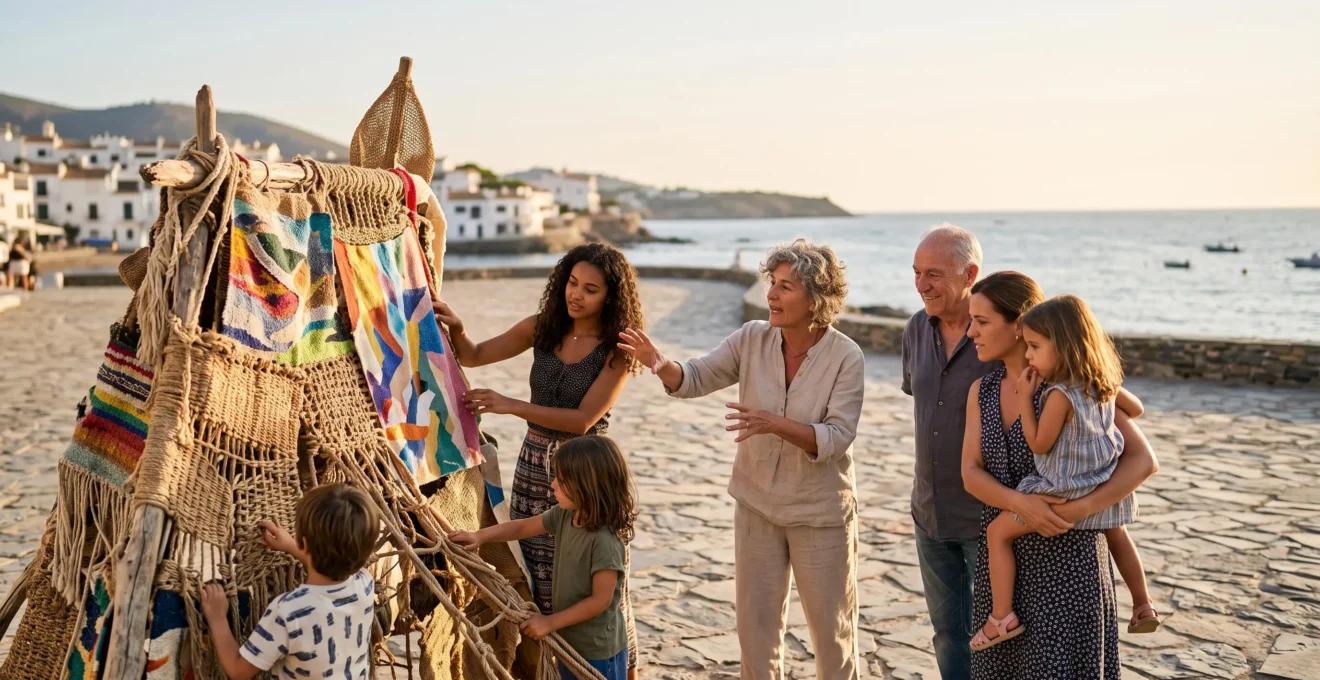
The high local turnout at island art festivals isn’t about convenience; it’s because these events prioritize active participation over passive viewing, transforming residents into cultural co-creators.
- Authentic community bonds are forged through shared creative acts, not just shared geography.
- Access is often earned through involvement, like volunteering, which deepens the connection to the event.
Recommendation: To truly experience a destination’s living culture, look for opportunities to participate, not just to spectate.
It’s a curious paradox. An island, a destination synonymous with tourism, hosts a vibrant arts festival. One might expect the crowds to be a sea of visitors, cameras in hand, seeking a picturesque cultural experience. Yet, data consistently shows that locals make up the overwhelming majority of attendees. The common assumption is that it’s a matter of simple proximity, but this overlooks a much deeper, more dynamic truth about what makes these events culturally magnetic.
While many large-scale events are designed with the tourist gaze in mind—presenting a polished, easily consumable version of “local culture”—the most successful island art festivals operate on a different principle entirely. They are not static exhibitions or folkloric displays preserved in amber. They are living, breathing ecosystems of contemporary creativity. The secret to their powerful local appeal lies not in what they show, but in what they invite people to do. It’s the shift from passive spectating to active co-creation.
This isn’t about simply being present; it’s about being a participant. The high local attendance is a direct result of programming that fosters a sense of ownership and shared identity. When residents are invited to volunteer, build installations, join workshops, or perform, the festival ceases to be something that happens *to* their town and becomes something that is created *by* their community. This article explores the mechanisms behind this powerful dynamic, from the psychology of participatory art to the practical ways you can engage with this living culture yourself. We’ll examine how festivals balance local and global talent, the threat of overtourism, and why Carnival remains the ultimate expression of community-led cultural vitality.
This guide breaks down the essential dynamics of contemporary island festivals. Explore the sections below to understand why they are a powerful expression of living culture and how to best experience them.
Summary: Why Island Art Festivals Attract 40% More Local Attendance Than Tourist Visitors
- Why Participatory Festivals Create Stronger Community Bonds Than Passive Spectating
- How to Find Festival Schedules and Secure Tickets for Limited-Capacity Events
- International Artist Showcases vs Local Creator Platforms: What Programming Balance Works?
- When Free Outdoor Events Versus Ticketed Venue Performances Occur
- The Overtourism Pressure Threatening Festival Authenticity for 65% of Events
- How to Experience Living Cultural Fusion Through Neighbourhood Festivals
- Why Carnival Provided Safe Cultural Expression Space for Marginalised Communities
- Why Canarian Carnival Ranks Among Europe’s Three Largest Street Festivals
Why Participatory Festivals Create Stronger Community Bonds Than Passive Spectating
The profound sense of community at a successful island art festival is not an accident; it’s a direct result of its design. Unlike events where an audience passively consumes a performance, participatory festivals are built on the principle of active involvement. This active role dissolves the typical barriers between artist and observer, creating a unique, temporary social space. It’s in this shared creative effort that deep, authentic bonds are formed among residents, fostering a powerful sense of cultural ownership.
The anthropologist Victor Turner identified this powerful bonding experience, giving it a specific name. He recognized that festivals create a liminal state where the normal rules and hierarchies of society are temporarily suspended. As he noted:
Turner calls this phenomenon “anti-structure” or, to use his more popular term, “communitas.”
– Victor Turner, In and Out of Time: Festivals, Liminality and Communitas
This state of communitas is the fertile ground where community ties are strengthened. It’s the feeling of togetherness that emerges from building a lantern for a parade, joining a drumming circle, or volunteering to guide visitors. Modern research confirms this effect, showing that active contribution is key. A study on festival engagement found that community members who play a participatory role, such as volunteering, have the opportunity to develop connectivity with others while contributing to the festival community, which in turn improves their subjective wellbeing. It is this act of co-creation that transforms a simple event into a cornerstone of local identity, making it irresistible to residents who want to be part of their own evolving cultural story.
How to Find Festival Schedules and Secure Tickets for Limited-Capacity Events
For the living culture seeker, gaining access to the most compelling festival events requires moving beyond the mindset of a typical tourist. The most sought-after experiences—intimate workshops with artists, limited-capacity performances, or participatory projects—are often not broadcast on major tourism websites. Instead, information flows through local channels. The key is to start by following the festival’s official social media accounts and subscribing to their newsletter months in advance. This is where early-bird tickets and special announcements are made first.
Beyond simply purchasing a ticket, the most rewarding path to access is through direct involvement. Many festivals are built on the energy of their communities, and volunteering is a structured way to become part of that energy. Not only does this often grant free access, but it places you at the very heart of the event’s creation. A recent guide on festival participation highlights that almost every major festival offers its own volunteer program, where you can apply to work in exchange for a ticket. This is the ultimate insider experience, offering a chance to connect with artists and fellow enthusiasts on a deeper level.
This pathway requires proactivity, as the most desirable roles and workshop slots are filled long before the event begins. By planning ahead, you shift from a passive consumer to an active participant, unlocking a far richer and more authentic festival experience.
Your Action Plan: The Volunteer-to-Access Pathway
- Early Research: Identify your target festivals and locate the “Volunteer” or “Get Involved” section on their official websites at least 4-6 months prior to the event date.
- Application Prep: Prepare a brief statement about your interests and any relevant skills. Many festivals look for enthusiastic and reliable individuals, not just experienced professionals.
- Timely Submission: Apply as soon as applications open. Limited-capacity volunteer and workshop slots are highly competitive and are often the first to fill up.
- Follow-Up: Monitor your email closely for communications regarding schedules, training, and team assignments. Punctuality and responsiveness are key.
- Network On-Site: Use the volunteering experience to connect with like-minded festival-goers, organizers, and artists. This can build a network that opens up future opportunities.
International Artist Showcases vs Local Creator Platforms: What Programming Balance Works?
The curatorial genius of a great island art festival lies in its ability to strike a delicate balance: celebrating the deep, gnarled roots of its local creative community while simultaneously drawing in the gravitational pull of international talent. This is not a zero-sum game. The most vibrant festivals use this dynamic to create a powerful cultural conversation. International artists can introduce new techniques, ideas, and global perspectives, acting as a catalyst that energizes the local scene.
However, without a strong platform for local creators, a festival risks becoming a generic, placeless event that simply uses the island as a scenic backdrop. The authenticity and soul of the festival come from its connection to place. This is achieved by giving local artists prime visibility, commissioning site-specific works that respond to the island’s environment and history, and creating collaborative projects where local and international artists work together. This fusion prevents the local culture from feeling parochial while ensuring the international contributions feel relevant and integrated.
The ideal programming balance feels like a healthy ecosystem. The international “stars” might draw initial attention, but it’s the rich, diverse, and deeply-rooted local talent that provides the substance and creates a lasting sense of identity. This approach ensures that the festival is not just a stage for visiting performers but a nurturing ground for the island’s own creative future. It empowers local artists, gives them a global platform, and affirms to the resident community that their culture is a living, evolving force worthy of celebration on the world stage.
When Free Outdoor Events Versus Ticketed Venue Performances Occur
The rhythm of an island art festival often follows a natural, intuitive flow that maximizes both accessibility and artistic focus. The programming is typically split between two distinct types of experiences: free, open-air events during the day and more formal, ticketed performances in dedicated venues at night. This structure is not arbitrary; it’s a strategic way to cater to different audiences and art forms while making the most of the island’s unique atmosphere.
Daytime is for exploration and participation. This is when public squares, parks, and waterfronts are transformed into sprawling canvases for interactive installations, spontaneous street performances, and large-scale community art projects. These free events are the festival’s public face, designed to be inclusive and to draw in a broad cross-section of the community, from families to curious passersby. They embody the spirit of “communitas,” removing financial barriers and encouraging serendipitous discovery. This is where the festival feels most like a collective celebration, a shared public experience owned by everyone.
As evening falls, the energy shifts inward. The focus moves to theaters, galleries, and converted warehouses for ticketed events. These performances—be it contemporary dance, experimental theater, or a concert by a headline musician—require a more controlled environment. The ticketing model supports the high production costs associated with these shows and ensures a focused, respectful audience for art forms that demand quiet concentration. This dual structure creates a holistic experience: the democratic, celebratory spirit of the day gives way to the intimate, concentrated artistic encounters of the night. It allows the festival to be both a community-wide spectacle and a space for profound, individual artistic engagement.
The Overtourism Pressure Threatening Festival Authenticity for 65% of Events
While art festivals can be powerful engines of cultural vitality, their very success can attract a force that threatens their soul: overtourism. When a festival becomes a major dot on the global tourism map, it faces immense pressure to scale up, standardize, and cater to the expectations of a transient audience. This often leads to a subtle but corrosive shift. The focus can move away from authentic co-creation and toward easily packaged, “Instagrammable” moments. The unique, quirky, and deeply local elements that defined the festival’s identity risk being sanded down in favor of a more generic, universally appealing product.
This pressure creates a fundamental tension between economic growth and cultural integrity. As one analysis points out, this is a growing concern, as recent studies show that festivals can act both as catalysts of overtourism and as focal points for community resistance to it. The issue becomes a question of “who is the festival for?” When streets become impassably crowded and the cost of participation skyrockets, locals can begin to feel alienated from their own event. The space for spontaneous creation and genuine connection shrinks, replaced by ticket queues and velvet ropes.
The challenge for festival organizers is to manage growth without sacrificing the participatory spirit that made the event special in the first place. This requires a conscious commitment to prioritizing local access, protecting non-commercial spaces, and resisting the temptation to turn every cultural expression into a commodity. Without this vigilance, a festival that was once a celebration of community can become just another attraction, losing the very authenticity that drew people to it.
How to Experience Living Cultural Fusion Through Neighbourhood Festivals
While large-scale island festivals offer incredible spectacle, the most potent expressions of living cultural fusion are often found in smaller, neighborhood-level celebrations. These hyper-local events, or “fiestas de barrio,” are the lifeblood of an island’s cultural ecosystem. They operate on a human scale, driven not by tourism boards or corporate sponsors, but by community associations, local artists, and families who have lived in the area for generations. Here, culture is not a performance; it is a lived reality.
Finding these events requires looking beyond the main tourist guides. The best way to discover them is to connect with the local rhythm. Talk to shopkeepers, bartenders, or residents you meet. Check the bulletin boards in local cafes, community centers, or town hall (ayuntamiento) offices. These festivals are often promoted through simple flyers and word-of-mouth, their schedules more fluid and their atmosphere more spontaneous. They are celebrations of a neighborhood’s specific identity, whether it’s honoring a patron saint, marking a historical event, or simply celebrating the harvest.
Attending a neighborhood festival is an exercise in respectful immersion. It’s an opportunity to witness cultural fusion in its rawest form—where traditional music might be played on an electric guitar, or where ancestral culinary recipes are shared alongside contemporary street food. You might find yourself invited to join a communal meal, or pulled into an impromptu dance. These are the spaces where the past and present are not in conflict but in constant, creative dialogue. For the traveler seeking genuine connection, these intimate gatherings offer a far more profound insight into an island’s soul than any large, ticketed event ever could.
Why Carnival Provided Safe Cultural Expression Space for Marginalised Communities
To understand the profound cultural power of events like the Canarian Carnival, one must look back at their origins. Carnival, in its historical context, was far more than just a party. Across the world, from the Caribbean to Brazil, it emerged as a critical, and often unique, “safe space” for marginalized and oppressed communities. It was a sanctioned period of “anti-structure,” where the rigid social hierarchies of colonial or authoritarian rule were temporarily inverted through masks, music, and satire.
During a time when their own cultural practices, religions, and languages were actively suppressed, Carnival provided a powerful outlet. The mask was not just for decoration; it was a tool of liberation. It granted anonymity, allowing individuals to critique powerful figures—plantation owners, colonial governors, the clergy—without fear of direct reprisal. The “Murgas” and “Comparsas” (Carnival groups) used song and performance to deliver sharp social and political commentary, disguised as festive entertainment. It was a space for subversive creativity, where collective identity could be affirmed and resistance could be expressed symbolically.
This tradition of using celebration as a form of cultural survival and expression is deeply embedded in Carnival’s DNA. It allowed enslaved people and their descendants to blend their African traditions with the Catholic pre-Lenten rituals imposed upon them, creating a rich, syncretic cultural form that was uniquely their own. This historical foundation is crucial; it explains why Carnival is not merely a spectacle but a profound act of cultural affirmation and resilience. It is a living testament to a community’s ability to maintain its spirit and voice against overwhelming pressure.
Key takeaways
- The primary driver for high local attendance at island festivals is the opportunity for active participation and co-creation, not just proximity.
- Authenticity is maintained by balancing high-profile international acts with strong, visible platforms for local artists and creators.
- The biggest threat to these festivals is overtourism, which pressures them to commercialize and can alienate the local community that gives them their soul.
Why Canarian Carnival Ranks Among Europe’s Three Largest Street Festivals
The Carnival of the Canary Islands, particularly in Santa Cruz de Tenerife and Las Palmas de Gran Canaria, is a cultural phenomenon on a staggering scale. It stands alongside Notting Hill and Venice as one of Europe’s largest and most spectacular street festivals, drawing millions of people. But its size is not just a measure of its popularity; it is a direct reflection of the deep-seated cultural ownership the local population feels for this event. It is the ultimate expression of the participatory principles that power the most successful festivals.
The grandeur of the Canarian Carnival is built from the ground up. It is the culmination of a year’s worth of work by thousands of residents organized into Murgas (satirical music groups), Comparsas (dance troupes), and Rondallas (musical ensembles). The breathtakingly elaborate costumes worn by the Carnival Queen contestants are not corporate-sponsored projects; they are feats of engineering and artistry, often funded by entire neighborhoods and crafted by local artisans over thousands of hours. This is community investment on a massive scale.
This deep community involvement is what elevates it from a mere event to a pillar of Canarian identity. The street is the main stage, and everyone is a performer. Unlike a ticketed concert, the value is not in watching a few stars, but in being part of a massive, collective creative act. This is the principle of “communitas” realized on an epic scale, where for a few weeks, the entire island is united in a shared project of joy, satire, and spectacle. Its ranking as one of Europe’s largest festivals is not a tourism statistic; it’s proof of what happens when an entire community becomes the heart of its own celebration.
Ultimately, the magnetic pull of a great island art festival comes from its ability to answer a fundamental human need: the desire not just to witness culture, but to be a part of its creation. By embracing a participatory model, you can move beyond the surface-level tourist experience and connect with the vibrant, beating heart of a place. The next step is to seek out these opportunities and become part of the story yourself.