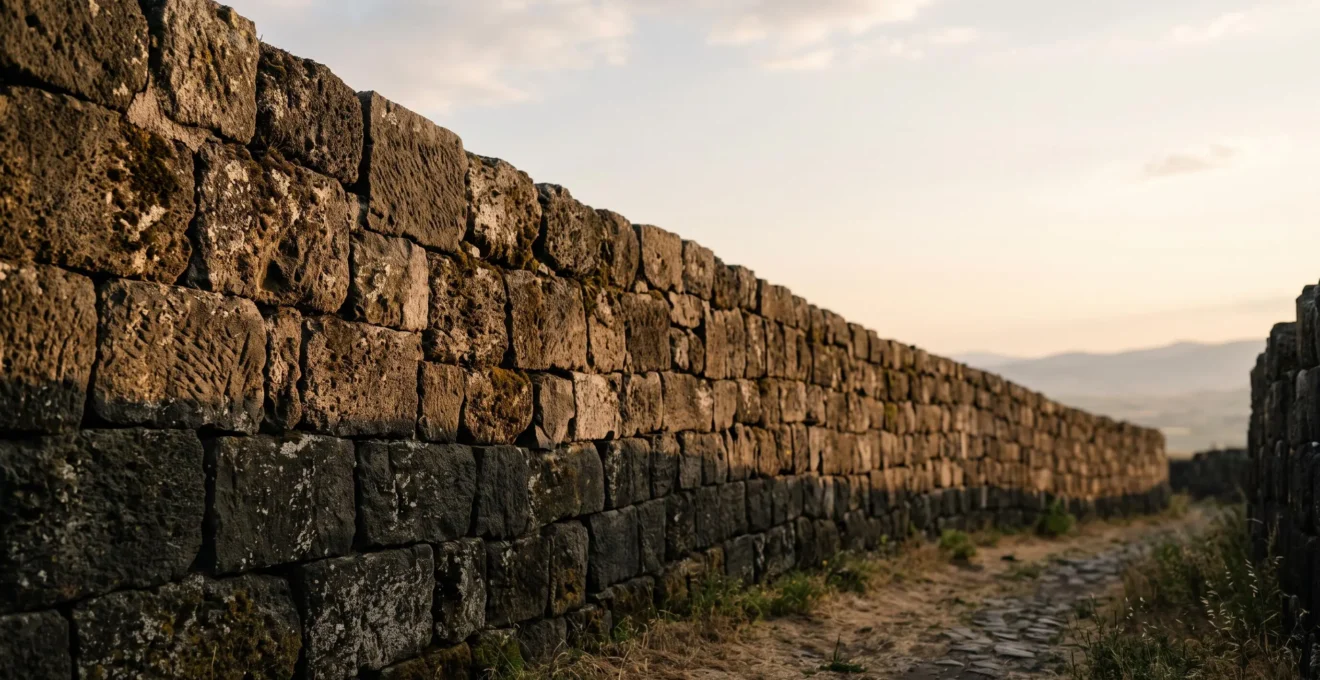
The enduring strength of a basalt structure lies not just in the stone itself, but in its traceable journey from volcanic eruption to finished wall.
- Geological forensics—analyzing mineral composition and texture—can pinpoint a stone’s specific quarry of origin.
- Prioritizing locally sourced basalt over imported materials drastically reduces a building’s embodied carbon ledger, a critical factor for sustainable construction.
Recommendation: Adopt a provenance-first methodology. By reading the volcanic DNA in the stone, you can verify its source, understand its properties, and build with true, quantifiable sustainability.
For centuries, architects and builders have revered basalt for its formidable strength and longevity. But to view its resilience as a simple, abstract quality is to miss the larger story etched into every block. The structural integrity of a 400-year-old basalt wall is a direct consequence of its origin—a story of volcanic fire, geological pressure, and a hyper-local supply chain. For material provenance researchers and sustainable builders, understanding this story is no longer just an academic exercise; it’s a critical professional competency.
Most discussions on building materials stop at generic advice: “use durable materials” or “source locally.” This approach fails to provide a working methodology. It ignores the fact that the stone itself is an archive. Its mineralogy, texture, and even the way it was cut contain a wealth of information. The real challenge is not just choosing basalt, but knowing how to read it—how to perform a kind of geological forensics to trace it back to its source quarry and, by extension, to its specific formation conditions.
This guide departs from superficial praise for basalt. Instead, it offers a forensic framework for understanding its complete life cycle. We will demonstrate that the stone’s superior performance is inextricably linked to its volcanic DNA and its embodied carbon ledger. By learning to decipher these clues, you can move beyond building with strong materials to building with verifiable intelligence, ensuring that your projects are not only structurally sound for centuries but also deeply rooted in the principles of local sourcing and environmental stewardship.
This article provides a comprehensive methodology for tracing basalt from its geological origins to its use in heritage structures. Explore the sections below to master the techniques of material provenance and sustainable specification.
Summary: A Forensic Guide to Basalt’s Structural Integrity
- Why Locally Quarried Stone Reduces Embodied Carbon by 75% Versus Imported Materials
- How to Identify Quarry Locations by Stone Colour and Mineral Composition
- Dressed Ashlar vs Rough Rubble Masonry: What Construction Quality Reveals
- How to Photograph Stone Texture Revealing Volcanic Formation Processes
- When Heritage Quarries Offer Guided Tours Explaining Extraction History
- Why Thermal Mass and Cross-Ventilation Eliminate Mechanical Cooling Needs
- Why Basalt Formations Reveal Eruption Temperatures Exceeding 1200°C
- Why Black Sand Beaches Signal Volcanic Activity Millions of Years Old
Why Locally Quarried Stone Reduces Embodied Carbon by 75% Versus Imported Materials
The conversation around sustainable building is rightly dominated by operational energy, but the carbon cost incurred before a building is even occupied—its embodied carbon—is a massive and often overlooked factor. Decisions made at the material specification stage create a permanent carbon ledger. As a building materials geographer, it is crucial to emphasize that building materials account for 11% of global greenhouse gas emissions. This makes your choice of stone not just an aesthetic or structural decision, but a direct climate action. Opting for a basalt quarried within a 50-mile radius versus one shipped from overseas can slash the material’s transport-related carbon footprint by over 75%, a saving that is locked in for the life of the building.
The primary driver of this difference is transportation. Heavy, dense materials like basalt are energy-intensive to move. Sea freight, rail, and trucking all contribute to the final embodied carbon tally. A local supply chain dramatically shortens this chain of emissions. Furthermore, local quarries often operate with a deeper connection to regional environmental standards and may employ less carbon-intensive extraction methods compared to large-scale international operations optimized purely for volume.
When comparing natural stone to manufactured alternatives, the benefits become even more stark. Basalt is a product of natural geological processes, requiring only extraction and cutting. In contrast, materials like precast concrete involve energy-intensive manufacturing, from cement production to casting and curing. This disparity is clear when examining the global warming potential (GWP) of each material.
The following data offers a clear comparison of the embodied carbon impact between natural stone and a common manufactured alternative for cladding projects. As the table illustrates, based on a whole-building life-cycle assessment, the choice of natural stone results in a significantly lower carbon footprint, underscoring the importance of material selection in sustainable design, as shown in a comparative analysis of cladding materials.
| Material | GWP per m² (kg CO2 eq) | Total Project Impact (kg CO2 eq) |
|---|---|---|
| Natural Stone Cladding | 21.4 | 5,157 |
| Precast Concrete Cladding | 62.3 | 15,014 |
By prioritizing locally quarried basalt, a sustainable builder is not just acquiring a superior material; they are making a conscious decision to minimize their project’s upfront environmental debt, creating structures that are both physically and ecologically resilient.
How to Identify Quarry Locations by Stone Colour and Mineral Composition
For a provenance researcher, a piece of basalt is not a monolithic black rock; it is a complex mosaic of minerals, each a clue to its unique origin. The ability to perform geological forensics in the field is what separates a casual observer from an expert. The specific shade of black, grey, or even greenish tint in basalt is determined by its mineralogical makeup—its volcanic DNA. This distinctive character comes primarily from volcanic materials rich in iron and magnesium, such as pyroxene and olivine. Subtle variations in the concentration of these minerals can create a unique signature that links a stone to a specific lava flow or quarry.
The most telling features are often the phenocrysts—larger, visible crystals embedded within the fine-grained matrix. These crystals, like olivine (often greenish) or plagioclase feldspar (typically whitish-grey), formed slowly as the magma cooled beneath the surface before being rapidly erupted. Their size, shape, and abundance are diagnostic tools. A basalt rich in large, glassy olivine phenocrysts likely originated from a different magma chamber than one characterized by fine, needle-like plagioclase crystals.
As this detailed view shows, the stone’s surface is a micro-landscape. Documenting these features is the first step in matching a building stone to a potential quarry source. However, some of the most powerful clues are invisible. Dark minerals like basalt often contain magnetite, an iron oxide that is strongly magnetic. A simple field test can reveal its presence. An analysis of black sand geology confirms that a simple magnet test can reveal the volcanic minerals in the stone. By placing a strong neodymium magnet underneath a sample or against a wall, you may feel a slight pull, confirming a high concentration of magnetite and thus reinforcing its volcanic origin. This low-tech test can be surprisingly effective in distinguishing true basalt from other dark sedimentary rocks.
Ultimately, by combining visual analysis of colour and phenocrysts with simple physical tests, a researcher can build a compelling profile of a stone’s origin, turning a simple heritage wall into a readable map of regional geology.
Dressed Ashlar vs Rough Rubble Masonry: What Construction Quality Reveals
The way basalt is shaped and laid in a wall is a powerful economic and social indicator. A materials geographer learns to read this masonry signature to understand the context of a building’s construction. The distinction between dressed ashlar and rough rubble masonry is not merely stylistic; it reveals crucial information about the project’s budget, the available labor skill, and, most importantly, the proximity to the quarry. These two styles represent opposite ends of the construction spectrum.
Dressed ashlar masonry consists of large, precisely cut blocks of stone with smooth faces and tight, uniform joints. Each block is “dressed” by a skilled stonemason to fit perfectly with its neighbors, often without the need for thick mortar beds. This type of construction was extremely expensive and labor-intensive. Its presence in a heritage building signifies immense wealth and high status. It also strongly suggests that the quarry was relatively close. Transporting massive, perfectly squared blocks over long distances with primitive technology was logistically prohibitive. Therefore, a fine ashlar wall is a reliable clue that a high-quality basalt source was located nearby.
On the other hand, rough rubble masonry utilizes uncut or minimally shaped stones of irregular size. The stones are laid in a more random pattern, with large, thick mortar joints filling the gaps. This technique required less skilled labor and was far more economical. It was the common choice for utilitarian structures like farm walls, foundations, and modest buildings. Critically, rubble masonry was also the practical solution when the stone source was far away. It was much easier to transport a cart of assorted, smaller stones from a distant quarry than to haul massive, dressed blocks. The builder would simply “make do” with what was available on site.
By analyzing the construction quality, a researcher can therefore deduce the relative value of the structure and form a strong hypothesis about the distance to the original quarry, adding another vital layer to the material’s traced history.
How to Photograph Stone Texture Revealing Volcanic Formation Processes
Documenting basalt for provenance research is a technical skill that goes far beyond taking a simple snapshot. The goal is to capture the stone’s texture and mineralogy in a way that makes its volcanic formation process legible. Effective photography acts as a data collection tool, revealing details of cooling rates, crystal formation, and vesicularity (gas bubbles) that are invisible to the naked eye from a distance. To achieve this, one must control the lighting and composition with scientific intent.
The single most important technique is using raking light. This involves positioning your light source (be it the sun or an artificial light) at a very low angle to the stone’s surface. This oblique light casts long shadows across the microscopic topography of the rock, dramatically exaggerating texture. It will make the boundaries between different mineral grains stand out, reveal subtle flow patterns from the lava’s movement, and highlight the edges of any embedded phenocrysts. Direct, frontal lighting, by contrast, flattens the surface and hides all of this crucial information.
For capturing the volcanic DNA, a macro lens is indispensable. It allows you to get close enough to photograph individual crystals and the fine-grained groundmass in which they are set. This level of detail is essential for comparing a sample from a building to potential source rocks from a quarry. When photographing for research, always include a scale reference in the shot. A small ruler or even a coin placed next to the area of interest provides an immediate sense of the size of the features being documented, which is critical for accurate analysis later.
Action Plan: Photographing Stone for Provenance Analysis
- Isolate Your Subject: Clean the stone surface of any dust or debris. Choose a representative area that displays key features like crystals or vesicles.
- Control Your Light: Position your primary light source (natural or artificial) at a low, raking angle (15-30 degrees) to the surface to maximize texture. Use a reflector to gently fill in deep shadows if needed.
- Set Up for Macro: Use a macro lens or macro setting on your camera. Mount the camera on a tripod to eliminate shake and ensure sharpness, which is critical at high magnifications.
- Include a Scale: Place a small, non-reflective ruler or a standard-sized object directly in the frame, on the same focal plane as the stone texture you are capturing.
- Document and Bracket: Take multiple shots, slightly varying the angle of light and the focus point (focus stacking). Record the location, date, and a general description for each set of photos.
By mastering these photographic techniques, a researcher can create a permanent, high-fidelity record of a stone’s texture, providing the visual evidence needed to link a heritage building back to its geological birthplace.
When Heritage Quarries Offer Guided Tours Explaining Extraction History
While field analysis is essential, some of the most profound insights into material provenance come from the source itself: the heritage quarry. When these historic sites are preserved and offer guided tours, they become living museums of geology, technology, and labor. For a researcher, visiting one is an unparalleled opportunity to connect a building’s stone directly to the landscape and the human history of its extraction. It bridges the gap between the finished wall and the raw earth.
A well-curated quarry tour does more than point out where the rock came from. It reveals the layered history of the site. Guides can show the evolution of extraction techniques, from primitive wedge-and-chisel marks on one rock face to the tell-tale signs of later black-powder blasting on another. They can point out the discarded spoil heaps, which are themselves an archive of the quality of stone deemed unsuitable by past generations. This provides invaluable context on the standards and economic pressures of different eras. You can see firsthand the specific geological strata that were most prized and why.
These tours offer a chance to collect reference samples directly from the source, an essential step in confirming a match with a heritage building. You can photograph the quarry faces, documenting the exact mineralogy and texture of the in-situ rock, creating a definitive baseline for comparison. This direct link is the gold standard in provenance research.
Case Study: The Enduring Legacy of Regional Basalt in U.S. Architecture
The story of basalt in construction is a story of local geology shaping civilization. A historical survey confirms how the historic use of basalt spans indigenous tool-making and colonial roadbeds to 21st-century plazas across nine U.S. regions. From the columnar basalts of the Columbia River Gorge that defined early infrastructure to the stones used in New England’s colonial foundations, the material’s availability dictated architectural vernacular and transportation routes. This layered history, showing how geology directly influenced everything from arrowheads to modern urban landscapes, is precisely the narrative that a heritage quarry tour brings to life for a visitor, connecting them to a long continuum of human-geological interaction.
For any serious material researcher, seeking out and participating in a heritage quarry tour is not a recreational diversion; it is a fundamental research activity that provides irreplaceable data and a tangible connection to the material’s supply chain.
Why Thermal Mass and Cross-Ventilation Eliminate Mechanical Cooling Needs
Basalt’s contribution to a building goes far beyond its structural strength; it is a key component of a passive climate control system. Its high density and specific heat capacity give it immense thermal mass, allowing it to function as a thermal battery. This property, when combined with intelligent design for cross-ventilation, can dramatically reduce or even eliminate the need for mechanical air conditioning, a major factor in both operational carbon emissions and a building’s long-term resilience.
The principle is simple: during a hot day, the thick basalt walls absorb a tremendous amount of heat energy from the sun and the ambient air, preventing that heat from penetrating the interior. The inside of the building remains cool and stable for many hours. The stone acts like a sponge for heat. Then, as night falls and the outside temperature drops, the process reverses. The stored heat is slowly released from the walls back to the exterior, “recharging” the thermal battery for the next day. This diurnal cycle creates a natural, passive cooling effect, smoothing out extreme temperature swings.
However, thermal mass alone is not enough. It must be paired with effective cross-ventilation. By strategically placing openings (windows, vents) on opposite sides of a structure, you can take advantage of natural air pressure differences to create a consistent flow of air. The practice of “night flushing”—opening windows after dark—is particularly effective. This allows cool night air to flow through the building, actively drawing the stored heat out of the basalt walls and carrying it away, ensuring the interior starts the next day as cool as possible.
For the sustainable builder, specifying thick basalt walls is not an old-fashioned choice. It is a forward-thinking strategy that leverages geology to create comfortable, low-energy environments that are less dependent on fragile and carbon-intensive mechanical systems.
Why Basalt Formations Reveal Eruption Temperatures Exceeding 1200°C
The dramatic, often hexagonal columns of basalt seen at sites like the Giant’s Causeway are more than just a geological curiosity; they are a precise thermal record of the planet’s inner heat. Basalt is a mafic lava, meaning it is low in silica and flows easily. It erupts at extremely high temperatures, typically between 1100°C and 1250°C. The presence of a basalt formation is, in itself, direct evidence of these incredible temperatures. However, specific features within the formation, like columnar jointing, allow us to read this thermal history with even greater precision.
Columnar jointing is the result of thermal contraction. As a thick lava flow begins to cool from the top down and the bottom up, it loses heat and shrinks. This shrinkage creates stress in the rock, which is relieved by cracking. In a uniform, homogeneous lava flow, these cracks ideally form at 120-degree angles to one another, creating the characteristic hexagonal columns. The process is analogous to the way mud cracks in a drying puddle, but on a massive and much hotter scale. The size of the columns is directly related to the cooling rate: faster cooling produces smaller columns, while very slow cooling can create massive pillars.
This is not just theory; it has been precisely modeled and measured. Laboratory experiments on basalt samples have pinpointed the exact temperature window in which this process occurs. A landmark study published in Nature Communications found that thermo-mechanical experiments on Icelandic basalt reveal the precise temperature window of column formation occurring between 890°C and 840°C. This fracturing happens after the lava has solidified (below its solidus temperature of around 980°C) but while it is still extremely hot. Finding columnar jointing in a quarry is therefore like finding a geological thermometer, confirming not only the volcanic origin but also providing specific data about its cooling history.
For a provenance researcher, these columns are a definitive signature. They prove the stone is not just volcanic, but is part of a thick, slow-cooling lava flow, a crucial piece of information when mapping the geology of a region and tracing a building material to its source.
Key Takeaways
- Traceability is Paramount: The true value of basalt lies in its traceable history, from volcanic formation to quarry extraction and final construction.
- Local Sourcing is a Carbon Imperative: Choosing local basalt over imported alternatives is one of the most impactful decisions a builder can make to reduce a project’s embodied carbon.
- Read the Masonry Signature: The style of stonework (ashlar vs. rubble) is a direct indicator of a project’s budget, labor skill, and proximity to the original quarry.
Why Black Sand Beaches Signal Volcanic Activity Millions of Years Old
The striking black sand beaches found in volcanic regions around the world are the final, weathered chapter in the long story of basalt. They represent the ultimate breakdown of massive lava flows into their constituent mineral grains. For a materials geographer, these beaches are a clear and dramatic signal of a region’s volcanic past and present. They are the direct result of coastal erosion acting upon basaltic headlands and cliffs, grinding the hard, dark rock down over millennia.
The deep black color comes from the same iron- and magnesium-rich minerals that define basalt itself: pyroxene, amphibole, and magnetite. As waves crash against basalt cliffs, the rock is mechanically broken apart. The softer minerals are washed away, while these heavier, denser dark minerals (known as heavy minerals) are left behind, concentrated on the beach by the sorting action of the waves. It’s important to note that geologists classify black sand into two main categories: one derived directly from fresh volcanic fragments (like ash) and another from the slow erosion and concentration of these heavy minerals from older rock. A mature black sand beach is evidence of this long-term erosional process.
A prime example of this process is Reynisfjara Beach in Iceland. Its world-famous black sands and pebbles are formed from the erosion of the surrounding basalt cliffs, which themselves originated from ancient lava flows from the nearby and still-active Katla volcano. Walking on this beach is literally walking on the ground-down remnants of a volcanic system. It provides a tangible, immediate link between the grand scale of a volcanic eruption and the fine grains of sand beneath your feet, showcasing the entire life cycle of the material in one location.
The presence of a black sand beach is therefore a powerful indicator for a provenance researcher. It confirms an active or recent history of basaltic volcanism in the region, providing a critical starting point for investigating the potential sources of basalt used in nearby heritage buildings.