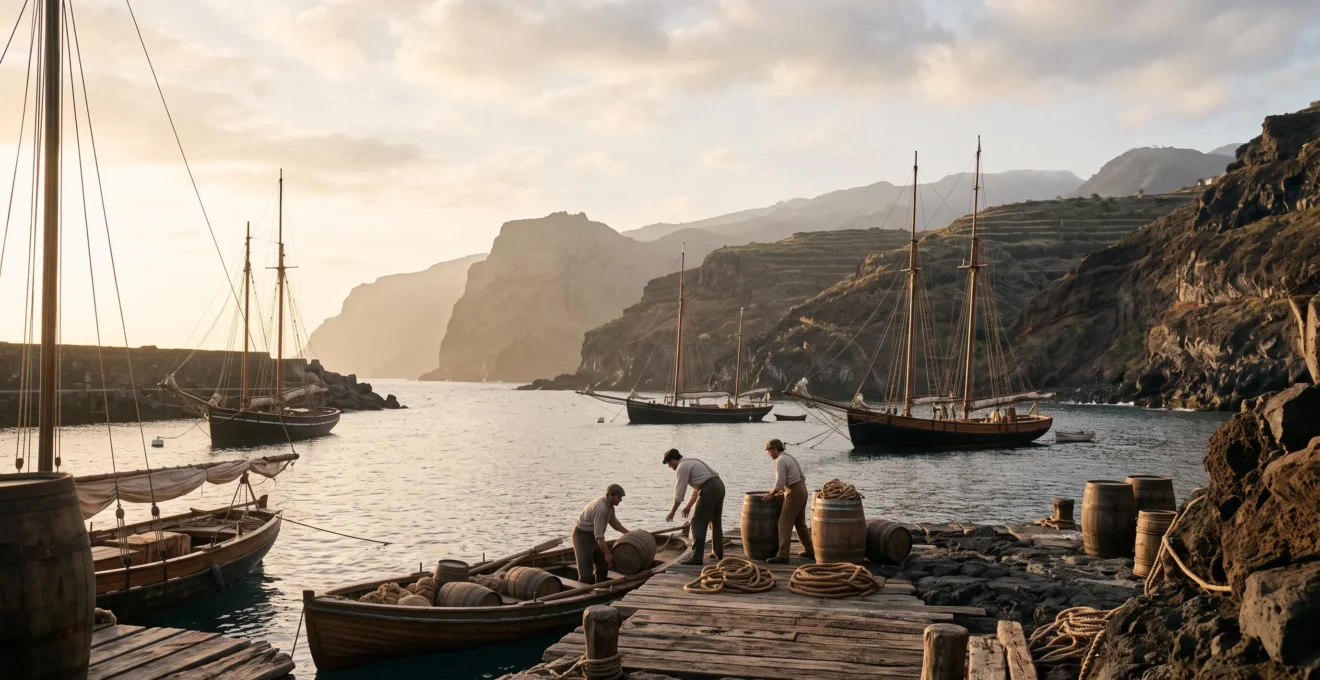
The Canary Islands were not a passive stopover but an active economic laboratory whose systems were foundational to the development of the Americas.
- Geographically, prevailing trade winds made the archipelago a non-negotiable waypoint for any westward transatlantic voyage.
- Economically, pan-European capital tested sugar plantation models and financial networks here decades before they were scaled in the Caribbean.
- Urbanistically, the unfortified grid-plan city of La Laguna served as the direct blueprint for hundreds of cities across Latin America.
Recommendation: To understand the Americas, historians must first analyze the Canary Islands as a systemic precedent, not a geographical footnote.
For centuries, maritime historians have noted the Canary Islands as a crucial final port of call for fleets sailing to the Indies. The common narrative paints a picture of ships taking on water, salted meat, and last-minute repairs before braving the vast Atlantic. While accurate, this view barely scratches the surface. It often treats the islands as a passive, convenient refueling station, a mere geographical footnote in the grand story of American colonization. This perspective overlooks the archipelago’s far more significant role: a dynamic and influential economic laboratory.
To truly trace the vast Atlantic commerce networks, one must move beyond the simple logistics of provisioning. We must examine the flows of capital, ideas, and social structures. The Canaries were the crucible where the machinery of the New World was forged. Here, Genoese and German bankers pioneered the financing of sugar plantations, a proto-colonial model that would be replicated with devastating efficiency in the Caribbean. The very layout of Latin American cities, with their iconic grid patterns and central plazas, was first tested in the unfortified town of La Laguna. Even the romanticized tales of pirates, while exciting, obscure the mundane, daily reality of commercial administration and contract law that formed the true bedrock of this transcontinental enterprise.
This analysis reframes the Canary Islands not as a simple waypoint, but as the essential network node where the economic, urban, and social templates for the Americas were designed, tested, and perfected. By understanding the Canaries as a systemic precedent, we gain a much deeper and more accurate understanding of the forces that connected three continents and built the modern world. This guide will explore the critical systems—navigational, economic, urban, and cultural—that establish the archipelago as the true starting point of the American colonial project.
Table of Contents: Why the Canaries were the Economic and Navigational Heart of Indies Voyages
- Why Westward Trade Winds Made the Canaries Unavoidable Navigation Waypoints
- How to Visit Maritime Museums Documenting Transatlantic Commerce Evidence
- Sugar Trade vs Wine Exports: What Commodities Drove Island Prosperity in Different Centuries?
- How to Trace Your Ancestry if Ancestors Provisioned Ships or Traded Goods
- The Romanticised Pirate Narrative Obscuring 90% of Actual Commercial History
- Why Unfortified Colonial Grids Influenced Latin American City Planning for 300 Years
- Why African Musical Traditions Survived Through Secular Carnival Rather Than Religious Ritual
- Why Island Identity Reflects 5 Distinct Cultural Tributaries
Why Westward Trade Winds Made the Canaries Unavoidable Navigation Waypoints
Before the age of steam, the ocean was not an open map but a landscape of invisible forces. For mariners sailing from Europe to the Americas, the most dominant of these forces were the northeast trade winds. These powerful, consistent winds blow from the northeast towards the southwest, creating a natural and reliable conveyor belt for sailing ships. To catch this atmospheric highway, fleets departing from Spain and Portugal had to first sail south along the African coast until they reached the latitude of the Canary Islands. This route, known as the “volta do mar,” was not a choice but a necessity dictated by meteorology. Attempting a direct westward crossing from Iberia would mean fighting against unfavorable winds and currents, a suicidal proposition for the era’s vessels.
The Canaries were therefore the perfect, and indeed mandatory, final assembly point. This wasn’t just theory; it was a rigidly followed practice. Historical shipping records of the Spanish Indies convoys show that the journey from Seville to the Canaries took approximately two weeks, after which the westward crossing to the Antilles would take about 40 days. Columbus’s 1492 voyage serves as the quintessential example. His fleet made a calculated stopover in the islands for repairs and resupply before using the trade winds to cross the open ocean. This established a pattern that virtually every subsequent fleet would follow for 300 years. The islands became the final logistical checkpoint, the last piece of Europe a sailor would see, and the gateway to the Atlantic’s main thoroughfare. Their role was not accidental but was geostrategically determined by the very physics of the planet.
How to Visit Maritime Museums Documenting Transatlantic Commerce Evidence
While texts and records provide the framework, maritime museums offer tangible connections to this history. Visiting these institutions allows one to see the physical artifacts of the transatlantic network, from ship models and navigational instruments to amphorae that carried wine and oil. When planning a visit to a museum in the Canary Islands, or any port city involved in this trade, the key is to look beyond the general exhibits. Focus on the collections that document commercial history, not just exploration or naval battles.
To get the most out of your visit, start by checking the museum’s online catalog or special collections page before you go. Look for keywords like “comercio,” “Indias,” “flota,” or “siglo XVI-XVIII.” This can help you identify specific objects or documents to seek out. For example, a museum like the Casa de Colón in Las Palmas de Gran Canaria may have exhibits detailing the specific goods used for provisioning, or notarial documents recording trade deals. Imagine finding a display on the cooperage trade; the barrels were the shipping containers of their day, essential for transporting everything from water to wine. Or you might find displays on the types of ceramics traded, allowing you to trace economic links between the Canaries, Seville, and the Caribbean.
When you are there, don’t just look at the objects—analyze their context. A simple navigational astrolabe tells a story of applied science. A collection of recovered coins from a wreck speaks to the flow of capital. By actively seeking out these economic stories, you transform the museum from a collection of old objects into a vibrant, three-dimensional database of the Atlantic trade network. Ask docents or guides specifically about exhibits related to port administration or merchant families; their answers can often unlock hidden narratives within the museum’s walls.
Sugar Trade vs Wine Exports: What Commodities Drove Island Prosperity in Different Centuries?
The Canary Islands’ economic history is not a single, monolithic story but a series of distinct cycles, each driven by a primary commodity and a different set of international players. The first and arguably most influential cycle was that of sugar in the 16th century. Long before sugarcane dominated the Caribbean, it was tested as a cash crop in the Canaries. This was not a local enterprise; it was an international venture. Financial backing arrived as early as 1484 from Genoese, Portuguese, and German capitalists, including the powerful Welser banking family. This infusion of pan-European capital transformed the islands, particularly Gran Canaria, into a proto-plantation economy.
This system, built on enslaved Guanche and later West African labor, was incredibly profitable. Research has documented that Genoese investors came to control over 50% of sugar-cane land, demonstrating the deep integration of the islands into European financial networks. However, by the 17th century, the sugar boom faded due to competition from the more productive plantations in Brazil and the Americas. The Canarian economy then pivoted to its next major commodity: wine. This new cycle was dominated by British merchant houses, who found a thirsty market in England and its colonies for the islands’ robust Malvasia (“Malmsey”) wines—famously referenced by Shakespeare. This shift also changed the labor system from outright slavery towards a model of tenant farming known as medianería.
The transition from sugar to wine illustrates the islands’ role as a flexible economic node in the evolving Atlantic system. It adapted to changing market demands, sources of capital, and labor structures. The following table highlights the key differences between these two foundational economic eras.
| Aspect | Sugar Economy (16th century) | Wine Economy (17th-18th century) |
|---|---|---|
| Dominant period | 16th century boom | 17th century onward, after sugarcane decline |
| Key financiers/traders | Genoese and Flemish merchant capital | British merchant houses |
| Labor system | Enslaved Guanche and later West African labor | Tenant farming (medianería) |
| Main export market | European elite demand | England (notably referenced by Shakespeare) |
How to Trace Your Ancestry if Ancestors Provisioned Ships or Traded Goods
For those with Canarian ancestry, tracing a family connection to the great age of sail is a fascinating challenge. The key is to shift focus from famous explorers to the vast support network that made their voyages possible: the merchants, farmers, artisans, and port officials. Your ancestor may not have been a conquistador, but they might have been a cooper who made the barrels, a merchant who sold the wine, or a notary who recorded the contract. These roles were vital and, crucially, they generated paperwork.
The single most important sources are notarial and parochial archives. Parish records (archivos parroquiales) of baptisms, marriages, and deaths are the bedrock of genealogy everywhere. In the Canaries, however, they can be cross-referenced with notarial protocols (protocolos notariales). These are the records of public notaries, and they contain everything from marriage contracts and wills to sales agreements and powers of attorney. For economic historians, they are a treasure trove. If your ancestor was involved in any form of commerce, their name might appear in these documents.
Academic research has successfully used insular notarial documentation to reconstruct the extensive networks of Portuguese, Genoese, and other foreign merchant communities established in the islands. These archives are the primary source for tracing commercial dealings, including the Atlantic slave trade. Start your search by identifying the specific island and town your family came from. Then, investigate the holdings of the relevant provincial historical archive (Archivo Histórico Provincial) in Las Palmas or Santa Cruz de Tenerife. Many records are being digitized, but an on-site visit is often necessary to access the full depth of these collections. Patience and a focus on commercial records, not just family vital statistics, are the keys to success.
Action Plan: Auditing Your Canarian Ancestral Records
- Identify Points of Contact: List all known ancestral names, towns, and approximate dates. Identify the relevant parish (parroquia) and provincial historical archive (Archivo Histórico Provincial).
- Collect Existing Records: Inventory all family documents you possess—birth certificates, letters, photos. Look for mentions of occupations, properties, or business names.
- Check for Record Coherence: Cross-reference names and dates from family lore with online genealogical databases and the catalog of the historical archives. Are there matches for notarial or parish records?
- Analyze for Economic Clues: In the records you find, search for keywords related to trade: “comerciante” (merchant), “vino” (wine), “azúcar” (sugar), “barril” (barrel), “navío” (ship). A will might list a warehouse or a share in a vessel.
- Build an Integration Plan: Create a timeline that integrates parish records (births, marriages) with any commercial activities found in notarial records. This builds a complete picture of your ancestor’s life and economic role.
The Romanticised Pirate Narrative Obscuring 90% of Actual Commercial History
The image of pirates and privateers—from Francis Drake to local corsairs—is deeply embedded in the popular history of the Canary Islands. These dramatic raids were real and had significant consequences. However, their constant retelling often creates a distorted view, obscuring the fact that for every day of pirate attack, there were thousands of days of mundane, routine, and highly regulated commerce. The history of the Canaries is not primarily a swashbuckling tale; it is an administrative and economic one.
The raids were indeed spectacular. The most famous, the 1599 raid on Las Palmas led by the Dutch privateer Pieter Van der Does, involved an astonishing force of 76 ships and 12,000 men against a city of 5,000 inhabitants. While the attack was ultimately repulsed, its scale demonstrates that the islands were a high-value target. However, these were exceptional events, akin to major military campaigns, not everyday occurrences. The real impact of the pirate threat was not in the fighting itself, but in the massive, ongoing expense of fortification and coastal defense. The construction of watchtowers and fortresses was a constant drain on the colonial treasury.
A perfect example is the Castillo de San Buenaventura on Fuerteventura. This watchtower was ordered built in 1741 by the Commander General as a direct response to a single 1740 raid by English corsairs. This illustrates the dynamic perfectly: an isolated attack triggered a costly, permanent infrastructure investment. The focus on these spectacular but rare events masks the overwhelmingly peaceful and bureaucratic nature of daily life. The real story is found not in battle logs, but in shipping manifests, customs receipts, and notarial contracts—the paper trail of a functioning commercial network that operated continuously, with piracy as a high-stakes but infrequent interruption.
Why Unfortified Colonial Grids Influenced Latin American City Planning for 300 Years
Beyond economics, the Canary Islands served as a crucial urban laboratory. The design of cities in the Spanish Americas, characterized by a rational grid of streets (the damero) centered on a main square (plaza mayor), did not emerge in a vacuum. This model was first conceived and implemented in the Canary Islands, specifically in the city of San Cristóbal de La Laguna in Tenerife. Founded in 1496, La Laguna was deliberately designed as an inland city, safe from pirate raids, and therefore did not require defensive walls. This freedom from military constraints allowed for a purely philosophical and rational approach to urban planning.
This “city-republic” concept, with its grid layout based on navigational science and Renaissance humanism, became the proto-colonial model. It was a blueprint for a new kind of society, organized and hierarchical. As UNESCO notes in its World Heritage evaluation:
San Cristóbal de La Laguna is the first example of an unfortified town with a grid model that was the direct precursor of the settlements in the Americas under Spanish rule during colonial times.
– UNESCO, UNESCO World Heritage evaluation of San Cristóbal de La Laguna
This paragraph introduces the concept of La Laguna as a blueprint. The visual representation below helps to understand this unfortified grid structure that was exported across an ocean.
As the illustration shows, the layout is open and rational, designed for administration and civil life, not for siege warfare. This model was not just an aesthetic choice; it was a tool of colonial governance. A comparative academic study argues that La Laguna’s urban principles directly informed the pivotal 1573 Laws of the Indies, the legal code that standardized this grid-and-plaza model across Spanish America. From Mexico City to Lima, the urban DNA of hundreds of cities can be traced back to this initial experiment in Tenerife. The Canary Islands, therefore, exported not just goods, but the very physical structure of colonial power.
Why African Musical Traditions Survived Through Secular Carnival Rather Than Religious Ritual
The cultural fabric of the Canary Islands is a complex weave, and one of its most vibrant threads is the influence of West Africa. This influence arrived primarily through the brutal institution of slavery, first to work the sugar plantations. While the Catholic Church’s official religious rituals sought to syncretize or suppress African spiritual practices, these traditions found a more resilient and expressive home in a surprising place: the secular, pre-Lenten celebrations of Carnival.
Unlike the rigid, doctrine-heavy space of the church, Carnival was a time of “inversion,” where social norms were temporarily suspended. This liminal space provided a cultural loophole. Within the chaotic joy of street parades, drumming, and masked festivities, elements of African musicality—particularly complex polyrhythms and call-and-response patterns—could be preserved and practiced. These rhythms, disconnected from their original religious meanings to avoid persecution, survived as pure sound, as the engine of the celebration’s energy. The drum, a central element in many West African cultures, became the heartbeat of the Canarian Carnival.
This paragraph introduces the idea of Carnival as a vehicle for cultural survival. The accompanying image captures the energy and focus on rhythm that defines this expression.
As you can see, the focus is on the act of music-making, the rhythm, and the communal energy. This secular context was key to its survival. While religious authorities might scrutinize a hymn or a prayer for heresy, the “pagan” revelry of Carnival was often dismissed as harmless folk custom or, at worst, a temporary moral lapse. It was in this overlooked space that a powerful cultural memory was encoded in rhythm, passed down through generations not as sacred text but as the irresistible impulse to dance. This demonstrates how culture can be incredibly resilient, finding new vessels for expression even under the most oppressive conditions.
Key Takeaways
- The Canary Islands’ geographic position astride the trade winds made them a mandatory, not optional, waypoint for all westward Atlantic sailing for three centuries.
- The archipelago functioned as a proto-colonial laboratory where pan-European capital and plantation economics were tested before being implemented on a massive scale in the Americas.
- The unfortified grid plan of La Laguna was the direct urban blueprint for the 1573 Laws of the Indies, defining the layout of hundreds of cities across Latin America.
Why Island Identity Reflects 5 Distinct Cultural Tributaries
To speak of a single “Canarian identity” is to oversimplify a rich and layered history. The modern culture of the islands is best understood as a confluence of at least five major cultural tributaries that have flowed together over centuries. The first is the foundational, yet often submerged, indigenous Guanche heritage, which survives in place names, genetics, and certain agricultural practices like the consumption of gofio.
Upon this foundation was imposed the second and most dominant layer: Castilian culture. The Spanish conquest brought the language, the Catholic religion, and the legal and administrative systems that still form the bedrock of society. The third tributary is a broader Pan-European influence, a direct result of the islands’ role as a trade hub. The presence of Genoese, Flemish, Portuguese, and British merchants left its mark not just in surnames and economic history, but in architecture and customs. The fourth, as discussed, is the vital West African tributary, which arrived through the slave trade and infused the islands’ music and, to some extent, its spiritual worldview.
The fifth and final tributary is what could be called the “American Return.” Persistent economic hardship in the 19th and 20th centuries pushed large numbers of Canarians to emigrate, primarily to Cuba and Venezuela. When these emigrants or their descendants (the “Indianos”) returned, they brought back wealth, but also vocabulary, musical styles (like the punto cubano), culinary habits, and a new perspective. This back-and-forth flow created a unique transatlantic feedback loop. A perfect, everyday example of this multi-continental blend is one of the islands’ signature dishes, papas arrugadas. It is made with an ancient American potato variety, so unique it now holds a Protected Designation of Origin (PDO) status, cooked with sea salt from the Atlantic. It’s a dish that tells a story of indigenous American crops, oceanic geography, and centuries of cultural exchange.
By analyzing these interconnected systems—from trade winds and capital flows to urban grids and cultural synthesis—it becomes clear that the Canary Islands were far more than a provisioning stop. They were the active, foundational node of the Atlantic network, the laboratory where the Americas were first imagined and engineered. Understanding this role is essential for any serious study of transatlantic history.