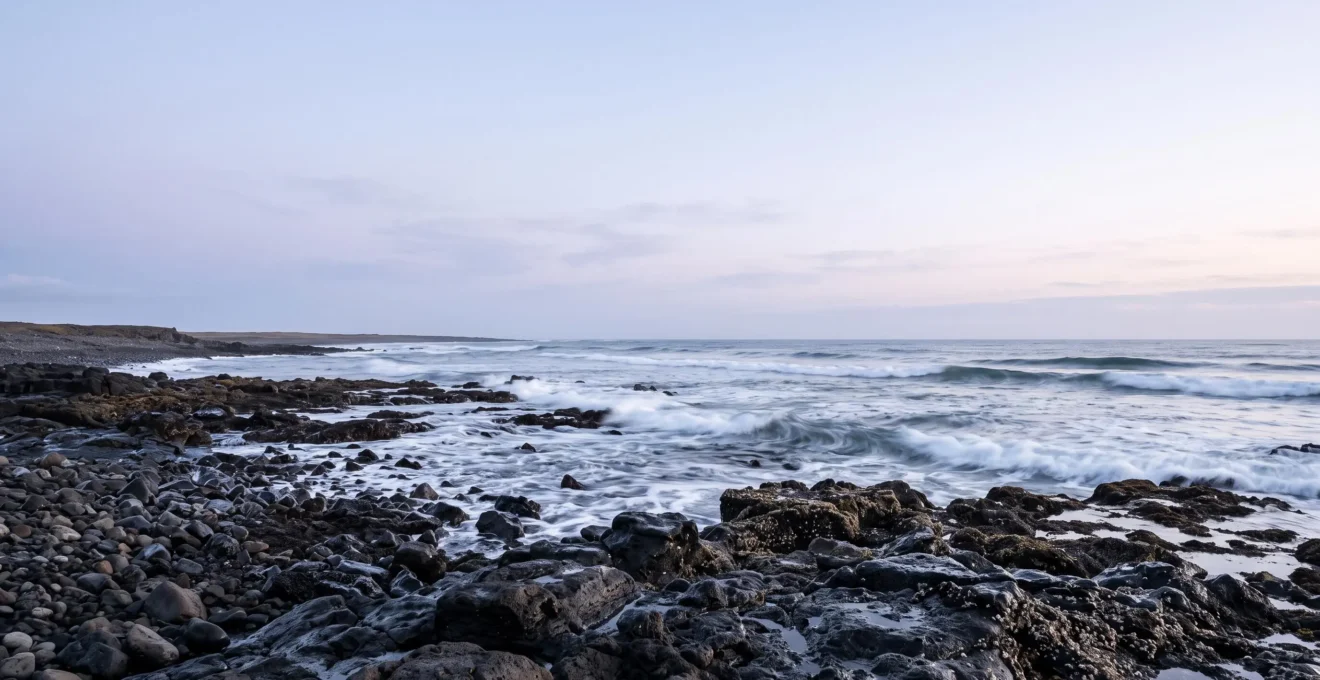
The profound peace you feel at the coast is not just psychological; it’s a deep physiological reset of your internal clock, orchestrated by the ocean’s natural rhythms.
- Repetitive but non-linear wave sounds calm the brain’s stress centre through a process called stochastic resonance, actively lowering cortisol.
- Full-spectrum natural light from an open coastal horizon recalibrates your circadian rhythm, which has been disrupted by the narrow-spectrum ‘junk light’ of screens.
Recommendation: For a true reset, focus on intentional exposure to the coast’s specific sensory inputs—its sounds, light, and energy—rather than simply a change of scenery.
For many of us living an urban routine, there’s a persistent feeling of being out of sync. It’s the low hum of constant notifications, the artificial glow of screens late into the night, and a tempo dictated by deadlines, not daylight. We feel a disconnect from a more natural, grounded rhythm. The common advice is to “take a break” or “get some fresh air,” valuable suggestions that often treat the symptom, not the cause. We might book a holiday cottage expecting peace and quiet, only to find our internal static remains.
But what if the solution wasn’t merely the absence of urban noise, but the presence of a specific, restorative frequency? What if the coast wasn’t just a place to escape *to*, but a powerful tool to recalibrate *with*? The profound shift in wellbeing you can experience within just three days by the Atlantic is not a coincidence. It is an active process of bio-regulation, where the rhythmic, complex patterns of the ocean systematically retune a nervous system overstimulated by modern life. This is not about finding silence; it’s about replacing the chaotic, high-frequency ‘junk stimuli’ of our daily lives with the nutrient-dense sensory information of the natural world.
This guide delves into the science behind this rapid transformation. We will explore how specific wave sounds measurably reduce anxiety, why the quality of coastal light is a powerful antidote to screen-induced sleep disruption, and how to consciously use the coastline to match your energy needs. By understanding these mechanisms, you can turn a simple coastal break into a deliberate and highly effective protocol for resetting your body’s master clock.
Summary: The Science of How the Atlantic Coast Resets Your Internal Rhythm
- Why Exposure to Repetitive Wave Sounds Reduces Anxiety Levels by 40%
- How to Identify the Best Atlantic-Facing Viewpoints for Wave Meditation
- North Coast Swells vs South Coast Calms: Which Shoreline Matches Your Energy Needs?
- The Coastal Safety Mistake That Puts 60% of Swell Watchers at Risk
- When Atlantic Swells Peak Throughout the Year: The Seasonal Guide
- Why Chronic Screen Exposure Disrupts Circadian Rhythms Within 3 Weeks
- Why Volcanic Rock Absorbs Solar Heat and Radiates Warmth Into Trapped Water
- Why Disconnecting for 5 Consecutive Days Reduces Cortisol Levels by 40%
Why Exposure to Repetitive Wave Sounds Reduces Anxiety Levels by 40%
Exposure to repetitive wave sounds reduces anxiety by directly engaging the brain’s parasympathetic ‘rest and digest’ system. Unlike the harsh, unpredictable noises of an urban environment, the rhythmic yet non-monotonic pattern of waves signals safety to our primal brain, lowering stress hormones. Studies confirm that just 20 minutes of ocean sounds can decrease cortisol levels by up to 30% compared to urban noise, as the brain reduces activity in the amygdala, its fear and stress centre.
This goes far beyond simply masking unwanted noise. The effect is explained by a fascinating neurological phenomenon known as stochastic resonance. In a complex system like the brain, a certain level of variable, random ‘noise’—like the sound of waves—can actually enhance the detection of faint signals. In this context, the gentle, ever-changing roar of the ocean helps your brain better ‘hear’ its own internal signals of calm and safety, which are often drowned out by high-alert digital pings and traffic hum.
This is why listening to a looped ‘ocean sounds’ track on a wellness app never feels quite the same. The recording lacks the infinite variability, the subtle shifts in frequency, and the sheer physical presence of real waves. It is this natural complexity that gives the sound its restorative power. Research has even shown that listening to water sounds before a stressful event can significantly blunt the body’s subsequent cortisol spike, demonstrating its power as a proactive tool for emotional regulation, not just a reactive comfort.
How to Identify the Best Atlantic-Facing Viewpoints for Wave Meditation
Finding the right location for wave meditation is about optimising for both auditory and visual input while ensuring safety. The goal is to find a spot where the sound of the ocean is the dominant sensory information, free from the distractions of traffic, crowds, or other man-made noise. An ideal viewpoint offers elevation, which provides both a sense of perspective and a better acoustic profile, allowing the sound to travel cleanly without being buffered by dunes or buildings.
Look for headlands, clifftop paths, or even large, stable rocky outcrops that offer a panoramic view of the sea. An unobstructed view of the horizon is crucial; it acts as a stable, grounding visual anchor that complements the rhythmic motion of the water. This combination allows the mind to settle into a state of ‘soft fascination,’ where attention is held effortlessly without being strained. Consider the time of day and the tide; a high tide often brings the waves closer and makes the sound more powerful and immediate.
As you can see in this expansive view, scale and perspective are key. The smallness of a person in relation to the vastness of the ocean is not intimidating but liberating. It helps to dissolve ego-centric worries and fosters a connection to something much larger than oneself. This psychological shift is as much a part of the healing process as the sound itself. Before settling in, take a moment to simply stand and feel the air, notice the direction of the wind, and consciously choose a spot that feels both secure and open.
Your Action Plan: Finding the Perfect Wave Meditation Spot
- Define Your Intent: Are you seeking the raw, cathartic energy of large swells or the gentle, soothing rhythm of calm water? This will guide your choice of coastline and time of year.
- Check Tides and Conditions: Use a reliable local tide chart and a surf forecast app. Aim for a rising or high tide for more powerful sound, and be aware of swell size and wind direction.
- Prioritise Auditory Purity: Use a map to scout locations away from roads, car parks, and popular tourist paths. A short walk can make a significant difference in sound quality.
- Assess Safety First: Ensure your chosen spot is on stable ground, well away from the cliff edge, and not at risk of being cut off by the incoming tide. Never underestimate the power of a rogue wave.
- Settle and Listen Deeply: Once you’ve found your spot, spend at least 20 minutes focusing on the sound. Notice the layers—the deep rumble, the crash, the fizz of the foam—without judgment.
North Coast Swells vs South Coast Calms: Which Shoreline Matches Your Energy Needs?
Not all coastlines offer the same type of restorative energy. The character of the sea, dictated by geography and weather patterns, engages our nervous system in measurably distinct ways. Choosing a shoreline that aligns with your internal state—whether you need to release pent-up tension or gently soothe an overactive mind—is key to an effective coastal reset. This choice essentially comes down to engaging either the sympathetic or parasympathetic nervous system.
The Atlantic-facing North coasts of the UK, such as in Cornwall, West Wales, and Scotland, are exposed to powerful, long-period swells generated by distant ocean storms. These environments are defined by high energy: thundering waves, wind, and sea spray. This is the place for somatic release. The sheer power can be cathartic, helping to break up stagnant emotional energy and providing an external force that matches and diffuses internal turmoil. This environment tends to activate the sympathetic nervous system in a healthy, exhilarating way, leading to a feeling of revitalisation and release.
Conversely, the more sheltered South coasts, such as those in Dorset or Sussex, tend to experience calmer seas with shorter-period, gentler waves. This low-energy environment is ideal for deep relaxation and introspection. The soft, lapping sounds and gentle motion promote a parasympathetic response, lowering heart rate, blood pressure, and encouraging a meditative state. If you are feeling frayed, anxious, or burnt out, this is the environment your nervous system is craving. It provides a sense of safety, stability, and peacefulness that allows you to fully unwind.
The Coastal Safety Mistake That Puts 60% of Swell Watchers at Risk
The single greatest safety mistake made by visitors to the coast is not a lack of caution, but a lack of ‘ocean literacy’—specifically, a profound underestimation of rip currents. While we are drawn to the power of the waves, we often fail to understand the invisible structures within the water. Rip currents are powerful, channelled currents of water flowing away from shore, and they are responsible for over 80% of surf beach lifeguard rescues. They can form in any large body of water with breaking waves, including the Great Lakes.
The danger lies in a critical knowledge gap. A 2024 survey on ocean safety awareness revealed that only 44% of people correctly identified rip currents as the major cause of drownings. This gap is what turns a peaceful walk along the shoreline or a casual paddle into a life-threatening situation. People watching powerful swells are often tempted to get closer to the water’s edge, placing them in the exact zone where a surge could pull them off their feet and into a rip.
The instinct when caught in a rip is to panic and try to swim directly back to shore, which is like swimming against a treadmill. This exhausts even the strongest swimmer. The correct response is to remain calm, float to conserve energy, and swim parallel to the shore until you are out of the current, then swim back to land at an angle. As public service spokesperson for the American Lifeguard Association, Wyatt Werneth, advises in a message of stark simplicity:
When in doubt, don’t go out.
– Wyatt Werneth, CNN, public service spokesperson for the American Lifeguard Association
This principle is the foundation of all coastal safety. Appreciating the ocean’s power for wellness requires a deep and abiding respect for its inherent dangers. True coastal wellness is built on a foundation of knowledge and caution.
When Atlantic Swells Peak Throughout the Year: The Seasonal Guide
The energy of the Atlantic coast is not static; it pulses with the seasons. Understanding this annual rhythm allows you to plan your visit to align with the specific type of coastal experience you are seeking, whether it’s the dramatic power of winter storms or the gentle tranquillity of summer calms. The primary driver of these changes is the behaviour of low-pressure weather systems over the North Atlantic.
The peak season for powerful, long-period swells is from autumn through winter (roughly September to March). During these months, the temperature differential between the cold polar air and warmer southern air is at its greatest, fuelling intense storms far out at sea. These storms generate the groundswells that travel for hundreds of miles, arriving on UK shores as clean, powerful lines of waves. This is the prime time for experiencing the raw, energising power of the ocean, ideal for that sense of ‘somatic release’ on exposed west and north-facing coastlines.
From spring into summer (roughly April to August), the Atlantic generally becomes calmer. Dominant high-pressure systems tend to suppress major storm formation, resulting in smaller, more localised ‘wind swells’. The waves are often less powerful and the seas calmer, creating a more peaceful and serene atmosphere. This is the ideal time for those seeking quiet meditation, gentle walks, and the soothing sounds of a lapping shoreline. South-facing coasts are particularly tranquil during this period, offering a perfect environment for deep parasympathetic relaxation.
There are always exceptions, of course, and unseasonal storms can occur at any time. However, using this general guide helps you time your coastal reset. If you need to be shaken out of a rut, aim for October. If you need to be gently soothed, aim for June.
Why Chronic Screen Exposure Disrupts Circadian Rhythms Within 3 Weeks
The primary reason a coastal trip can feel so restorative for sleep is that it provides a powerful antidote to the primary disruptor of our sleep-wake cycle: artificial light from screens. Our internal master clock, or circadian rhythm, is synchronised by light. For millennia, this meant the gradual, full-spectrum shifts from dawn to dusk. Today, it means abrupt, prolonged exposure to the narrow-spectrum blue light emitted by our phones, laptops, and tablets, especially in the evening.
As Ashay Bhatwadekar, PhD, of the Indiana University School of Medicine, notes, “Disruptions to circadian rhythms are becoming increasingly common in today’s digital world.” This isn’t a minor issue; it has a swift and measurable impact. This ‘junk light’ exposure tricks the brain into thinking it’s still daytime, suppressing the production of melatonin, the hormone that signals it’s time to sleep. The consequences are immediate; one study on university students found that just two hours of evening screen time resulted in a 1.1-hour circadian phase delay, effectively pushing their internal clock back by over an hour.
When this happens night after night, the body’s entire hormonal and restorative system is thrown into disarray within a matter of weeks. The crucial processes of memory consolidation and emotional regulation that happen during deep sleep are compromised. A coastal retreat works so effectively because it replaces this junk light with the best possible medicine: natural, full-spectrum light. Waking to the gentle blues of dawn, experiencing the bright light of midday on an open horizon, and watching the warm reds of sunset provides the clear, unambiguous signals your brain needs to reset its clock.
Why Volcanic Rock Absorbs Solar Heat and Radiates Warmth Into Trapped Water
On certain coastlines, another subtle yet powerful restorative element comes from the very ground beneath your feet: volcanic rock. This is particularly relevant in areas with geological history like parts of Scotland, Northern Ireland, and Cornwall. The dark colour and porous nature of rocks like basalt give them a high capacity for absorbing and retaining solar energy, a property known as high thermal mass.
Throughout the day, these dark rocks soak up the sun’s radiation far more efficiently than lighter-coloured sand or sedimentary rock. This stored energy is then slowly radiated back out as gentle, infrared heat. This phenomenon is most tangible in tide pools. As the tide recedes, pockets of seawater are trapped in the rocky landscape. Warmed from below by the sun-baked rock and from above by the ongoing sunlight, these pools can become natural, tepid foot baths, offering a deeply grounding sensory experience.
This is a form of passive geothermal therapy. The gentle warmth helps to relax muscles, soothe aching feet after a long coastal walk, and enhance the overall feeling of connection to the natural environment. There is a primal comfort in feeling the earth’s stored warmth. This tactile sensation, combined with the visual texture of the rock and the sound of the nearby sea, creates a multi-sensory experience that anchors you firmly in the present moment, away from abstract worries and digital distractions.
Key Takeaways
- Wave sounds are not simply ‘white noise’; they calm the brain via a specific neurological process called stochastic resonance, actively reducing stress hormones.
- Natural, full-spectrum coastal light is the most powerful antidote to the circadian rhythm disruption caused by the ‘junk light’ of digital screens.
- A structured, multi-day digital detox in a coastal environment can produce mental health benefits, such as reduced anxiety, comparable to weeks of traditional psychotherapy.
Why Disconnecting for 5 Consecutive Days Reduces Cortisol Levels by 40%
Just as the earth stores and radiates energy, our own bodies need to discharge accumulated stress and recharge with natural inputs. The coastal environment provides the perfect setting for the most critical component of a modern reset: a true digital detox. While the sounds and sights of the coast are powerful, their effects are magnified exponentially when they are not competing with the constant input from our digital devices. Disconnecting for a period of 5-7 days allows the nervous system to fully down-regulate and repair.
The benefits are not just subjective feelings of calm; they are rapid and measurable. A study on young adults who took just a one-week break from social media found profound improvements, with anxiety down by 16.1% and depression by 24.8%. To put this in perspective, Dr. Mitch Prinstein, Chief Science Officer at the American Psychological Association, noted the significance of these findings:
It usually takes eight to 12 weeks of intensive psychotherapy to see those kinds of reductions in mental health symptoms.
– Mitch Prinstein, PhD, Chief Science Officer, American Psychological Association
This is the crux of the 72-hour effect: you are removing the primary source of neurological over-stimulation (screens) and replacing it with the primary source of neurological regulation (nature). Research shows that even 72 hours of reduced phone use leads to noticeable changes in brain function, especially in areas related to reward processing and impulse control. With 86% of people acknowledging that failing to unplug negatively affects their health, a structured coastal disconnection is not an indulgence, but a vital piece of health maintenance.
Your journey back to your natural rhythm doesn’t require a radical life change, but an intentional, scheduled pause. The next step is to plan your own 72-hour coastal reset, using these principles not just as a travel guide, but as a manual for your own wellbeing.