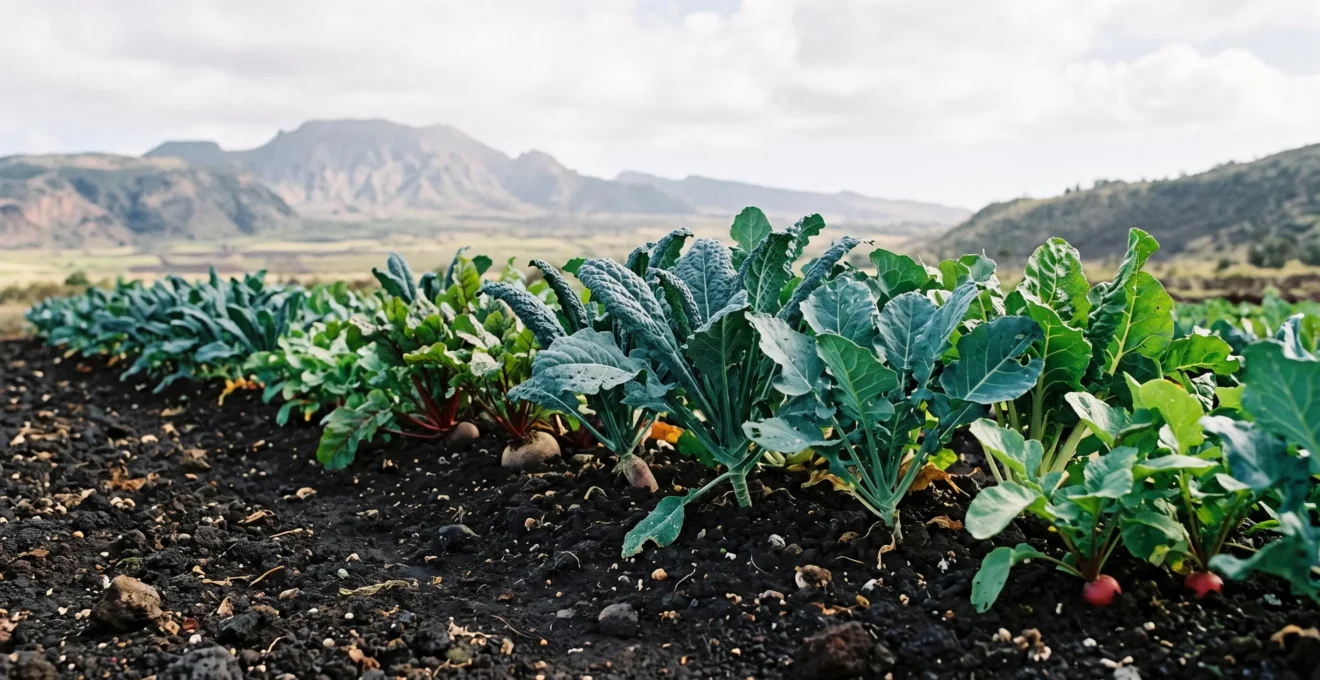
The exceptional nutrient density of crops grown in volcanic soils is not magic; it’s the direct result of continuous mineral release from basaltic rock, unlocked by specific soil microbes.
- Unlike depleted sedimentary soils, young volcanic material provides a slow-release source of essential trace elements like iron, magnesium, and calcium.
- This process is not just chemical; it’s biological. Mineral-solubilizing microorganisms are essential for making these rock-bound nutrients available to plants.
Recommendation: For growers, the focus should shift from simple N-P-K fertilization to fostering the microbial life that performs this natural mineral extraction.
Every dedicated grower, from the backyard permaculturist to the professional organic farmer, shares a common goal: to produce not just food, but nourishment. We strive for crops that are vibrant, resilient, and packed with flavour and nutrients. The common wisdom often points to a supposed holy grail of fertility: volcanic soil. We hear tales of lush landscapes and bounteous harvests from places like Italy, Hawaii, or the Canary Islands, and the simple explanation is always “the soil.”
But this explanation is both true and deceptively simple. It leads many to believe that “volcanic ash” is a kind of magical fertilizer, a one-time deposit of goodness. This surface-level understanding misses the profound and dynamic processes at play beneath the surface. It fails to explain why some volcanic soils are supremely fertile, while others can be challenging, or why their extraordinary productivity can be so easily destroyed by conventional farming practices.
What if the true advantage of these soils isn’t a static property, but an ongoing geological and biological process? The secret lies not just in the initial composition of the ash, but in the slow, continuous weathering of basaltic parent material and the thriving microbial ecosystems that have evolved to feast upon it. This unlocks a spectrum of trace minerals that are simply absent or locked away in most of the world’s agricultural lands.
This article will dissect the science behind this volcanic advantage. We will explore the unique chemical signature of basaltic weathering, identify the tell-tale signs of these fertile zones, compare their properties to other soil types, and understand the critical threat that modern agriculture poses to this natural inheritance. By understanding the “why,” you can learn “how” to harness this power for exceptional productivity.
To navigate this deep dive into the earth’s fertility engine, this guide breaks down the core concepts into distinct, logical sections. The following summary outlines the key topics we will explore, from foundational soil science to practical applications and conservation.
Summary: The Complete Grower’s Guide to Volcanic Soil Fertility
- Why Basaltic Weathering Releases Trace Minerals Absent From Sedimentary Soils
- How to Identify Volcanic Agricultural Zones by Vegetation Vigour and Crop Colour
- Young Volcanic Ash vs Aged Clay Soils: What Cultivation Challenges Each Presents?
- How to Experience Working Farms Demonstrating Volcanic Soil Cultivation
- The Fertilisation Excess Destroying Natural Volcanic Soil Fertility
- Why Island Age Determines Vegetation Cover and Soil Development Stages
- Why PDO Certification Preserves Heirloom Potato Varieties From Industrial Displacement
- Why Papas Arrugadas Require Specific Atlantic Salt Concentrations
Why Basaltic Weathering Releases Trace Minerals Absent From Sedimentary Soils
The fertility of volcanic soils, known as Andosols, is fundamentally different from that of common sedimentary soils. While volcanic soils make up less than 1% of the world’s soils, their productivity is legendary because they are, in essence, young, unrefined rock in the process of breaking down. Sedimentary soils, formed from transported and heavily weathered materials, are often ancient and leached of their most valuable micronutrients. Volcanic soils, by contrast, are a direct link to the Earth’s mineral-rich mantle.
The key process is basaltic weathering. Basalt, a dark, fine-grained volcanic rock, is rich in ferromagnesian minerals. As this parent material is exposed to water, temperature changes, and biological activity, it slowly decomposes. This weathering doesn’t just release the major nutrients (like phosphorus and potassium) but also a full suite of trace elements crucial for plant health and, by extension, human nutrition. This includes iron, manganese, zinc, copper, and boron, which are often the limiting factor in conventional agriculture.
This chemical process is supercharged by biology. Recent research highlights the critical role of mineral-solubilizing microorganisms (MSMs). These bacteria and fungi colonize the surface of rock fragments and produce organic acids and ligands. According to a Frontiers in Microbiology editorial review, these substances act like natural chelating agents, prying mineral ions from the crystal structure of the rock and making them water-soluble and available for plant roots to absorb. This is a living, breathing system of nutrient extraction, far more sophisticated than a simple application of synthetic fertilizer.
How to Identify Volcanic Agricultural Zones by Vegetation Vigour and Crop Colour
For the trained eye, landscapes sitting on volcanic soils often broadcast their fertility. The most obvious indicator is the sheer vigour of the vegetation. Plants appear healthier, more robust, and often exhibit a deeper, richer green colour. This isn’t just a subjective observation; it’s a direct visual manifestation of superior nutrient availability, particularly magnesium, which is a central component of the chlorophyll molecule responsible for photosynthesis.
The colour of the crops themselves can also be a clue. The increased availability of minerals like iron directly impacts the final product. For instance, a study on potatoes grown near the Cotopaxi Volcano found they contained elevated levels of iron and magnesium. This mineral enrichment not only enhances the nutritional value but can also affect pigmentation and flavour profiles, contributing to the unique terroir of volcanic-grown produce.
Beyond visual cues, the soil itself has distinct characteristics. Andosols are typically dark (from dark brown to black), have a low bulk density, and possess a uniquely fluffy, loamy texture. This structure is due to the formation of specific, non-crystalline clay minerals called allophane and imogolite, which create stable aggregates. This leads to excellent drainage, high water retention, and a superb environment for root growth—a trifecta for any grower. A controlled study demonstrated this effect clearly, showing how a volcanic slag substrate significantly boosted cucumber yield and quality by improving the entire root-zone environment.
Your Field Assessment Checklist: Identifying High-Potential Volcanic Soil
- Observe Vegetation: Look for exceptional vigour, deep green colours, and high biodiversity in native plants and weeds. This signals broad-spectrum nutrient availability.
- Check Soil Texture & Colour: Dig a small pit. The soil should be dark, lightweight, and porous. It should crumble easily and feel loamy, not sticky like heavy clay or gritty like pure sand.
- Examine Parent Material: Search for small, dark, often porous basaltic or scoria rock fragments within the soil profile. This is the source of future fertility.
- Assess Drainage and Water-Holding Capacity: The soil should feel moist but not waterlogged. Its structure allows it to absorb heavy rain without pooling and retain it for dry periods.
- Review Local History & Geology: Use geological maps or local knowledge to confirm you are in a zone of geologically recent volcanic activity. Older volcanic soils can be heavily weathered and less fertile.
Young Volcanic Ash vs Aged Clay Soils: What Cultivation Challenges Each Presents?
While volcanic soils offer immense potential, they are not a uniform monolith. Their properties—and challenges—change dramatically with age. A young soil, recently formed from fresh ash deposits, presents a very different set of conditions compared to an ancient, heavily weathered volcanic clay.
The primary challenge in young volcanic soils is often high aluminium toxicity coupled with low pH. Fresh volcanic ash can be quite acidic, and this acidity mobilizes aluminium, which is toxic to most plant roots, stunting growth and inhibiting nutrient uptake. A field experiment on blueberries in southern Chile found that plant growth in acidic volcanic soil responded primarily to soil liming (to raise pH and lock up aluminium) rather than nitrogen fertilization. This underscores a key principle for growers: in these young soils, managing pH is the first and most critical step to unlocking their mineral wealth.
In contrast, aged, heavily weathered volcanic soils present a different problem. Over millennia of intense rainfall and leaching, they can lose their silica and valuable base cations (like calcium, magnesium, and potassium). They transition from fertile Andosols towards less fertile soil types like Ultisols or Oxisols. While their clay content gives them good structure, their nutrient bank is depleted. The challenge here is not toxicity, but deficiency, requiring careful and sustainable nutrient replenishment to maintain productivity.
The following table, based on the typical chronosequence of Andosol development, summarizes these critical differences.
| Characteristic | Young Volcanic Ash | Mature Andosol | Ancient Weathered Volcanic Clay |
|---|---|---|---|
| Dominant clay type | Silica-rich allophane | Balanced allophane/humus complexes | Aluminium-rich allophone, gibbsite |
| Fertility profile | Mineral-rich but unstable | Highly fertile, high water retention | Desilicated, nutrient-depleted |
| Main limitation | Aluminium toxicity, low pH | High phosphorus retention/fixation | Reclassified toward Ultisols/Oxisols, reduced fertility |
How to Experience Working Farms Demonstrating Volcanic Soil Cultivation
Reading about volcanic soils provides a theoretical foundation, but to truly understand their power, one must see them in action and feel the soil in hand. Many of the world’s most unique agricultural landscapes are built on this geological gift, offering opportunities for agro-tourism and hands-on learning for curious growers. These are not large-scale industrial operations but often small, family-run farms that have honed their practices over generations to work in harmony with the local terroir.
From the terraced vineyards on the slopes of Mount Etna in Sicily to the coffee fincas of the Colombian Andes and the taro patches of Hawaii, these farms are living laboratories. Visiting them allows you to observe the practical application of principles we’ve discussed: seeing the deep colour of the crops, the unique texture of the soil, and the specific cultivation techniques used to manage its properties. It’s an opportunity to speak with farmers who have an inherited, intuitive understanding of their land’s potential and its limitations.
This direct experience bridges the gap between science and practice. It provides a tactile understanding that no book can replicate—the feeling of crumbling the dark, porous, and surprisingly lightweight soil between your fingers, a substance teeming with potential life.
As the image portrays, there is a deep connection between a grower and their soil. This connection is particularly strong in volcanic regions, where the land is often both a source of immense fertility and a reminder of nature’s power. Many farm-stay programs or agricultural tours in volcanic regions offer this kind of immersive experience, providing an invaluable education for any permaculturist or organic grower seeking to deepen their understanding of soil.
The Fertilisation Excess Destroying Natural Volcanic Soil Fertility
The exceptional fertility of Andosols is a double-edged sword. Their natural richness has, in many places, been taken for granted, leading to management practices that ultimately degrade their unique properties. The most significant threat is the overuse of synthetic nitrogen fertilizers, a hallmark of industrial agriculture. This practice is particularly destructive to the delicate balance of volcanic soils.
Andosols have a high buffering capacity, meaning they can resist changes in pH. However, this capacity is not infinite. The heavy, repeated application of ammonium-based fertilizers leads to a process of intense soil acidification. This acidification breaks down the beneficial allophane clay structures, releases toxic aluminium (as seen in young soils), and decimates the microbial communities responsible for natural nutrient cycling. A study of cultivated Japanese Andosols found that while most remained healthy, about 5% had reached extreme levels of acidity directly attributable to heavy fertilization, effectively sterilizing their productive potential.
Once this natural fertility engine is broken, farmers become trapped in a vicious cycle. They must apply ever-increasing amounts of synthetic inputs to compensate for the loss of natural soil function, further acidifying the soil and destroying its structure. The soil’s remarkable water-holding capacity diminishes, and its ability to provide a slow release of trace minerals is lost. It becomes a mere physical substrate, dependent on a constant drip of chemical life support. As one study noted, these soils require a more thoughtful approach.
The Andosols in this study display low nutrient-holding capacity and require special management practices to maintain their productivity.
– Study on long-term land-use change in West Java Andosols, Mineralogical and surface charge characteristics of Andosols experiencing long-term, land-use change in West Java, Indonesia
The lesson for permaculture practitioners is clear: the goal is not to extract maximum yield in the short term but to preserve and enhance the soil’s natural systems. This means prioritizing organic matter, fostering microbial life, and avoiding the synthetic inputs that dismantle this precious geological inheritance.
Why Island Age Determines Vegetation Cover and Soil Development Stages
The concept of soil development over time, or chronosequence, is nowhere more visible than on a chain of volcanic islands, such as the Hawaiian archipelago. The age of the island, determined by its position over the volcanic hotspot, directly dictates the stage of soil development and, consequently, the type and density of its vegetation cover. This provides a perfect living laboratory for understanding soil evolution.
On the youngest islands or near recent lava flows, you find bare, black basaltic rock. Life begins with pioneer species—lichens and mosses that can cling to the rock surface. They begin the slow process of biological weathering, their mild acids etching the rock and trapping dust and organic debris. This creates the first embryonic soil, a thin veneer capable of supporting hardy ferns and grasses.
As you move to older islands or further from the eruption center, the soil becomes progressively deeper and more developed. A study of young volcanic soils in the Ecuadorian Andes found that soil depth to the parent rock horizon varied from just 27 cm under pasture to over 100 cm under remnant forests, showing how vegetation actively builds soil. Over thousands of years, this process creates the deep, dark, and incredibly fertile Andosols we associate with peak volcanic fertility, capable of supporting lush, complex forests.
However, the timeline continues. On the most ancient, multi-million-year-old islands, the process reverses. Centuries of heavy tropical rainfall eventually leach the Andosols of their key nutrients. The fertile, dark soil is slowly replaced by red, iron-rich, and far less productive clays known as Oxisols. The landscape, while still green, has lost the explosive fertility of its youth. This visual timeline teaches a crucial lesson: soil is not a static entity but a dynamic system in a constant state of formation and, if mismanaged, degradation.
Why PDO Certification Preserves Heirloom Potato Varieties From Industrial Displacement
The unique mineral profile and texture of volcanic soils give rise to equally unique crop varieties, adapted over centuries to a specific terroir. However, in a globalized food system that prioritizes yield, uniformity, and transportability, these heirloom varieties are often at risk of being displaced by modern industrial hybrids. This is where legal frameworks like the Protected Designation of Origin (PDO) play a crucial role in agricultural conservation.
PDO, or its equivalent in various countries (like AOP in France or DOP in Spain), is a form of intellectual property protection. It legally guarantees that a product carrying the name—be it cheese, wine, or a potato—originates from a specific geographical area and has been produced according to a strict, traditional method. This creates a powerful economic incentive for farmers to continue cultivating traditional, often lower-yielding, heirloom varieties.
A perfect example is the “Papa Negra” or black potato of the Canary Islands. Grown in the dark volcanic soils, these small, knobbly potatoes have a distinct nutty flavor and firm texture that cannot be replicated elsewhere. Without PDO protection, farmers might be tempted to switch to higher-yielding white potatoes demanded by the mass market. However, the PDO certification for “Papas Antiguas de Canarias” allows farmers to command a premium price for their unique product. Consumers who purchase them are not just buying a potato; they are buying a taste of the volcanic terroir and supporting the preservation of agricultural biodiversity.
This system transforms a heritage crop from a quaint relic into a viable, premium agricultural product. It ensures the survival of genetic material perfectly adapted to volcanic soils and preserves the cultural and culinary knowledge associated with its cultivation.
Key Takeaways
- True volcanic fertility comes from the slow, continuous weathering of basaltic rock, not just a one-time ash deposit.
- Microbial life is the essential bridge, producing acids and ligands that unlock rock-bound minerals for plant uptake.
- Over-application of synthetic nitrogen fertilizers acidifies Andosols, destroying their unique structure and natural fertility engine.
Why Papas Arrugadas Require Specific Atlantic Salt Concentrations
The ultimate expression of a terroir is often found in its simplest and most traditional culinary preparations. For the volcanic soils of the Canary Islands, that expression is “papas arrugadas,” or wrinkly potatoes. This dish, a staple of Canarian cuisine, is a masterclass in how a specific cooking method can elevate the unique properties of a locally-grown ingredient. It’s a recipe that is inseparable from its volcanic and oceanic context.
The method is deceptively simple: small, unpeeled heirloom potatoes (like the previously mentioned Papa Negra) are boiled in incredibly salty water. Traditionally, this was done directly in seawater, but today it is replicated by adding a large quantity of sea salt to fresh water—roughly 250g of salt per kilogram of potatoes. During the boiling process, the potatoes absorb a small amount of salt, but crucially, the hypertonic solution draws moisture out of the potato’s skin. After the water is poured off, the potatoes are briefly dry-heated in the pot, which causes the skin to wrinkle and a delicate crust of salt to crystallize on the surface.
This technique would be unremarkable with a standard, starchy potato. But when applied to a Canarian black potato, grown in mineral-rich volcanic soil, the result is magical. The potato’s flesh becomes dense, creamy, and its inherent nutty, earthy flavour is intensely concentrated. The salty crust provides the perfect counterpoint. It is the combination of the specific potato variety, the volcanic soil minerals that shaped its flavour, and the Atlantic sea salt used in its preparation that creates a dish far greater than the sum of its parts. It demonstrates that true soil-to-table cuisine is about understanding and respecting the unique gifts of a specific place.
Harnessing the power of volcanic soils is about embracing a more holistic, biology-first approach to agriculture. It requires shifting your focus from feeding the plant with chemicals to fostering the soil ecosystem that will nourish it naturally. By understanding the principles of weathering, microbial action, and pH management, you can unlock an unparalleled level of fertility and produce crops with exceptional nutrient density and flavour.