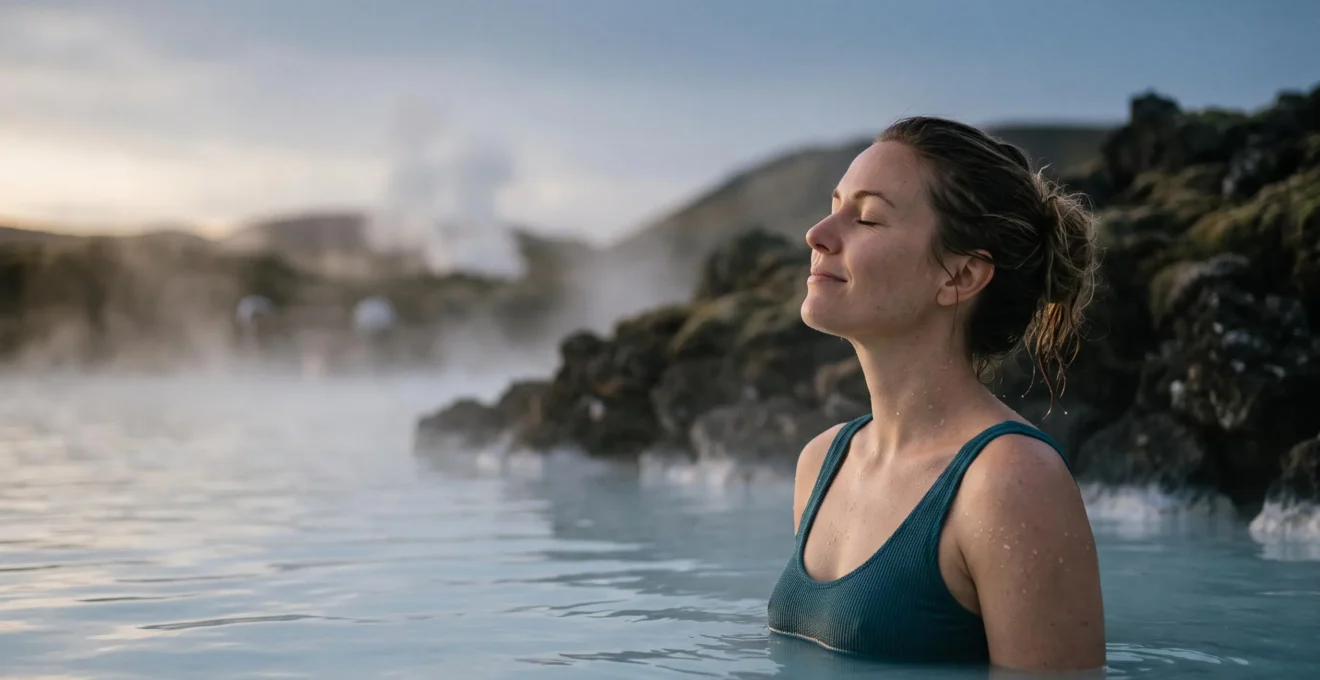
The effectiveness of geothermal therapy for joint pain lies not in the heat alone, but in the specific geochemical signature of the water and mud, which acts as a targeted mineral-delivery system for inflamed tissues.
- Silica-rich water enhances skin penetration, delivering anti-inflammatory compounds deeper than conventional pools.
- Volcanic mud provides sustained, deep-penetrating heat that standard water soaks cannot match, targeting localized joint pain.
- Sulphur, a key mineral in many thermal springs, has been clinically shown to reduce the specific inflammation markers associated with arthritis.
Recommendation: To find effective relief, look beyond generic “hot springs” and seek out therapies whose specific mineral profiles—like silica for skin or sulphur for joints—are matched to your condition.
For those navigating the persistent challenge of joint pain, the allure of a warm, soothing soak is undeniable. Many have tried conventional treatments with limited success, leading them to explore natural alternatives. The world of wellness often points towards geothermal springs, promising relaxation and relief. However, a crucial misunderstanding often sabotages the outcome: the belief that all hot water is created equal. A hotel spa’s heated, chlorinated pool offers temporary comfort, but it lacks the therapeutic engine of a true geothermal source.
The common advice to “soak in mineral water” is a platitude that misses the entire point. It’s akin to telling someone to “eat food” for their health without specifying what kind. The true power of balneotherapy (the treatment of disease by bathing) is rooted in geochemistry. The specific blend of minerals dissolved in the water, a unique “geochemical signature” forged deep within the earth, determines its therapeutic action. But if the key minerals—silica, sulphur, magnesium—can’t effectively penetrate the skin and reach the target tissues, the entire process is futile.
This guide moves beyond the superficial to explore the mechanisms of action. We will dissect why the composition of a spring is more important than its temperature, how different minerals target different ailments, and why volcanic mud offers a completely different, and often more potent, form of thermal therapy. The key is not simply to find heat, but to understand and leverage a targeted mineral-delivery system, turning a passive soak into an active strategy for profound and lasting pain relief.
To navigate this complex topic, this article breaks down the science behind geothermal healing. We will explore the properties of key minerals, the practical methods for maximizing their benefits, and the evidence supporting their use for conditions like arthritis.
Contents: The Science of Geothermal Healing
- Why Silica-Rich Thermal Water Penetrates Skin 40% Deeper Than Chlorinated Pools
- How to Locate Natural Thermal Pools Without Commercial Development
- Volcanic Mud vs Mineral Water Soaking: What Each Treatment Targets
- How to Maximise Mineral Absorption During 30-Minute Thermal Sessions
- The Temperature Misjudgement Causing Skin Irritation in 25% of First-Timers
- Why Basalt Formations Reveal Eruption Temperatures Exceeding 1200°C
- Why Mineral Composition Determines Which Conditions Respond to Water Therapy
- Why Sulphur-Rich Springs Reduce Arthritis Inflammation Within 7 Days
Why Silica-Rich Thermal Water Penetrates Skin 40% Deeper Than Chlorinated Pools
The first barrier to any topical therapy is the skin itself. For the therapeutic minerals in thermal water to be effective, they must first pass through this protective layer. This is where the mineral silica (silicon dioxide) plays a decisive role. Unlike the sterile, chemically treated water of a standard swimming pool, silica-rich thermal water possesses unique properties that enhance its bioavailability. The silica exists in a colloidal form, which means the particles are small enough to interact with the skin’s structure in a way that larger, undissolved particles cannot.
This interaction is not merely passive. Research into the dermatological properties of thermal water demonstrates that silica has a direct biological effect. It helps to calm inflammation and support the repair of a compromised skin barrier, a common issue in conditions like psoriasis and eczema which often accompany joint pain. A healthy barrier is more receptive to mineral uptake. In a study on the effects of silica-rich water on skin, researchers observed an 82.4% inhibition of skin irritation, highlighting its potent anti-inflammatory and barrier-strengthening capabilities. This effect helps create the ideal conditions for other therapeutic minerals to penetrate more effectively.
Furthermore, studies on skin cells have shown that thermal water with a high concentration of sodium and silica can help regulate the life cycle of keratinocytes, the primary cells that make up our epidermis. In hyperkeratotic conditions, these cells multiply too quickly. By modulating their proliferation, silica-rich water helps to restore a more normal, functional skin surface. This dual action—calming irritation and normalizing cell function—is what fundamentally separates a therapeutic soak from a simple hot bath, turning the water itself into an active agent for skin health and mineral delivery.
How to Locate Natural Thermal Pools Without Commercial Development
Finding an authentic geothermal spring, free from the concrete and chlorine of commercial resorts, is the first step toward experiencing इसकी true therapeutic potential. The search requires a blend of geological awareness and modern research tools. These undeveloped pools are often found in regions with a history of volcanic activity, along fault lines, or in areas where the Earth’s crust is thinner, allowing geothermal heat to reach surface water.
Your search should begin online, but not with typical tourism websites. Instead, turn to more specialized resources. Geological survey websites for your region often publish maps of thermal activity and known spring locations. Hiking forums and communities dedicated to outdoor exploration are also invaluable; users often share coordinates and descriptions of remote, natural hot pots. Use search terms like “wild hot spring,” “primitive thermal pool,” or “natural hot pot” along with the geographic area you wish to explore. These keywords will help filter out the commercial spas and resorts.
Once you have a potential location, cross-reference it with satellite imagery on platforms like Google Earth. Look for tell-tale signs: steam rising from a riverbank, unique mineral deposits (often white, yellow, or reddish-orange) staining the surrounding rocks, or patches of melted snow in an otherwise frozen landscape. While some may wonder about the potability of this water, it is crucial to exercise extreme caution. The focus of this therapy is transdermal absorption, not ingestion, as mineral content and bacteria levels are unknown and potentially harmful if consumed. Always filter and treat any water from natural sources before drinking.
Volcanic Mud vs Mineral Water Soaking: What Each Treatment Targets
While often grouped together, volcanic mud therapy (pelotherapy) and mineral water soaking (balneotherapy) are distinct treatments with different mechanisms of action. Understanding their differences is key to choosing the right therapy for your specific condition. A mineral water soak is primarily a vehicle for transdermal mineral absorption across the entire body, while a mud treatment is a tool for delivering deep, sustained, and localized heat.
Volcanic mud, or peloid, is a mixture of mineral-rich earth and geothermal water that has matured over many years. Its therapeutic power comes from its unique thermodynamic properties. A double-blind trial on patients with knee osteoarthritis, published in a journal indexed by the National Center for Biotechnology Information, highlighted that medical muds have a high heat retention and low heat conduction capacity. This means that when a hot mud pack is applied, it transfers its heat to the body very slowly and evenly, allowing it to penetrate deep into the muscle and joint tissue without causing superficial skin burns. This deep, endogenous heat formation is profoundly effective for localized, chronic inflammation like that found in an arthritic knee or a sore lower back.
Case Study: Targeted Heat for Knee Osteoarthritis
In a controlled trial, 60 patients with knee osteoarthritis were treated with hot mud packs for two weeks. The researchers noted that this method provokes endogenous heat formation without burning the skin, leading to significant clinical improvements. This demonstrates the unique value of mud’s thermodynamic properties for targeting joint-specific inflammation, something a simple water soak cannot replicate.
A mineral water soak, by contrast, involves faster heat exchange and a shallower depth of penetration. Its primary strength is in delivering dissolved minerals like sulphur, magnesium, and silica to the entire surface of the skin. It is best suited for systemic benefits, supporting the skin barrier, and providing a gentler, whole-body anti-inflammatory effect. The choice between them is strategic: for a painful, specific joint, mud is superior; for overall skin health and widespread, milder aches, mineral water is the preferred modality.
| Criteria | Volcanic Mud (Peloid) | Mineral Water Soak |
|---|---|---|
| Primary mechanism | Adsorption + deep heat conduction | Transdermal mineral absorption |
| Heat behaviour | High retention, slow homogeneous release to tissue | Faster heat exchange, shallower penetration |
| Clinical guideline status | Class IIa recommendation for knee osteoarthritis (ISMH 2024) | Used as complementary balneotherapy modality |
| Best suited for | Localised joint/muscle inflammation, chronic rheumatic pain | Whole-body mineral uptake, skin barrier support |
How to Maximise Mineral Absorption During 30-Minute Thermal Sessions
Stepping into a thermal spring is only the beginning. To transform a simple soak into a therapeutic session, you must create the optimal conditions for mineral absorption. The biological activity of thermal water depends directly on its ionic composition, but as research has confirmed, these minerals must reach viable skin layers to exert their beneficial effects. The duration of your soak is a critical factor; sessions are typically recommended to last between 20 to 30 minutes. This provides enough time for therapeutic effects to begin without over-exposing the skin to heat.
Before you even enter the water, a simple preparation step can significantly enhance uptake. Gently exfoliating the skin with a soft brush or cloth removes dead skin cells that can impede mineral penetration. This creates a clearer pathway for the ions in the water to interact with the living layers of the epidermis. During the soak, gentle movement is key. Slowly moving your arms and legs or lightly massaging sore joints encourages circulation, both in the water around you and at the skin’s surface, constantly refreshing the layer of mineral-rich water in direct contact with your body.
It is important to approach this with a nuanced understanding. While the localized, dermal effects of these minerals are well-documented for skin conditions, the idea of them entering the bloodstream and affecting the whole body is debated. As the authors of a comprehensive review in the International Journal of Biometeorology state:
There is no evidence of the absorption of minerals from thermal water into the circulatory system.
– International Journal of Biometeorology review authors, Comprehensive review of dermatological and cosmeceutical manifestations of thermal water and future insights
This expert conclusion suggests the primary benefits for joint pain likely come from a combination of the heat and the local anti-inflammatory effects of minerals acting on and just below the skin, rather than from systemic absorption. Therefore, maximizing your session is about optimizing this local, targeted delivery.
Action Plan: Maximizing Your Thermal Soak
- Preparation: About an hour before your soak, drink a large glass of water to ensure you are well-hydrated. Avoid applying any lotions, creams, or oils to your skin, as they can create a barrier.
- Pre-Soak Exfoliation: Just before entering the water, use a dry brush or a rough towel to gently exfoliate your entire body. Focus on areas with thicker skin like elbows, knees, and feet.
- During the Soak: Enter the water slowly. For the first 10 minutes, remain relatively still to allow your body to acclimatize. For the next 15-20 minutes, perform gentle movements or self-massage on sore joints to encourage circulation.
- Post-Soak Rinse: After exiting the water, rinse with cool, clean water if available, but avoid using soap. Gently pat your skin dry, leaving it slightly damp to allow some of the mineral residue to remain on the surface.
- Rest and Rehydrate: Rest for at least 20-30 minutes after your session. Your body has undergone a therapeutic process. Drink another glass of water to continue rehydrating from the inside out.
The Temperature Misjudgement Causing Skin Irritation in 25% of First-Timers
While the title of this section points to a specific statistic, the underlying principle is a universal and critical aspect of safe balneotherapy: temperature matters immensely. Misjudging the water temperature is one of the most common mistakes newcomers make, leading to outcomes that range from ineffective to dangerous. The therapeutic window for geothermal water is generally considered to be between 37°C and 40°C (98°F and 104°F). Below this range, the heat may not be sufficient to induce the desired physiological effects, such as vasodilation and muscle relaxation. Above this range, the risk of skin irritation, burns, and cardiovascular stress increases significantly.
The first type of misjudgment is assuming “hotter is better.” Eager for relief, a person might seek out the hottest part of a spring, enduring discomfort in the belief that it will be more effective. This is a serious error. Excessive heat can trigger an inflammatory response in the skin, causing redness, itching, and irritation that negates the anti-inflammatory benefits of the minerals. For individuals with pre-existing skin conditions or sensitive skin, this can lead to a significant flare-up. It’s crucial to listen to your body; the water should feel very warm and deeply comforting, but never painfully hot.
The second, more subtle misjudgment is underestimation. In a natural setting, the temperature of a pool can vary significantly from one spot to another. An edge fed by a cool stream will be much less therapeutic than the area near the geothermal source. Before settling in for a 20-minute soak, it’s essential to test different parts of the pool with your hand or foot to find a location that sits comfortably within the optimal therapeutic range. A waterproof thermometer can be a valuable tool for those who want to be precise and ensure both safety and efficacy during their sessions.
Why Basalt Formations Reveal Eruption Temperatures Exceeding 1200°C
The dark, often hexagonal columns of basalt rock that characterize many volcanic landscapes are more than just dramatic scenery. They are a geological testament to the immense power and extreme temperatures from which geothermal therapies are born. Basalt is a type of igneous rock that forms from the rapid cooling of lava. The key to its story lies in its fine-grained texture. When magma erupts as lava, it can reach temperatures well in excess of 1,200°C (2,200°F).
At these extreme temperatures, all minerals are in a molten, liquid state. As the lava flows and cools, these minerals begin to crystallize. The size of the crystals that form is directly related to the cooling speed. If the lava cools slowly, deep underground, large, visible crystals have time to grow, forming rocks like granite. However, when lava cools rapidly upon exposure to the air or water at the surface, the crystals have very little time to form. The resulting rock, basalt, is so fine-grained that individual crystals are often not visible to the naked eye. This texture is a direct signature of rapid cooling from an extremely hot liquid state.
This geological fact provides a powerful context for geothermal therapy. The water and mud used in these treatments are heated by the same magmatic engine that once produced these incredible temperatures. The mineral composition of the water is a direct result of it percolating through these volcanic rocks, dissolving their elemental components over millennia. Soaking in a geothermal spring is, in a very real sense, connecting with the residual energy of an ancient eruption, a process that began at temperatures capable of melting rock.
Why Mineral Composition Determines Which Conditions Respond to Water Therapy
The central thesis of modern balneotherapy is that not all springs are created equal. The therapeutic outcome of a geothermal soak is determined less by its temperature and more by its specific geochemical signature. A spring rich in sulphur will have a different effect than one rich in silica or bicarbonate. This is why historical spa towns were often famous for treating specific ailments; their local water source happened to have the right mineral profile for that condition. Today, science is beginning to validate these historical observations, moving toward a future of “precision balneotherapy.”
The core question is how this works. Do the benefits come from a single dominant mineral, or from the synergistic effect of the entire composition? While a high concentration of a particular mineral like sulphur is a strong indicator of its likely use for arthritis, researchers increasingly believe that the full spectrum of dissolved solids, including trace elements, plays a role. The interactions between these minerals, and even with the natural microbiome of the skin, may be what truly drives the anti-inflammatory and healing effects. This is a paradigm shift away from a simplistic “one mineral, one disease” model.
This new approach seeks to transform balneotherapy from an observational art into an evidence-based science. The goal is to create a framework where a patient’s condition can be matched to a geothermal source with the optimal mineral profile. This would involve detailed analysis of both the patient’s specific type of inflammation and the precise ionic makeup of the water. While much of this is still in the research phase, it points to a future where a prescription might not be for a pill, but for a two-week course of bathing in a specific, medically-validated thermal spring. The focus is shifting from generic wellness to targeted, personalized therapy based on hard data.
Key Takeaways
- The therapeutic power of a geothermal source is defined by its unique “geochemical signature,” not just its heat.
- Different minerals target different conditions: silica supports the skin barrier, while sulphur directly addresses joint inflammation.
- Volcanic mud and mineral water are distinct therapies; mud delivers deep, localized heat, while water is for whole-body mineral exposure.
Why Sulphur-Rich Springs Reduce Arthritis Inflammation Within 7 Days
For those suffering from arthritis, particularly rheumatoid arthritis (RA), sulphur is one of the most important minerals to look for in a geothermal spring. The characteristic “rotten egg” smell of many hot springs is the sign of hydrogen sulphide gas, indicating a high concentration of this potent anti-inflammatory element. The evidence supporting the use of sulphur-rich water and mud for arthritic conditions is robust and growing, offering a science-backed ray of hope.
Sulphur is a critical component of human connective tissue, including cartilage, tendons, and ligaments. The theory is that by absorbing sulphur transdermally, the body gains access to a key building block for joint repair. More importantly, sulphur appears to have a direct impact on the inflammatory process itself. A systematic review of eight randomized controlled trials covering 496 patients with RA found that balneotherapy provided significant benefits in pain reduction and improved function. Another study noted that sulphide balneotherapy led to a significant reduction in white blood cell and neutrophil counts, which are key markers of systemic inflammation.
A compelling controlled study conducted in Israel provides a clear picture of its efficacy. In the trial, 40 patients with acute RA were divided into groups receiving daily hot mud packs, daily sulphur baths, a combination of both, or their usual medication as a control. The results were unequivocal: the groups receiving mud and balneotherapy showed a significant improvement in symptoms and clinical indices compared to the control group, with no adverse effects. This demonstrates that sulphur-based therapies are not just a placebo; they produce measurable, positive changes in the clinical course of arthritis.
| Spring / Study Water | Sulphide Concentration | Reported Outcome |
|---|---|---|
| Osteoarthritis hip study water | 13.2 mg/L | Significant decrease in pain and stiffness, improved function |
| Saratoga natural hot springs | 191 mg/L | Historically used for psoriasis, eczema and joint inflammation |
| SZHR sulfide balneotherapy cohort | Not specified (3-week course) | Significant reduction in white blood cell and neutrophil counts |
Now that you understand the science that separates a simple hot bath from a targeted therapeutic treatment, the next step is to seek out these specific geothermal sources. Instead of looking for just any “hot spring,” begin searching for silica-rich waters for skin support or, for those with joint pain, sulphur-rich springs and peloid therapy centers. Your journey to relief begins with asking the right questions and demanding a therapy as sophisticated as your condition.
Frequently Asked Questions About Geothermal Water Therapy
Does a single mineral determine a spring’s therapeutic effect, or does the full composition matter?
This is an open scientific question. While a high concentration of one mineral (like sulphur) is a strong indicator of its primary use, researchers suggest the therapeutic outcome is likely driven by the synergistic signature of multiple minerals working together. Key research is now focused on identifying which molecular pathways are affected by these complex mineral interactions, rather than focusing on one mineral alone.
Is balneotherapy already considered evidence-based for matching mineral profiles to conditions?
Not yet fully. While there is strong evidence for specific applications (like sulphur for arthritis), scientists argue that future research must move beyond observational data. The goal is to conduct controlled molecular studies that clarify host-mineral-microbe interactions, which will be the final step in transforming traditional balneotherapy into a form of evidence-based precision medicine.