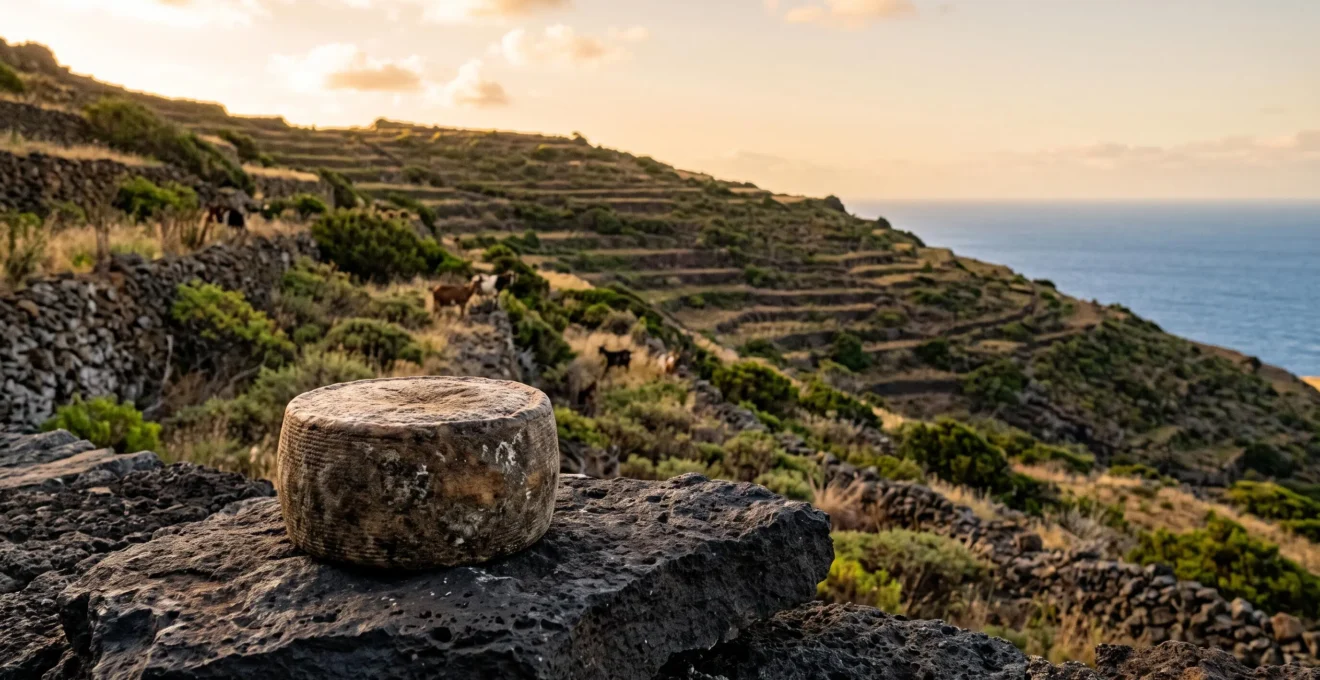
Canarian cheese excellence is not an accident; it is a direct result of a verifiable ‘triangle of quality’ that judges can measure.
- The islands’ unique volcanic geology directly enriches the goat milk with a mineral and fatty acid profile impossible to replicate elsewhere.
- Strict Protected Designation of Origin (PDO) rules act as a legal guarantee of breed, process, and provenance, eliminating inconsistencies.
Recommendation: When selecting a Canarian cheese, look for the official PDO seal—it is your single most reliable indicator of award-winning potential and authentic taste.
For any connoisseur following the Spanish national dairy awards, a startling pattern emerges year after year: a disproportionate number of accolades go to cheeses from the Canary Islands. It’s easy to dismiss this as subjective preference, to simply say they “taste good.” But from a judge’s perspective, taste is the result of verifiable criteria. The dominance of Canarian cheese is not a matter of luck; it is the predictable outcome of a unique terroir that begins deep within the Earth’s crust.
Many guides will point you towards the classic pairings with local wines or the famous papas arrugadas (wrinkled potatoes). While delicious, these accompaniments are secondary to the core product. The real secret lies in a concept I call the ‘triangle of excellence’: the inseparable link between the volcanic mineral-rich soil, the specific genetics of the goats feeding on it, and the rigorous production standards codified by law. Understanding this triangle is the key to appreciating why these cheeses are not just different, but objectively superior in their category.
This is not another simple travel guide. This is a judge’s breakdown of the evidence. We will move beyond vague descriptors and delve into the science of the soil, the chemistry of the milk, and the legal framework of the Protected Designations of Origin (PDO). We will explore how maturation transforms simple milk into a complex tapestry of flavours and how to identify true authenticity. Ultimately, you will learn to see, and taste, Canarian cheese through the eyes of a competition judge—recognizing the credentials that make it a consistent champion.
This analysis will deconstruct the elements that contribute to this consistent, award-winning quality. The following sections break down each component, from the foundational geology to the final product you can taste and verify for yourself.
Summary: The Judge’s Guide to Canarian Cheese Excellence
- Why Volcanic Pasture Creates Unique Fatty Acid Profiles in Goat Milk
- How to Visit Award-Winning Queserías Offering Tasting Sessions
- Fresh Queso Blanco vs Aged Curado: What Maturation Achieves in Flavour Complexity?
- How to Identify Authenticity Using PDO Labels and Producer Certifications
- The Storage Temperature Mistake Spoiling 70% of Purchased Artisanal Cheese
- Why Basaltic Weathering Releases Trace Minerals Absent From Sedimentary Soils
- Why PDO Certification Preserves Heirloom Potato Varieties From Industrial Displacement
- Why Papas Arrugadas Require Specific Atlantic Salt Concentrations
Why Volcanic Pasture Creates Unique Fatty Acid Profiles in Goat Milk
The first point of quality control for any cheese is the milk, and Canarian goat milk possesses a chemical signature that is nearly impossible to replicate. This begins with the pastureland, which is rooted in volcanic, not sedimentary, soil. This geological distinction is the foundation of the cheese’s unique character. The goats, particularly the native Majorera and Palmera breeds, graze on hardy vegetation that draws a unique profile of minerals directly from the basaltic rock beneath.
This “geochemical signature” is then expressed in the milk itself. Specifically, it influences the composition of fatty acids. For instance, Spanish researchers have found that goat milk naturally contains a higher concentration of medium-chain triglycerides (MCTs) than cow milk, which are easier to digest and contribute to a distinctive creamy texture. In the Canary Islands, the unique diet of the goats, enriched by mineral-rich flora, further enhances this profile, lending a subtle, almost nutty flavour that judges can distinguish even in the freshest cheeses. Some PDO regulations insist on raw, unpasteurised milk for certain cheeses, preserving this delicate and unique biochemical fingerprint from pasture to palate.
This direct transfer of terroir into biochemistry is the first piece of evidence in a judge’s notebook. It is a tangible quality advantage that sets the baseline for excellence before the cheesemaking process even begins. The milk is not just an ingredient; it is a concentrated expression of the island’s unique geology.
How to Visit Award-Winning Queserías Offering Tasting Sessions
Appreciating award-winning cheese requires more than just reading about it; it demands a “credentialed tasting” at the source. Visiting a quesería (cheese dairy) in the Canary Islands is not a typical tourist excursion. It is an opportunity to witness the ‘triangle of quality’ in action and taste products that have been validated by expert panels. The key is to target producers within the three main cheese PDOs: Queso Majorero, Queso Palmero, and Queso de Flor de Guía.
Many award-winning farms are small, family-run operations and offer tasting sessions by appointment. A well-planned itinerary can become a gastronomic pilgrimage. For example, National Geographic’s guide to the islands highlights how a journey can be built around these tastes, suggesting a stop on La Gomera to try almogrote, a tangy cheese paste, paired with a local white wine. This illustrates how even a small detour can provide a unique tasting context. Your visit should be structured around these PDO regions, starting in Fuerteventura for Majorero, the first Spanish goat cheese to receive PDO status, and then exploring Gran Canaria or La Palma for their distinct offerings.
When you visit, you are not just a customer; you are an observer verifying authenticity. Ask about the goat breed, whether the milk is raw or pasteurised, and how the rennet is sourced. This is your chance to connect the theory of terroir with the tangible practice of artisan production, transforming your understanding of the cheese from a simple food item to a piece of cultural and geological heritage.
Your Action Plan: Planning Your Quesería Visit
- Identify target regions: First, decide which of the three main PDOs you want to explore—DOP Queso Majorero (Fuerteventura), DOP Queso Palmero (La Palma), or DOP Queso de Flor de Guía (Gran Canaria).
- Research certified producers: Use the official PDO council websites or tourism boards to find a list of registered queserías that offer tours and tastings. Prioritize those with recent national or international awards.
- Book in advance: Contact your chosen producers directly via email or phone. Many are small operations and require appointments, especially for English-language tours. Specify you are interested in a guided tasting.
- Prepare your questions: Go beyond “is it good?”. Ask about the specific goat breed, the use of raw milk, the type of rennet (animal vs. vegetable), and aging times. This shows respect and deepens your understanding.
- Purchase from the source: Buying directly from the farm guarantees authenticity and supports the artisans preserving these traditions. This is the best way to bring a piece of verifiable quality home.
Fresh Queso Blanco vs Aged Curado: What Maturation Achieves in Flavour Complexity?
When tasting Canarian cheeses, you will encounter a spectrum of ages, from fresh and milky (tierno or queso blanco) to semi-cured (semicurado) and fully aged (curado). From a judge’s standpoint, maturation is a transformative process that creates measurable complexity. While a fresh cheese showcases the pure quality of the milk, an aged cheese demonstrates the cheesemaker’s skill in controlling chemistry and time.
A fresh queso blanco is soft, moist, and has a clean, lactic, and slightly salty taste, directly reflecting the quality of the goat’s milk. It’s the purest expression of the terroir. As the cheese ages, a process of controlled dehydration and enzymatic action begins. Moisture evaporates, concentrating the fats and proteins. Enzymes, either from the milk itself or the rennet, break down these larger molecules into smaller, more volatile compounds that we perceive as complex aromas and flavours. This is what judges refer to as flavour development.
In a well-aged curado, you can expect a firmer, more brittle texture. The flavour deepens, evolving from simple milkiness to a symphony of nutty, buttery, and sometimes spicy notes. You may even notice tiny, crunchy crystals within the paste. These are tyrosine crystals, amino acids that form during prolonged aging and are a hallmark of a well-matured, high-quality cheese. This transition from a simple, fresh product to a complex, aged one is a masterclass in food science, all happening within the quiet, cool walls of the aging cellar (cava de maduración).
How to Identify Authenticity Using PDO Labels and Producer Certifications
In a market with many “Canarian-style” imitations, the Protected Designation of Origin (PDO), or Denominación de Origen Protegida (DOP) in Spanish, is a consumer’s—and a judge’s—most crucial tool. It is not a marketing gimmick; it is a legally binding quality contract. A PDO label guarantees that the cheese was produced in a specific geographical area, using milk from specific local breeds, and following a strict, traditional method that has been officially registered and is subject to inspection.
The Canary Islands are home to three cheese PDOs, each with its own non-negotiable rules that create a distinct and verifiable product. For example, DOP Queso Majorero must be made primarily from the milk of the Majorera goat on the island of Fuerteventura. In contrast, DOP Queso de Flor de Guía from Gran Canaria is unique for its use of thistle flower as a vegetable rennet. When you see the official red and yellow PDO seal, you know these rules have been followed. Many authentic cheeses, like Majorero, also feature a rind coated in paprika (pimentón) or roasted barley flour (gofio), which acts as a traditional preservative and adds flavour. While the rind is edible, its texture can be coarse, so it’s a matter of personal preference.
This table summarizes the core guarantees provided by each of the three main Canarian cheese PDOs, offering a clear guide to what a judge looks for in terms of authenticity and adherence to standards.
| PDO / Cheese | Main Island | Milk Base | Distinctive Guarantee |
|---|---|---|---|
| D.O.P. Queso Majorero | Fuerteventura | Majorera goat milk (up to 15% Canarian sheep milk allowed) | First goat cheese to obtain PDO status in Spain (1996); recognizable paprika coating and braided rind impression |
| D.O.P. Queso de Flor de Guía | Gran Canaria | Base of 60% sheep’s milk mixed with cow’s or goat’s milk | Curdled using thistle flower rather than animal rennet |
| D.O.P. Queso Palmero | La Palma | Palmera goat milk | Tied to the native Palmera breed and the island’s volcanic grazing land |
Case Study: Grupo Ganaderos de Fuerteventura
A prime example of this system in practice is the Grupo Ganaderos de Fuerteventura. As a producer specializing in cheese from goat and sheep milk, they combine traditional methods with modern technology. Crucially, their flagship Majorero cheese is protected under PDO status. The company also emphasizes sustainable farming practices. This combination of official PDO registration and a traceable, sustainable production model is exactly what distinguishes genuine artisanal cheese from generic imitations and provides the verifiable credentials that judges look for.
The Storage Temperature Mistake Spoiling 70% of Purchased Artisanal Cheese
After investing in a high-quality, award-winning Canarian cheese, the final step is preserving its integrity until the moment of tasting. Unfortunately, this is where many connoisseurs make a critical error. The most common mistake is treating artisanal cheese like a block of industrial cheddar: wrapping it in plastic and placing it in the coldest part of the refrigerator. This effectively suffocates the cheese and ruins the very complexity you paid for.
Artisanal cheese is a living product. It needs to breathe. As Joey Wells, a global cheese expert for Whole Foods Market, stated emphatically in The Daily Meal:
Cheese needs air and humidity to breathe, so you should never wrap it at home in plastic wrap, which is a full barrier.
– Joey Wells, The Daily Meal
Plastic wrap traps moisture and ammonia, leading to off-flavours and promoting the growth of bad bacteria. The ideal environment for cheese is cool and humid, mimicking the cellars in which it was aged. The goal is to maintain a recommended relative humidity of around 85%, which is far from the dry, cold air in a standard fridge.
The best practice is to use dedicated cheese paper or wrap the cheese in parchment paper and then place it in a partially sealed container or a specific drawer in your fridge. The vegetable crisper is often the best compromise, as it’s the most humid and least cold part of the appliance. Proper storage is the final act of respect for the cheesemaker’s craft.
Your Action Plan: Auditing Your Home Cheese Storage
- Check your environment: The cheese should be in the warmest, most humid part of your refrigerator, typically a vegetable crisper drawer. Never store it on a cold, dry shelf.
- Inventory your materials: Discard the plastic wrap. Use specialized cheese paper, or alternatively, wrap the cheese first in parchment paper, then place it loosely in a plastic bag or container.
- Establish a routine: For larger pieces of hard cheese, turn them over once every few days. This helps the cheese to breathe evenly and prevents moisture from pooling on one surface.
- Perform regular inspections: Before serving, smell the cheese. A strong smell of ammonia is a warning sign of suffocation. Check for any mold that is not part of the cheese’s original character (e.g., blue veins in a goat cheese).
- Create an intervention plan: If unwanted surface mold appears on a hard cheese like a curado, it is safe to cut it off with a generous margin (about 1 inch). For soft, fresh cheeses, any new mold means the cheese must be discarded.
Why Basaltic Weathering Releases Trace Minerals Absent From Sedimentary Soils
To truly understand the “geochemical signature” of Canarian cheese, we must go deeper than the pasture—to the rock itself. The Canary Islands are volcanic, not continental. Their soil is not the result of millennia of eroded sedimentary rock like limestone or sandstone, which are common in mainland Europe. Instead, it is born from weathered basalt, an igneous rock forged in fire.
This is a critical distinction. Sedimentary soils are often rich in calcium, but can be lacking in other essential trace minerals. Basalt, on the other hand, is a treasure trove of elements like iron, magnesium, and manganese. The process of basaltic weathering, where wind and rain slowly break down the rock, releases these minerals into the soil. While this volcanic soil is often low in organic matter, agronomic studies confirm its richness in these basaltic mineral elements. These are the same minerals that are often absent or less available in mainland pastures.
This geological privilege is not just theoretical; it has been documented as a defining feature of the islands’ agriculture. Studies on the “Papas Antiguas de Canarias” PDO, for instance, note that the crops have adapted to the climate and possess unique features due to this very specific environment. The same geological foundation that creates a “privileged haven” for heirloom potatoes is what feeds the pastures for the goats. The plants absorb these trace minerals, the goats consume the plants, and the minerals become bioavailable in their milk, ultimately contributing a complexity and depth of flavour to the cheese that simply cannot be sourced from a different geology.
Why PDO Certification Preserves Heirloom Potato Varieties From Industrial Displacement
The story of the Canary Islands’ heirloom potatoes, or papas antiguas, provides a powerful parallel to the world of cheese and demonstrates the critical role of PDO certification in protecting agricultural heritage. Before the establishment of their own PDO, these unique, small, and often knobby potato varieties were at risk of being completely displaced by high-yield, visually uniform industrial potatoes favoured by large-scale supermarkets.
The “Papas Antiguas de Canarias” PDO, established in 2013, was a deliberate act of preservation. By legally protecting these varieties, the PDO created a premium market for them, linking their unique identity directly to a specific culinary use: the famous papas arrugadas. As a result of this protection, official records show that a total of 46 historic varieties are now safeguarded, of which 29 are genetically unique to the islands. Without the PDO, many of these would likely have vanished.
This case study is a perfect model for what PDO status achieves. It shows how origin, specific agronomy, and traditional practices create value for a product that might otherwise be deemed commercially unviable. It formalizes and protects the very “-terroir” that makes a product special. Just as the potato PDO saved dozens of heirloom varieties from extinction, the cheese PDOs for Majorero, Palmero, and Flor de Guía protect specific goat breeds, raw milk production, and artisanal techniques from the pressures of industrial homogenization. The PDO is, therefore, not just a label; it is an active and essential shield for biodiversity and tradition.
Key Takeaways
- The excellence of Canarian cheese is rooted in the unique mineral profile of its volcanic soil, which directly enriches the goat milk.
- Protected Designation of Origin (PDO) labels are not just for marketing; they are legal guarantees of authenticity, breed, and traditional methods.
- Proper storage is critical; never use plastic wrap, and store cheese in the most humid part of your refrigerator to allow it to breathe.
Why Papas Arrugadas Require Specific Atlantic Salt Concentrations
The final piece of the Canarian gastronomic puzzle, and a frequent companion to its cheeses, is the humble yet iconic papas arrugadas. The “wrinkled potatoes” are a testament to the islanders’ genius for creating profound flavour from simple, local ingredients. The secret to their unique, salty crust and tender interior lies not just in the potato variety but in the very specific cooking method dictated by the island’s geography: the use of highly saline water.
The origin story of the dish is rooted in practicality. On islands with a historical scarcity of fresh water, it made sense to use what was abundant: seawater. Cooks would boil the small, unpeeled potatoes in water as salty as the Atlantic. After cooking, the water is drained, and the potatoes are returned to the hot pot for a few moments. This crucial step allows the remaining moisture on their skins to evaporate instantly, leaving behind a delicate, crystalline crust of salt. This is what creates the signature “wrinkle.”
This method only works perfectly with the small, waxy papas antiguas. Their thin skins allow the salt to form a crust without penetrating too deeply and overpowering the potato’s own nutty, earthy flavour—a flavour which, of course, also comes from that same volcanic soil. The process is a perfect harmony of geology (the potato) and oceanography (the salt), creating a side dish that is as deeply rooted in its environment as the cheeses it so often accompanies. It’s a final, delicious piece of evidence for the power of Canarian terroir.
Now that you understand the full ‘triangle of excellence’—from the basaltic soil to the protected production methods—you are equipped to taste Canarian cheese not as a tourist, but as a connoisseur. You can identify the credentials, appreciate the complexity born from maturation, and respect the heritage preserved by the PDO system. This is how you find the consistent, award-winning quality that sets these cheeses apart on a national stage.