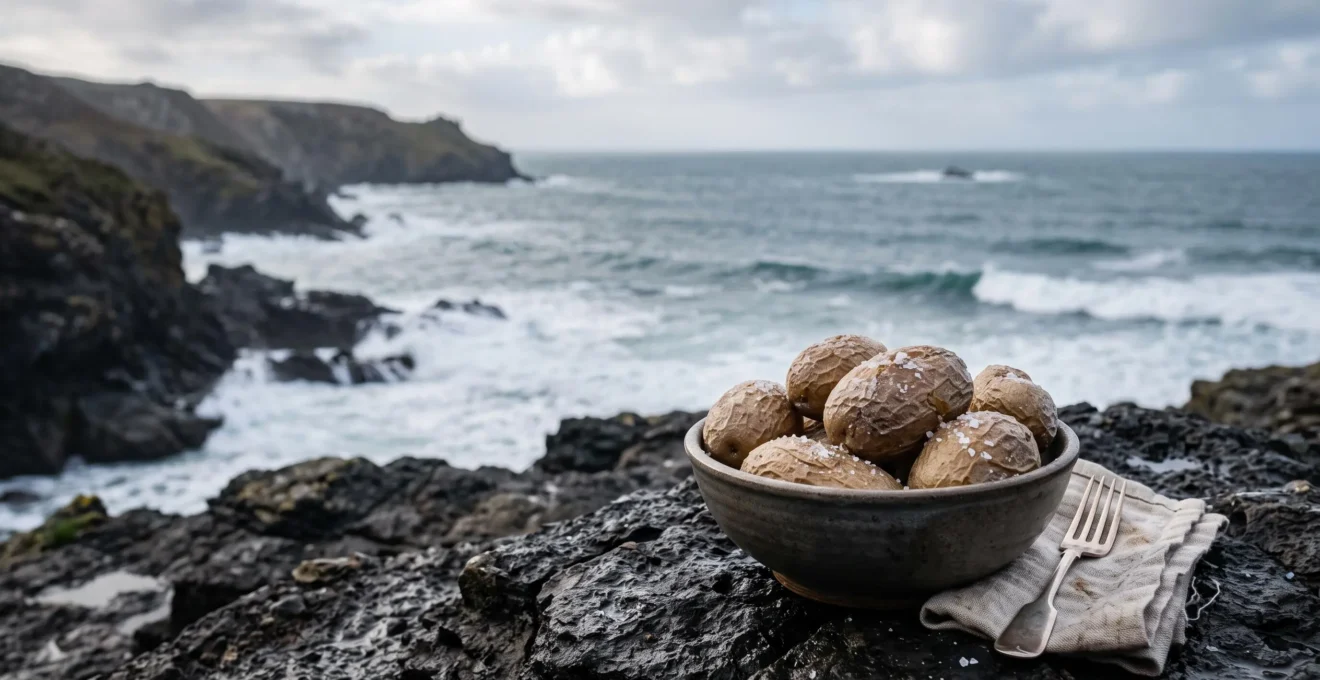
Authentic Papas Arrugadas are not a product of simple cooking, but a legally protected expression of the Canary Islands’ unique terroir, where specific potato genetics and volcanic soil mineralogy are made manifest by a precise salt crusting technique.
- The “Papas Antiguas de Canarias” PDO status is an economic and ecological necessity, protecting ancient varieties from industrial displacement and invasive pests.
- The characteristic wrinkled, salt-crusted skin is achieved not just by boiling in salty water, but by a final dry-heat crystallization step that most imitations omit.
Recommendation: To experience this dish authentically, look beyond the recipe and seek to understand the legally certified components—from the specific potato variety to the mineral-rich salt—that define its protected status.
For the discerning culinary traveler, certain dishes transcend their ingredient list to become a pure expression of place. Papas Arrugadas, the “wrinkled potatoes” of the Canary Islands, are a paramount example. Many guides offer a simplistic recipe: boil small potatoes in salty water. This approach, however, misses the entire point. It’s like suggesting a fine wine is just fermented grape juice. The true essence of this dish lies not in a generic method, but in a legally defined and geologically unique ecosystem.
The conversation around Papas Arrugadas must move beyond the kitchen and into the realm of agricultural heritage and geographical indication. The real story involves the Protected Designation of Origin (PDO), the specific mineralogy of volcanic soils, the precise saline concentration of the Atlantic, and heirloom potato varieties that trace their lineage back centuries. This is not merely a recipe; it is a certification of authenticity, a taste of legally protected terroir.
This guide departs from simple instruction. Instead, it offers an analysis through the lens of a PDO specialist. We will deconstruct the elements that make this dish inimitable, exploring why the soil, the salt, and the potato itself are non-negotiable components of an authentic experience. Understanding these foundations is the only way to truly appreciate this cornerstone of Canarian gastronomy and distinguish the genuine article from a pale imitation.
To fully grasp the complexity and heritage encapsulated in this dish, this guide examines each critical component. From the legal protections preserving ancient potato genes to the specific geological and botanical elements that define its flavour, the following sections provide a comprehensive certification of what makes Papas Arrugadas a true culinary treasure.
Summary: Why Papas Arrugadas Are a Certified Taste of Canarian Terroir
- Why PDO Certification Preserves Heirloom Potato Varieties from Industrial Displacement
- How to Identify Authentic Preparation Using Seawater Versus Table Salt
- Black Wrinkled Potatoes vs White Varieties: What Soil Conditions Determine Colour?
- How to Prepare Papas Arrugadas at Home Replicating Island Salt Concentrations
- The Boiling Mistake That Prevents Proper Salt Crust Formation in 80% of Attempts
- Why Basaltic Weathering Releases Trace Minerals Absent from Sedimentary Soils
- Why Endemic Pepper Varieties Deliver Heat Profiles Distinct from Mainland Chillies
- Why Mojo Picón Contains 12 Ingredients Unavailable Outside Atlantic Islands
Why PDO Certification Preserves Heirloom Potato Varieties from Industrial Displacement
The foundation of authentic Papas Arrugadas is the potato itself, and not just any potato will do. The ‘Papas Antiguas de Canarias’ hold a coveted Protected Designation of Origin (PDO) status from the European Union, a legal shield that is crucial for their survival. This certification is far from a simple marketing label; it is an active conservation tool. Officially, the PDO protects a total of 29 heirloom varieties, each with a unique history, texture, and flavour profile developed over centuries of cultivation in the islands’ specific microclimates.
This legal protection provides a vital economic incentive for farmers to continue cultivating these often low-yield, labor-intensive varieties. Without the premium price and prestige afforded by the PDO, the temptation to switch to high-yield, disease-resistant industrial cultivars would be overwhelming. The threat is not hypothetical. The arrival of pests like the Guatemalan potato moth in 1999, which caused devastating crop losses, illustrates the fragility of this agricultural ecosystem. The PDO framework supports the investment in protective measures and traditional farming practices necessary to safeguard this biodiversity.
Ultimately, the PDO ensures that when you eat a certified ‘Papa Antigua’, you are tasting a piece of living history. It guarantees that the potato has been grown in its traditional soil, using ancestral knowledge, and possesses the genetic heritage that makes the final dish inimitable. This certification is the first and most important mark of authenticity, a bulwark against the homogenizing forces of industrial agriculture.
How to Identify Authentic Preparation Using Seawater Versus Table Salt
The second pillar of authenticity lies in the cooking medium: the salt. Historically, Canarian fishermen cooked their potatoes in pots of clean seawater directly on their boats. This practice is the origin of the dish’s signature salinity. Modern preparations replicate this with coarse sea salt, but the principle remains the same: the salt must be unrefined and rich in a complex profile of minerals. Using iodized table salt is a fundamental misunderstanding of the dish’s chemistry and flavor.
As experts in salt mineralogy explain, the difference is profound. As noted by Santa Prisca & Co in their analysis of sea salt composition:
True sea salt offers a complex mineral profile with elements like magnesium and potassium, which create a more nuanced flavor and support your body’s natural balance in ways refined table salt cannot.
– Santa Prisca & Co, Minerals in Sea Salt: What You Need to Know
This mineral complexity is what distinguishes the taste. An authentic preparation results in a crust that is intensely savory but not harshly “salty.” The magnesium and other trace elements in Atlantic sea salt contribute subtle bitter and sweet notes that balance the pure sodium chloride. You can often identify a genuine preparation by sight. The salt crust should appear as a delicate, flaky, and slightly uneven white powder coating the wrinkled skin, not a uniform, gritty layer.
This macro view reveals the nature of a proper salt crust. The crystals are irregular and cling to the potato’s surface, a direct result of the evaporation of mineral-rich water. This is the visual signature of a process that respects the traditional use of unrefined Atlantic sea salt, a crucial step in certifying the dish’s authenticity.
Black Wrinkled Potatoes vs White Varieties: What Soil Conditions Determine Colour?
Within the family of ‘Papas Antiguas de Canarias’, one finds a spectrum of colors, from the pale ‘Papa Blanca’ to the striking, dark-skinned ‘Papa Negra’. A common misconception is that this color difference is dictated by the volcanic soil itself. However, the role of the soil is more complex and foundational. Soil conditions determine the potato’s texture and mineral uptake, but its color is a matter of pure genetics.
The volcanic soil of the Canary Islands is uniquely suited to cultivating these heirloom varieties. Characterized by a high concentration of basaltic minerals and a relative lack of organic matter, the soil forces the potatoes to develop a denser flesh and a more concentrated flavor. As explained in a profile on Canarian products, this volcanic soil has given rise to a unique product with a differentiated morphology, shaping its texture and size, but not its pigment. The dark purple and black hues of varieties like the ‘Papa Negra’ are due to high concentrations of anthocyanins, the same antioxidant pigments found in blueberries and blackcurrants. These are genetic traits inherited through specific potato lineages, not absorbed from the soil.
The flesh of these potatoes further showcases this genetic diversity. The official ICEX description of the PDO product highlights this characteristic:
The color of the flesh ranges from dark yellow to bright egg yolk yellow, becoming a deeper color when cooked, with very attractive anthocyanin rings.
– ICEX – Foods and Wines from Spain, Papas Antiguas de Canarias PDO official product description
Therefore, when selecting potatoes, the color indicates the specific heirloom variety and its associated flavor profile (e.g., ‘Papa Negra’ is often described as being more chestnut-like and dense), while the wrinkled skin and deep flavor of any color are a testament to the island’s unique volcanic terroir.
How to Prepare Papas Arrugadas at Home Replicating Island Salt Concentrations
While nothing can replace the authentic terroir, it is possible to replicate the cooking process at home with a high degree of fidelity, provided one pays close attention to the salt concentration. The goal is to create a brine that mimics the salinity of the Atlantic Ocean, which is approximately 3.5%, or 35 grams of salt per liter of water. For cooking purposes, this is often increased significantly. The key is using coarse, unrefined sea salt. Iodized table salt is chemically inappropriate for this dish; analysis shows that iodized table salt provides about 78 micrograms of iodine per quarter teaspoon, an element and flavor profile completely foreign to the traditional method.
The technique itself is about achieving a super-saline environment that both cooks the potato and initiates the formation of the crust. The process relies on osmosis and evaporation. During boiling, the starchy potatoes absorb some of the salty water. The crucial final step, however, is drying the potatoes in the pot after draining, which allows the salt solution on the skins to evaporate, leaving behind the characteristic white, wrinkled crust.
A methodical approach is essential to achieve the correct result. The following plan breaks down the process into its core, non-negotiable actions for authentic crust formation.
Action Plan: Replicating Canarian Salt Concentration
- Sourcing: Identify and procure small, waxy potatoes with thin skins and, most importantly, coarse, non-iodized sea salt.
- Measurement: For every 1 kilogram of potatoes, use approximately 250 grams of coarse sea salt. This ratio is key to creating the super-saline brine.
- Boiling Process: Place unpeeled, washed potatoes in a pot, add the salt, and cover with just enough cold water. Bring to a boil and cook for 20-30 minutes until tender.
- Crystallization: This is the critical step. Drain the water completely, then return the pot to a very low heat. Shake the pot gently for a few minutes until the remaining moisture evaporates and a fine, white salt crust forms on the wrinkled skins.
- Verification: The final potatoes should be completely dry on the outside, with a visible but delicate salt crust. The skin should be wrinkled but intact.
The Boiling Mistake That Prevents Proper Salt Crust Formation in 80% of Attempts
Countless attempts to make Papas Arrugadas at home result in disappointment: potatoes that are simply boiled and salty, but lack the signature wrinkled, crystalline skin. The failure almost always stems from a single, critical omission in the final stage of cooking. The common mistake is to treat the process as simple boiling, where potatoes are drained and served immediately.
The authentic technique requires a second, distinct phase after the boiling is complete: dry-heat crystallization. As explained by Stefan’s Gourmet, this final agitation is not optional. The process of cooking in heavily salted water and then shaking them in the drained pot over heat is what creates the appearance. Skipping or rushing this “drain-and-shake” step leaves the brine on the potato surface as a wet film, which will not form the delicate, snow-like crust. The gentle, dry heat forces the last bit of water to rapidly evaporate, causing the dissolved salt to crystallize onto the skin.
The Drain-and-Shake Technique
The method’s success lies in its physics. After the potatoes are cooked and the water is poured off, a thin layer of highly concentrated saltwater clings to the skins. By returning the pot to very low heat and shaking gently, you accomplish two things simultaneously. First, the residual heat evaporates the water. Second, the gentle agitation prevents the potatoes from sticking and ensures all surfaces are exposed to the dry air in the pot. This forces the dissolved sodium chloride and other minerals to precipitate out of the solution and crystallize directly onto the skin, creating the iconic ‘arrugada’ (wrinkled) and crusted texture. As culinary author Lauren Aloise emphasizes, the key is to continue until “all water has evaporated and the potatoes are covered in a layer of sea salt.”
This is not merely a stylistic flourish; it is the defining technical step of the entire recipe. It is the moment where the potato transforms from a boiled vegetable into a true Papa Arrugada. Failing to execute this final, dry-heat crystallization is the single biggest reason for failure, leaving the cook with a dish that is salty in taste but entirely inauthentic in texture and appearance.
Why Basaltic Weathering Releases Trace Minerals Absent from Sedimentary Soils
To truly understand the terroir of the Canary Islands, one must look beneath the surface. The islands are volcanic in origin, and their soil is not the typical sedimentary loam found in most of Europe. It is a product of weathered basalt, a dark, igneous rock rich in specific minerals. This geological foundation is a critical, inimitable component of the ‘Papas Antiguas’ flavor profile, imparting a subtle mineral depth that cannot be replicated in other soils.
Basaltic rock is rich in ferromagnesian minerals. As it weathers, it breaks down and releases elements like magnesium, iron, calcium, and potassium into the soil in a form that is readily available to plants. This is fundamentally different from sedimentary soils, which are often composed of quartz and clay minerals with a different nutritional profile. Research into basalt as a soil amendment confirms its power; studies show that adding crushed basalt can result in plant-available calcium, magnesium, and potassium increased between 62% and 252% compared to untreated plots. This mineral-rich environment is what gives Canarian produce its characteristic vigor and flavor concentration.
This environment is the cradle of the Papa Antigua. The potato plants draw these basaltic trace minerals from the soil, which concentrate in the tuber. This imparts a distinct earthy, almost nutty flavor and a denser, waxier texture than potatoes grown in standard agricultural soil. When a food protectionist speaks of terroir, this is precisely what they mean: the direct, tasteable influence of the underlying geology on the final agricultural product.
Why Endemic Pepper Varieties Deliver Heat Profiles Distinct from Mainland Chillies
The authenticity of the Papas Arrugadas experience extends to its classic accompaniment, mojo picón. The “picón” (spicy) element of this sauce is derived from local chilli peppers, but these are not your standard mainland varieties. The Canary Islands, due to their geographic isolation, function as a natural laboratory for evolution, a concept known as island biogeography. This isolation has led to the development of endemic pepper varieties with unique characteristics.
On mainland continents, plant species are subject to a wide range of cross-pollination and competitive pressures. On an island, the gene pool is limited. Over millennia, this leads to speciation, where plants adapt to the specific microclimate, soil, and pollinators of their isolated environment. In the case of Canarian peppers, this has resulted in distinct profiles of capsaicinoids, the chemical compounds responsible for the sensation of heat.
While a jalapeño or a habanero from the mainland might deliver a sharp, aggressive heat, endemic Canarian varieties like the ‘pimienta picona’ or ‘pimienta de la puta madre’ often present a different heat signature. The heat can be slower to build, more aromatic, or have a fruitier, smokier undertone that is intrinsically linked to the plant’s unique genetic makeup. This is why a mojo picón made in Tenerife with local peppers will have a flavor and heat profile that cannot be precisely replicated in Madrid or London, even if using the exact same recipe. The pepper itself is an expression of the island’s endemic flora, another layer of protected, inimitable terroir.
Key Takeaways
- Authenticity is legally defined: The “Papas Antiguas de Canarias” PDO protects 29 heirloom varieties, making the specific potato a non-negotiable starting point.
- Process over ingredients: The signature wrinkled salt crust comes from a specific post-boiling, dry-heat crystallization step, not just from using salty water.
- Terroir is tasteable: The unique flavor profile is a direct result of minerals from basaltic volcanic soil and the specific saline composition of Atlantic sea salt.
Why Mojo Picón Contains 12 Ingredients Unavailable Outside Atlantic Islands
While the “12 ingredients” may be a slight exaggeration, the sentiment is entirely correct: a truly authentic Mojo Picón relies on a symphony of local components that are difficult, if not impossible, to source elsewhere in their original form. The base recipe, as documented in culinary encyclopedias, consists of oil, garlic, vinegar, salt, and spices like cumin and coriander. However, it is the specific, endemic nature of these “simple” ingredients that creates the inimitable final product.
The key components that defy export are:
- The Pepper: As discussed, endemic ‘pimienta picona’ varieties have a unique heat and flavor profile.
- The Vinegar (Vinagre de Vino): Often made from local Malvasia or Listán grape varieties, imparting a specific acidic and aromatic character.
- The Salt: Unrefined sea salt harvested from the Canarian coast, carrying the Atlantic’s specific mineral balance.
- The Garlic (Ajo): Local garlic varieties can have a sharper, more intense flavor than mass-market imports.
The synergy of these elements is what defines the sauce. It is a classic accompaniment, and as Mediterranean Living notes, these potatoes are always served with a variety of mojos. The magic is in the combination of these hyper-local ingredients.
The traditional mortar and pestle, or ‘mortero’, symbolizes this fusion. It is a tool for physically combining these elements, a process that melds the sharp heat of the endemic pepper, the bite of local garlic, the bright acid of island vinegar, and the mineral tang of Atlantic salt into a unified, potent sauce. The final mojo is therefore not just a recipe, but a concentration of the island’s unique botanical and geological heritage, the perfect and necessary partner to the terroir-driven Papa Arrugada.
Now that you can certify the authenticity of each component, from the potato’s legal designation to the sauce’s endemic ingredients, the next step is to actively seek out and support this remarkable example of culinary heritage. When you travel, ask for the ‘Papas Antiguas de Canarias’ by name and appreciate the intricate story of soil, salt, and tradition you are about to taste.