The perceived salinity in volcanic wine is not a direct taste of the rock or the sea, but the signature of a complex geological and biological chain reaction.
- Nutrient-stressed volcanic soils alter vine physiology, which in turn influences yeast metabolism during fermentation.
- Specific sulfur compounds (thiols) and acids (like succinic acid), not dissolved minerals, create the aromas and tastes we label as “flinty” or “saline.”
Recommendation: Approach your next tasting not by looking for a literal taste of the volcano, but by identifying the textural and aromatic clues of this unique terroir expression, from mouth-watering acidity to a savory, umami-like finish.
The experience is as paradoxical as it is profound: swirling a glass of pale, golden wine grown on a dark, volcanic slope hundreds of metres above the sea, only to be met with a distinct, mouth-watering salinity on the palate. For wine geologists and aspiring sommeliers, this phenomenon is a central mystery. The common, romantic notion that vines “drink up” minerals from the soil and deliver them to our glass is a persistent but chemically inaccurate simplification. If the salinity isn’t coming directly from the rock, and the vineyard is far from the influence of ocean spray, where does this captivating flavour originate?
The answer lies not in a single source, but in a fascinating chain of causation that begins deep within the Earth’s crust. It’s a story of geological scarcity, chemical transformation, and remarkable human ingenuity. To truly understand the saline expression of volcanic wines, one must move beyond simplistic explanations and instead trace the journey from parent rock to grapevine, from yeast cell to serving temperature. It is a journey that reveals how nutrient stress, specific microbial activity, and deliberate viticultural choices converge to create a flavour profile that is both an illusion and an authentic expression of place.
This guide deconstructs that journey. We will explore the extreme viticultural landscapes of Lanzarote, delve into the geochemistry of basaltic soils, identify the specific grape varieties that act as clear conduits for this expression, and provide a framework for detecting these nuances in the glass. By connecting the soil pit to the palate, we can finally decode the geological truth behind volcanic wine’s signature salinity.
Summary: Why Volcanic Wines Express Salinity Despite Growing 300m Above Sea Level
- Why Lanzarote Vines Grow in Individual Pits Protected From Atlantic Winds
- Why Semi-Circular Stone Walls Create Sheltered Microclimates for Single Vines
- How to Date Lava Flows Using Rock Colour and Weathering Patterns
- Why Basaltic Soils Impart Flinty Minerality Detectable on the Palate
- Listán Blanco vs Malvasía: What Grape Varieties Express Volcanic Character Best?
- How to Conduct Systematic Tastings Comparing Volcanic and Sedimentary Terroirs
- How to Access Volcanic Vineyard Soil Pits During Guided Terroir Tours
- The Serving Temperature Mistake Masking 70% of Mineral Complexity
Why Lanzarote Vines Grow in Individual Pits Protected From Atlantic Winds
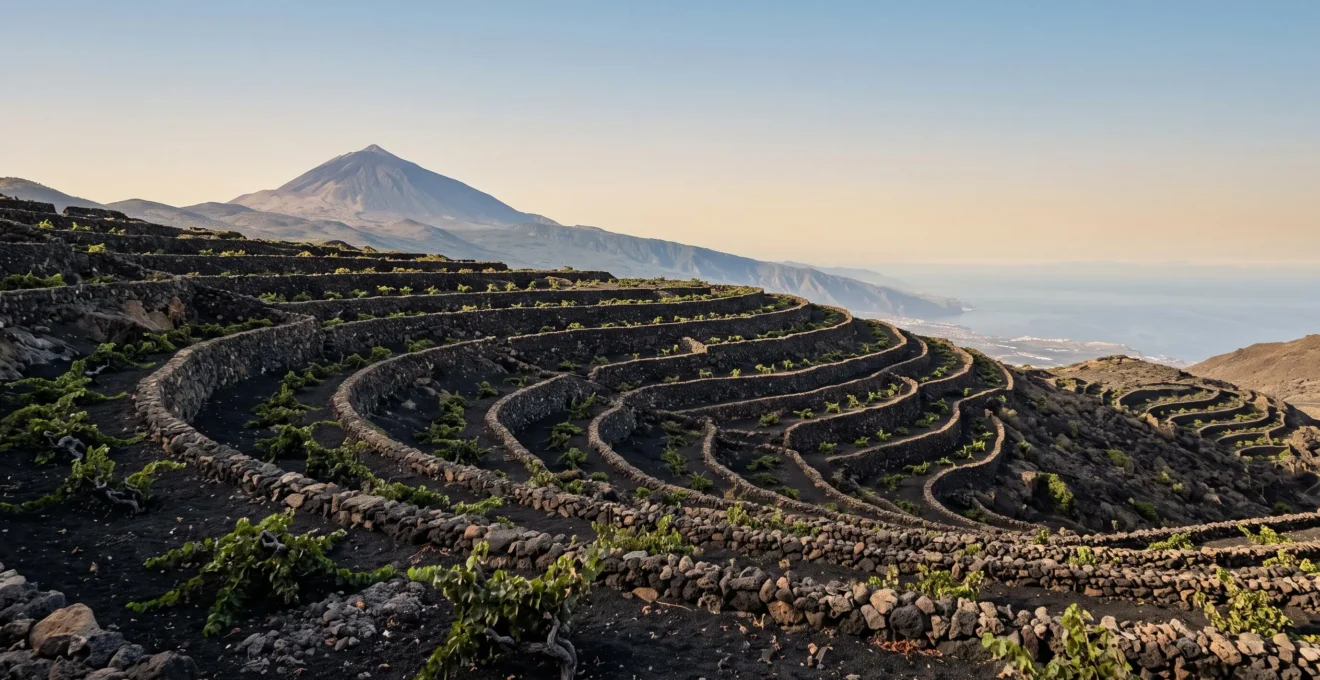
Nowhere is the conversation between geology and viticulture more dramatic than in Lanzarote’s La Geria region. Here, the landscape appears more lunar than terrestrial, a vast expanse of black volcanic ash punctuated by thousands of conical pits, or hoyos. Each pit, sometimes dug as deep as six feet, shelters a single grapevine. This extreme practice is not for aesthetic effect; it is a brilliant feat of agricultural engineering born from cataclysmic events. The primary purpose is to bypass the sterile, sun-baked surface and allow the vine’s roots to reach the fertile paleosol buried beneath the ash from the 18th-century eruptions.
This “enarenado” method, as it is known, also serves a second crucial function in one of Europe’s driest wine regions. The island receives an average annual rainfall of only 100 to 150 millimeters, making water retention paramount. The thick layer of porous volcanic ash, or picón, acts like a sponge, capturing the scant rainfall and morning dew while simultaneously preventing evaporation under the intense sun. This creates a uniquely stable and protected subterranean environment for the vine, a stark contrast to the harsh, wind-battered conditions on the surface.
As described by travelers exploring La Geria, farmers use this method by digging deep holes into the black volcanic ash, known locally as lapilli. This allows each vine, sitting alone in its pit, to tap into the moisture and nutrients held in the buried soil. This system is a direct and ingenious response to a volcanic history that both destroyed the old farmland and provided the very materials for its rebirth, concentrating the vine’s resources and, ultimately, its fruit.
Why Semi-Circular Stone Walls Create Sheltered Microclimates for Single Vines
If the hoyo is the first line of defence against Lanzarote’s harsh environment, the semi-circular stone wall, or zoco, is the second. Zooming in on the landscape reveals that each pit is accompanied by one of these low, crescent-shaped walls. Their construction is precise and purposeful: they are built on the northeastern side of the vine, directly in the path of the prevailing, moisture-stripping Atlantic trade winds. This orientation is not accidental; it is a critical element in creating a sheltered microclimate for the individual plant.
The zoco functions as a windbreak, reducing the desiccating effect of the constant wind and mitigating physical damage to the vine. By creating a pocket of still air, it also helps to raise the ambient temperature around the vine and trap warmth radiated by the black volcanic rock. This small temperature differential can be crucial for achieving full phenolic ripeness in the grapes. The combined system of pit and wall is so land-intensive that it dramatically impacts planting density.
The result is a stark difference in vineyard management. A study of the traditional hoyo system shows that it accommodates only 300 to 400 plants per hectare, a fraction of the 3,000 to 7,000 vines found in conventional European vineyards. This low density means each vine has exclusive access to the water and nutrients in its immediate vicinity, forcing a kind of concentrated effort that is often reflected in the intensity of the resulting fruit. The zoco is therefore not just a wall; it is a tool for climate modification at the most granular level, essential for making quality viticulture possible in such an extreme setting.
How to Date Lava Flows Using Rock Colour and Weathering Patterns
To understand the soil, a geologist must first understand its history. The dramatic landscape of Lanzarote was largely forged by the Timanfaya eruptions, the most significant volcanic event in the Canary Islands’ recorded history. A photographer’s field account notes that starting on September 1, 1730, and continuing for six years, cataclysmic eruptions buried nearly a third of the island’s most fertile lands under a thick blanket of lava and ash. This six-year timeline is a crucial piece of information for reading the landscape today.
In a soil pit or a road cutting, these different eruptive phases can be distinguished. Geologists and trained observers can date the relative ages of lava flows by observing their colour and weathering patterns. Newer lava flows, like those from Timanfaya, are typically jet black or dark grey and have sharp, jagged textures (known as ‘a’ā lava). Their surfaces are relatively unweathered, with little soil development or vegetation. Older lava flows, from previous geological eras, will appear more weathered. Their colours often shift to reddish-browns due to the oxidation of iron-rich minerals like pyroxene and olivine within the basalt. Their textures are smoother, and they are more likely to support soil and plant life.
The scale of the Timanfaya event was immense, with lava flows and pyroclastic deposits covering approximately 23 to 25 percent of Lanzarote’s surface. This history explains why the picón ash is so widespread and why farmers had to dig through this recent, sterile layer to find the older, fertile soil beneath. By learning to read the subtle differences in rock colour, texture, and erosion, a wine geologist can piece together the eruptive history of a specific vineyard plot and begin to hypothesize how these different parent materials might influence the soil’s chemistry and physical properties.
Why Basaltic Soils Impart Flinty Minerality Detectable on the Palate
Here we arrive at the core of the question: how does basaltic soil translate to a “flinty” or “saline” note in the wine? The key is to abandon the idea of direct mineral transfer. Instead, the soil acts as a powerful regulator of the vine’s metabolism. As Master Sommelier John Szabo notes, “Wines produced from volcanic soils tend have a savory, mouthwatering quality. These wines have more intense minerality, salinity and higher acidity.” This sensory profile is the end product of a complex biochemical process, not the taste of dissolved rock.
Industry analysis for wine buyers confirms that the perceived minerality is not from the vine absorbing rock dust. Instead, it frequently arises from the activity of specific yeast strains under conditions of nutrient stress. Volcanic soils, particularly young ones, can be low in certain essential nutrients like nitrogen. This stress influences yeast metabolism during fermentation, promoting the formation of reductive sulfur compounds, or thiols. Compounds like benzyl mercaptan (struck match) and other thiols are responsible for the aromas we describe as “flinty,” “gunflint,” or “reductive minerality.”
Essentially, the soil’s chemical composition influences the pH and nutrient availability for the vine. This, in turn, dictates the nutrient composition of the grape must that goes into the fermentation tank. As an insightful analysis of volcanic wines explains, it’s the yeast metabolism, regulated by nutrient stress and the mineral composition of the must, that creates the “mineral” sensation. The basaltic soil doesn’t flavor the wine directly; it sets the stage for a specific fermentation chemistry that does.
Listán Blanco vs Malvasía: What Grape Varieties Express Volcanic Character Best?
The terroir’s message, no matter how strong, needs a messenger. In wine, that messenger is the grape variety. Not all varieties are equally adept at transmitting the subtle signatures of their soil. In volcanic regions, winemakers often gravitate towards “transparent” varieties—grapes that have a relatively neutral or non-aromatic primary profile, allowing the secondary characteristics derived from soil and fermentation to shine through.
In the Canary Islands, Listán Blanco and Malvasía Volcánica are two prime examples. Listán Blanco (the same grape as Palomino Fino from Jerez) is known for its ability to reflect terroir, often producing wines with crisp acidity and a saline finish. Malvasía Volcánica, a local variant, offers more aromatic intensity but still retains a core of savory, mineral-driven structure. The choice of grape is critical because even among the volcanic Canary Islands, regional mineral signatures differ measurably. Research shows that Tenerife wines have elevated Fe and Mn, while Lanzarote wines show higher Na, likely from marine aerosols. A transparent grape variety will be better able to express these subtle, localized differences.
Winemaking choices are equally crucial in letting the terroir speak. A wine bar’s tasting guide astutely notes that many producers in volcanic regions favor fermentation and aging in neutral vessels like stainless steel, concrete, or old, large-format oak. Techniques like extended lees aging are also common. These decisions are made specifically to preserve the tension, aromatics, and textural components derived from the vineyard, rather than masking them with the vanilla and spice flavors of new oak. The goal is to provide a clear canvas for the soil-driven sensations to be perceived, allowing the signature of the volcano to be tasted.
How to Conduct Systematic Tastings Comparing Volcanic and Sedimentary Terroirs
For the sommelier student or wine geologist, tasting is a form of data collection. To truly understand volcanic terroir, it’s essential to taste systematically. This means comparing wines from volcanic soils against those from a different, well-defined soil type, like limestone or clay-based sedimentary soils. The goal is to isolate the variables and identify the recurring sensory markers of volcanic origin. When tasting, pay less attention to primary fruit aromas and more to structural components: acidity, texture, and the finish.
Volcanic wines often exhibit a specific quality of acidity—not just high, but what is often described as “saline” or “salty.” This mouth-watering sensation is not due to sodium chloride but is linked to the wine’s acid profile, particularly the presence of succinic acid. This compound is a natural byproduct of fermentation and contributes a flavor that is a complex mix of salty, bitter, and acidic. Recent research shows that succinic acid is produced by yeasts during the initial stages of alcoholic fermentation, and its concentration can be influenced by the amino acid profile of the grape must—which, as we’ve seen, is tied back to the soil’s nutrient status.
When setting up a comparative flight, control as many variables as possible. Use wines from the same grape variety, the same vintage, and with similar winemaking techniques (e.g., both unoaked). For example, compare a Sauvignon Blanc from the basalt soils of Mount Etna against one from the limestone-clay soils of Sancerre. Look for that savory, almost umami-like quality and the persistent, mouth-watering finish in the volcanic example. This is the “palatable signature” of the terroir.
Action Plan: Setting Up a Comparative Terroir Tasting
- Select a Control Grape: Choose a “transparent” grape variety known to reflect terroir, such as Chardonnay (unoaked), Riesling, or Sauvignon Blanc.
- Isolate Soil Type: Find two wines of the same grape and vintage, one from a confirmed volcanic soil (e.g., Etna, Santorini, Soave Classico) and one from a sedimentary soil (e.g., Sancerre, Chablis, Mosel).
- Standardize Conditions: Serve both wines at the same, correct temperature in identical glassware to ensure a level playing field for aroma and flavor perception.
- Focus on Structure, Not Fruit: In your notes, prioritize describing the quality of the acidity (sharp, broad, saline?), the texture (chalky, silken, grippy?), and the length and nature of the finish (savory, bitter, sweet?).
- Record Perceived Minerality: Use specific descriptors for any “mineral” notes. Are they flinty (reductive sulfur), chalky (textural), or saline (acid/umami-driven)? Compare these notes between the two wines.
How to Access Volcanic Vineyard Soil Pits During Guided Terroir Tours
For the geologically-minded wine lover, a guided terroir tour is an opportunity to connect the wine in the glass with the ground underfoot. Accessing and interpreting a vineyard soil pit is a highlight of such an experience. A good guide won’t just point to the ground; they will open up a cross-section of the earth and explain the story written in its layers. In a volcanic region like the Canary Islands, this story is particularly vivid. A visitor’s account of a Lanzarote tour describes how guides illustrate the way each vine sinks its roots through the black ash to find the fertile soil beneath, highlighting the hoyos and stone walls that create a unique microclimate.
When you find yourself in front of a soil pit, you are essentially looking at a geological map. You can observe the different horizons: the dark, porous picón on top, its depth, and the transition to the older, often lighter-colored paleosol beneath. You can feel the texture of the different layers—the grittiness of the ash, the potential clay content of the buried soil. This hands-on analysis is invaluable.
Furthermore, scientific analysis backs up what can be observed in the pit. Studies using elemental mapping have quantified the unique mineral signatures of these wines. One extensive analysis quantified key minerals in 190 wine samples and found that distinct elemental profiles emerged by island. For example, while Tenerife wines had elevated Iron and Manganese, the wines from Lanzarote showed higher levels of Sodium. This is a crucial data point, confirming a measurable chemical signature that aligns with the island’s proximity to the ocean and the likely influence of marine aerosols being trapped in the porous soils. Seeing the soil structure firsthand provides the physical context for these abstract chemical results.
Key Takeaways
- The ‘saline’ taste in volcanic wines is not from dissolved rock but a perceived quality driven by high acidity (including succinic acid) and savory compounds produced during fermentation under nutrient stress.
- Extreme viticulture, like the ‘hoyos’ and ‘zocos’ of Lanzarote, is a direct human adaptation to harsh volcanic conditions, creating microclimates that are essential for concentrating flavors in the grapes.
- Serving temperature is critical. Many of the thiol compounds that create the “flinty” mineral aromas are highly volatile and can be completely masked if the wine is served over-chilled.
The Serving Temperature Mistake Masking 70% of Mineral Complexity
After a wine’s entire journey—from the volcanic eruption that formed its soil, through the decades of vine growth and the precise work in the cellar—its final expression can be undone in a moment by a simple mistake: serving it too cold. The complex aromas we perceive as “minerality” are often composed of highly volatile chemical compounds, particularly thiols. Their volatility, which is their ability to leap from the wine and reach our nose, is directly governed by temperature.
As a tasting room explainer clarifies, compounds that produce struck-match or flinty aromas are effects of fermentation and aging, not rock dust in the glass. Over-chilling a white wine effectively locks these delicate compounds in place, numbing the palate and rendering the wine aromatically flat. What might have been a complex, savory, and mineral-driven wine presents as simple, acidic, and uninteresting. While the exact percentage is metaphorical, it’s not an exaggeration to say a significant portion of the wine’s aromatic complexity is lost when served straight from a domestic refrigerator (typically 3-4°C / 37-40°F).
Temperature is a critical variable at every stage. Just as fermentation temperature can drastically alter the final flavor profile—one study noted that Sauvignon Blanc fermented at 20°C produced higher final levels of key thiols than wine fermented at 13°C—serving temperature dictates whether we can even perceive them. For complex, mineral-driven whites, a serving temperature of 10-13°C (50-55°F) is often ideal. This is cool enough to be refreshing but warm enough to allow the full spectrum of aromas to be released, revealing the true, hard-won character of its volcanic terroir.
By connecting the geological history, viticultural ingenuity, and the underlying biochemistry, we can now appreciate the saline tang in a glass of volcanic wine not as a simple taste, but as the final, audible note of a complex chord. To fully cement this knowledge, the next step is to apply it methodically in your own tastings, moving from theory to practice.