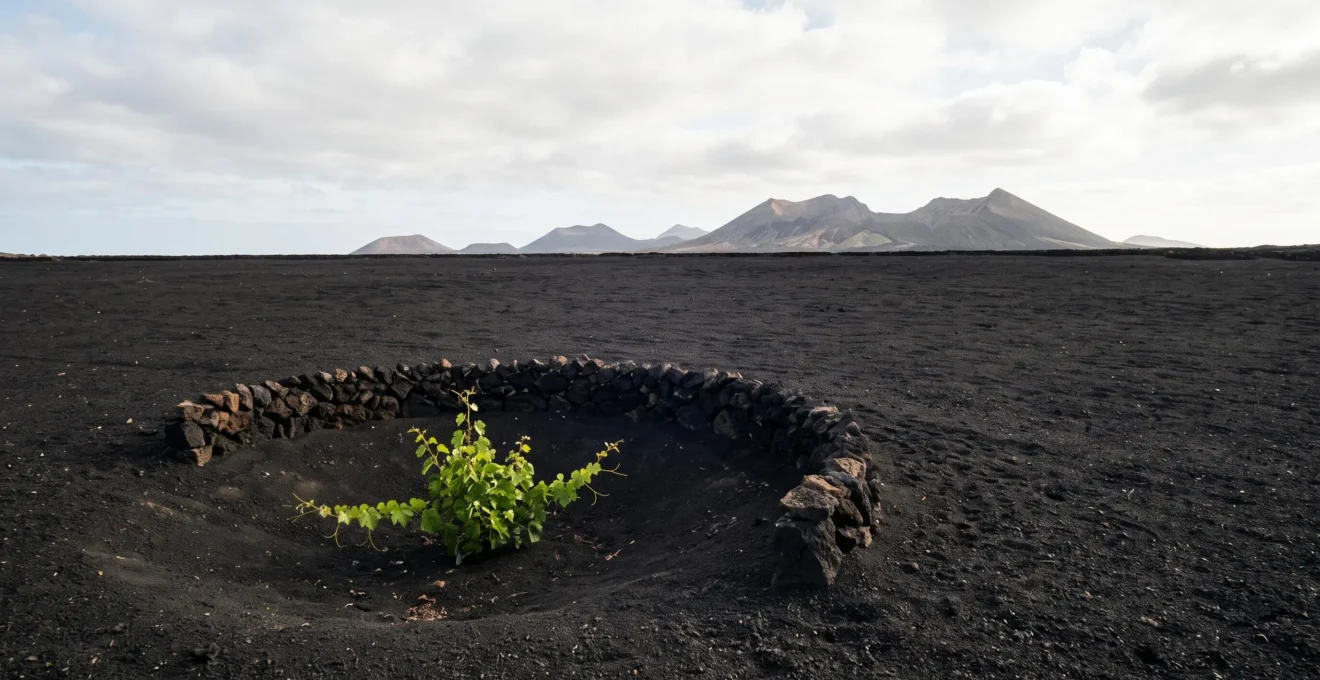
Lanzarote’s viticulture is not merely unique; it’s a masterpiece of engineered survival against a hostile volcanic landscape.
- Each vine pit, or hoyo, is a purpose-built microclimate, using volcanic ash as a thermal battery and stone walls to wage climatic warfare against Atlantic winds.
- This extreme, entirely manual method produces exceptionally low yields but results in wines of profound minerality and complexity, thanks to ancient, phylloxera-free vines.
Recommendation: To truly understand this terroir, one must appreciate the science behind the spectacle—recognizing every pit and wall as a deliberate act of ingenuity.
At first glance, the wine region of La Geria in Lanzarote presents a stunning paradox: vibrant green vines thriving in what appears to be a desolate, black, wind-scoured volcanic wasteland. The landscape, a geometric pattern of thousands of crescent-shaped craters, looks more suited to a lunar mission than agriculture. Standard viticultural wisdom would deem this land barren and untamable. Yet, here, the Malvasia Volcánica grape flourishes, producing some of the world’s most distinctive wines. This is not an accident of nature, but a triumph of human ingenuity.
The common explanation is that the pits, or hoyos, protect the vines from the wind. While true, this simple statement barely scratches the surface of the sophisticated system at play. This article goes beyond the picturesque scenery to deconstruct the “Engineered Survival” of Lanzarote’s vineyards. We will explore how generations of viticultores have turned the remnants of volcanic annihilation into a precise, life-sustaining system. This is a story of climatic warfare, where every stone wall is a shield, every black granule of ash is a thermal battery, and every pit is a sanctuary, demonstrating a profound understanding of micro-environmental control. It’s a testament to adapting not just to an environment, but to actively engineering it for survival.
This guide delves into the science, history, and sensory experience of this extreme viticulture. We will examine how each element of this unique terroir, from basaltic geology to oceanic influence, contributes to the final character of the wine in your glass.
Summary: A Deep Dive into Lanzarote’s Volcanic Vine-Pits
- Why Semi-Circular Stone Walls Create Sheltered Microclimates for Single Vines
- How to Visit Active Crater Vineyards During Harvest Season
- Volcanic Ash Viticulture vs Traditional Soil Cultivation: What Trade-Offs Exist?
- How to Photograph Geometric Pit Patterns From Elevated Viewpoints
- The Vine Damage Caused by 40% of Tourists Walking Between Fragile Pits
- Why Basalt Formations Reveal Eruption Temperatures Exceeding 1200°C
- Why Basaltic Soils Impart Flinty Minerality Detectable on the Palate
- Why Volcanic Wines Express Salinity Despite Growing 300m Above Sea Level
Why Semi-Circular Stone Walls Create Sheltered Microclimates for Single Vines
The iconic semi-circular stone walls, known as zocos, are the most visible element of Lanzarote’s climatic warfare. They are far more than simple windbreaks. Each wall is strategically built low and curved to disrupt the relentless northeasterly trade winds without creating turbulence that could damage the single vine it protects. This creates a pocket of relative calm, reducing physical stress on the plant and, crucially, minimizing moisture evaporation in an arid environment.
The ingenuity extends deep below the surface. The funnel-shaped pit, or hoyo, is painstakingly dug by hand. To reach the fertile paleosol beneath, workers must excavate through a thick layer of coarse black volcanic ash, called picón. Incredibly, each pit is dug through several metres of volcanic lapilli, a testament to the sheer manual effort required. This deep planting anchors the vine and gives it access to nutrients, but the picón layer itself performs a vital dual function. Its porous, sponge-like nature allows it to absorb and retain scarce atmospheric moisture, like morning dew, channeling it down to the roots. Simultaneously, its black colour creates a powerful thermal battery. It absorbs the intense solar radiation during the day and slowly releases that heat during the cool nights, moderating temperature swings and protecting the vine from extremes.
This combination of the zoco’s shelter and the picón’s hydrological and thermal properties creates a fully functional, self-sufficient microclimate inside each pit. It is a remarkable example of passive environmental engineering, where every element works in concert to make life possible in one of the world’s most challenging terroirs. This isn’t just farming; it is the creation of thousands of individual life-support systems.
How to Visit Active Crater Vineyards During Harvest Season
Witnessing the harvest, or vendimia, in La Geria is to see this system of engineered survival in action. Typically occurring from late July through August, it is one of the earliest wine harvests in Europe. However, planning a visit requires an understanding of its precarity. The process is, as one local winemaker puts it, fundamentally “difficult, irregular and expensive.” Unlike manicured European vineyards, there is no mechanization here. Every bunch of grapes is harvested by hand, with workers navigating the steep, loose ash of the hoyos.
Difficult, irregular and expensive
– Iván Monreal, Interview with RTVC, reported by Gazette Life
This manual labour, combined with the island’s challenging climate, means that yields are not only low but also wildly variable. The harvest volumes on the island can swing dramatically, dropping by as much as 50% from one year to the next depending on rainfall and heat. This makes every grape precious and the annual harvest a time of both intense work and celebration.
For visitors, the best way to experience the vendimia is by visiting the local bodegas (wineries). Many are open for tours and tastings, offering a frontline view of the grapes arriving. One notable example is Bodega La Geria, the island’s most-visited winery. Well-equipped for visitors, it hosts a public harvest festival each mid-August, a lively event that has traditionally featured camels transporting the grapes from the pits and even a grape-stomping session for children. Visiting a bodega during this time provides not only a taste of the finished product but also a profound respect for the immense human effort required to produce it.
Volcanic Ash Viticulture vs Traditional Soil Cultivation: What Trade-Offs Exist?
Comparing the viticulture of La Geria to a typical European vineyard reveals a world of stark trade-offs, where immense struggle is exchanged for unparalleled character. The most striking difference is in planting density. Where a standard vineyard in France or Italy might contain 3,000 to 7,000 vines per hectare, the density in Lanzarote is astonishingly low. Due to the space each hoyo requires, the planting density in La Geria is a fraction of that found elsewhere in Europe, sometimes as low as just 300 vines per hectare. This drastically limits production volume before a single grape is even grown.
This low density is a direct consequence of a system that is entirely manual, from digging the pits to harvesting the fruit. However, this struggle yields a remarkable, hidden advantage. The Canary Islands are one of the very few wine regions in the world that the devastating phylloxera pest never reached. This aphid wiped out most of Europe’s vineyards in the late 19th century, forcing growers to graft their vines onto resistant American rootstock. Because Lanzarote’s vines were isolated, they remain ungrafted on their own original rootstock (pie franco). Some of these plants are between 100 and 200 years old, possessing a genetic heritage and depth that is virtually extinct elsewhere. These ancient, resilient root systems delve deep into the volcanic soil, producing wines of incredible concentration, complexity, and mineral intensity.
| Metric | La Geria (volcanic ash) | Typical European vineyard |
|---|---|---|
| Planting density | As few as 300 vines/ha | 3,000–7,000 vines/ha |
| Mechanization | None — fully manual, hand-dug pits and hand-harvested | Often mechanized |
| Rootstock | Ungrafted, own-root vines (some 100–200 years old) | Grafted onto phylloxera-resistant rootstock |
The trade-off is clear: Lanzarote sacrifices quantity, efficiency, and ease for history, authenticity, and a unique flavour profile that cannot be replicated. It is a living museum of pre-phylloxera winemaking, preserved by its own isolation and the ingenuity of its growers.
How to Photograph Geometric Pit Patterns From Elevated Viewpoints
The landscape of La Geria is not just an agricultural marvel; it is a work of land art, a fact famously highlighted when local artist César Manrique‘s work brought its geometric beauty to the world stage at a 1964 MoMA exhibition in New York. For photographers, capturing the scale and texture of this engineered environment is a rewarding challenge. The key is to leverage light, perspective, and composition to translate its three-dimensional texture into a compelling two-dimensional image.
The most dramatic shots are often achieved from an elevated viewpoint, such as the hillsides surrounding the main valley or designated viewpoints (miradores). This perspective allows you to capture the repeating patterns of the hoyos and zocos, which create a mesmerizing geometric rhythm across the landscape. The contrast between the black ash, the vibrant green of the vines, and the dark stone of the walls is the central visual theme. To make this contrast pop, timing is everything. Shooting during the “golden hour”—the first hour after sunrise or the last hour before sunset—provides a low, soft light that rakes across the land, creating long shadows that define the shape and depth of each pit. This warm light also brings out the texture of the volcanic ash and the rugged stone walls.
Action Plan: Capturing La Geria’s Volcanic Vineyards
- Time Your Shoot: Plan to be on location during the golden hour (early morning or late afternoon) to use the low-angle light for optimal contrast and shadow definition.
- Seek Elevation: Find a safe, elevated viewpoint on the roads bordering La Geria (like the LZ-30) to photograph the vast geometric patterns of the pits from above.
- Emphasize Contrast: Compose your shots to play on the three core elements: the black of the ash, the green of the vines, and the texture of the stone walls.
- Consider Aerials: Use drone footage for breathtaking overhead views, but always verify local regulations and obtain permission, as these are active agricultural lands.
- Focus on Detail: In addition to wide landscapes, capture close-up shots that highlight the texture of the picón and the rugged construction of a single zoco.
While grand vistas are spectacular, don’t neglect the details. A close-up of a single vine within its protective crater, or the texture of the black ash against the gnarled wood of an old vine, can tell a powerful story of resilience. The goal is to capture not just the beauty, but the feeling of this place: a landscape born of fire and shaped by human hands.
The Vine Damage Caused by 40% of Tourists Walking Between Fragile Pits
The stunning visual appeal of La Geria has made it a major tourist attraction, but its very popularity poses a significant threat to its fragile ecosystem. While the volcanic landscape appears rugged and permanent, the picón ash layer is incredibly delicate. A widely cited (though difficult to verify) local statistic suggests that up to 40% of visitors stray from marked paths, walking between the pits to get a better photo, unaware of the damage they are causing. Walking on the loose ash compacts it, destroying its porous, moisture-trapping structure and disrupting the delicate balance of the microclimate within the hoyo.
The system is in a constant, delicate equilibrium. The zocos are not just windbreaks; they are also retaining walls that prevent the loose ash from sliding down and burying the vines. Despite this, the natural movement of the soil requires immense and continuous upkeep. Twice a year, during pruning and after the harvest, workers must manually clear out excess picón that has accumulated in the bottom of the pits. This illustrates just how easily the ash layer shifts. When tourists walk on the slopes of the hoyos, they accelerate this erosion, collapsing the pit walls and effectively suffocating the very vines they came to admire. This compaction and displacement represents irreversible damage that requires significant manual labor to repair, if it can be repaired at all.
It is a stark reminder that this landscape is not a park or a simple natural wonder; it is a working agricultural system. The survival of this unique form of viticulture depends on visitors treating it with the respect it deserves. Appreciating this masterpiece of engineering means admiring it from the designated roads and winery paths, understanding that the greatest threat to its future is now coming from those who love it most. The best way to support the region is to stay off the ash, buy the wine, and spread the word about responsible tourism.
Why Basalt Formations Reveal Eruption Temperatures Exceeding 1200°C
To comprehend the terroir of La Geria, one must travel back to its violent birth. The landscape is not ancient but terrifyingly recent, sculpted by one of the longest and most powerful volcanic eruptions in recorded history. The words of a local priest, Father Andrés Lorenzo Curbelo, capture the cataclysmic beginning:
On the first day of September, 1730 between nine and ten o’clock at night, the earth suddenly opened near Timanfaya
– Father Andrés Lorenzo Curbelo, Eyewitness diary of the 1730 eruption
This was the start of the Timanfaya eruptions, a six-year period of fire and lava that buried a quarter of the island, including its most fertile agricultural lands, under a thick blanket of basalt. The dark rock formations and black ash that define the island today are the direct result of this event. The presence of basalt itself is a geological clue to the intensity of the eruption. Basalt is a mafic lava, which is less viscous and significantly hotter than the felsic lavas that create more explosive, cone-shaped volcanoes like Mount St. Helens. For basaltic lava to flow across the land, it must reach temperatures typically exceeding 1,200°C (2,200°F).
Geological research on the Timanfaya event shows it began with explosive ‘Strombolian’ fire-fountain activity, which created the scoria cones and the blanket of picón ash. This was followed by the effusive flow of lava. Visitors can still see two distinct types of basaltic lava flows in the landscape today: the rough, clinkery ‘a’ā flows and the smoother, ropey pāhoehoe flows. This geological terroir is the raw material the island’s farmers had to work with. They did not simply clear the rock; they learned to use its specific properties—the heat retention of the black ash, the mineral content of the basalt—to their advantage, turning a catastrophe into the foundation for a new form of agriculture.
Why Basaltic Soils Impart Flinty Minerality Detectable on the Palate
The term “minerality” in wine can be elusive, but in the case of Lanzarote’s Malvasia Volcánica, it is a distinct and defining characteristic. Tasters frequently describe notes of flint, wet stone, and a smoky or gunpowder-like quality. This is not a fanciful metaphor; it is the direct sensory expression of the island’s unique geological terroir. The vines’ roots are in direct contact with the decomposed basalt and nutrient-rich paleosol, drawing up minerals that influence the grape’s chemical composition and, ultimately, its flavor.
This connection between soil and taste is so pronounced that it’s scientifically measurable. A recent mineral analysis of Canary Islands wines found that manganese, magnesium and sodium levels could correctly classify a wine’s island of origin with 85% classification accuracy. This demonstrates that each island imparts a unique mineral fingerprint, and Lanzarote’s is inextricably linked to the Timanfaya eruptions. The “flinty” note is a direct translation of this basaltic DNA.
Furthermore, the extreme growing conditions intensify this expression. As noted in studies of the region’s terroirs, the combination of nutrient-poor volcanic soil and the need to grow on their own roots (pie franco) induces significant physiological stress in the vines. This stress forces the plant to work harder, resulting in lower yields of smaller, more concentrated grapes. This concentration doesn’t just apply to sugars and acids, but also to the mineral compounds absorbed from the soil. The resulting wine is therefore a potent distillation of its place, a liquid expression of the struggle and resilience required to grow in volcanic ash.
Key Takeaways
- Lanzarote’s viticulture is a system of “Engineered Survival,” not just a quaint tradition.
- Each pit (hoyo) and wall (zoco) creates a precise microclimate, using volcanic ash as a thermal and hydrological regulator.
- The wines’ unique quality comes from ancient, ungrafted vines that survived the phylloxera plague, a rarity in the wine world.
Why Volcanic Wines Express Salinity Despite Growing 300m Above Sea Level
Perhaps the most enchanting and surprising characteristic of Lanzarote’s white wines is a distinct saline, or salty, finish. It evokes a fresh sea breeze and adds a mouth-watering quality that makes the wines exceptionally good partners for seafood. The immediate assumption is that this salinity comes directly from the volcanic soil, which is known to be rich in minerals. While the soil provides the foundational “flinty” minerality, the secret to the salinity appears to be carried on the wind.
The vineyards of La Geria, though not on the coast, are constantly exposed to the Atlantic trade winds. These winds, known locally as the alisios, travel thousands of miles across the ocean, picking up microscopic particles of salt spray. This saline aerosol is then deposited over the island, coating the leaves and grapes of the vines. While the plant’s roots are drawing minerals from the basaltic earth, its foliage is literally being seasoned by the sea. This combination of earth and ocean influence is what creates the wine’s complex, layered profile.
The case of the Listán Blanco grape provides compelling evidence. In mainland Spain, where it is known as Palomino, it produces largely neutral base wines for Sherry. However, as noted by wine experts, on the Canary Islands, this same grape develops vibrant acidity and a pronounced saline minerality. The grape’s DNA is the same; the only difference is the terroir. It is the specific alchemy of Lanzarote’s volcanic soil and the ever-present ocean influence that transforms a neutral grape into one that speaks so clearly of its island home. The salinity is not a flavour from the deep earth, but a taste of the Atlantic sky.