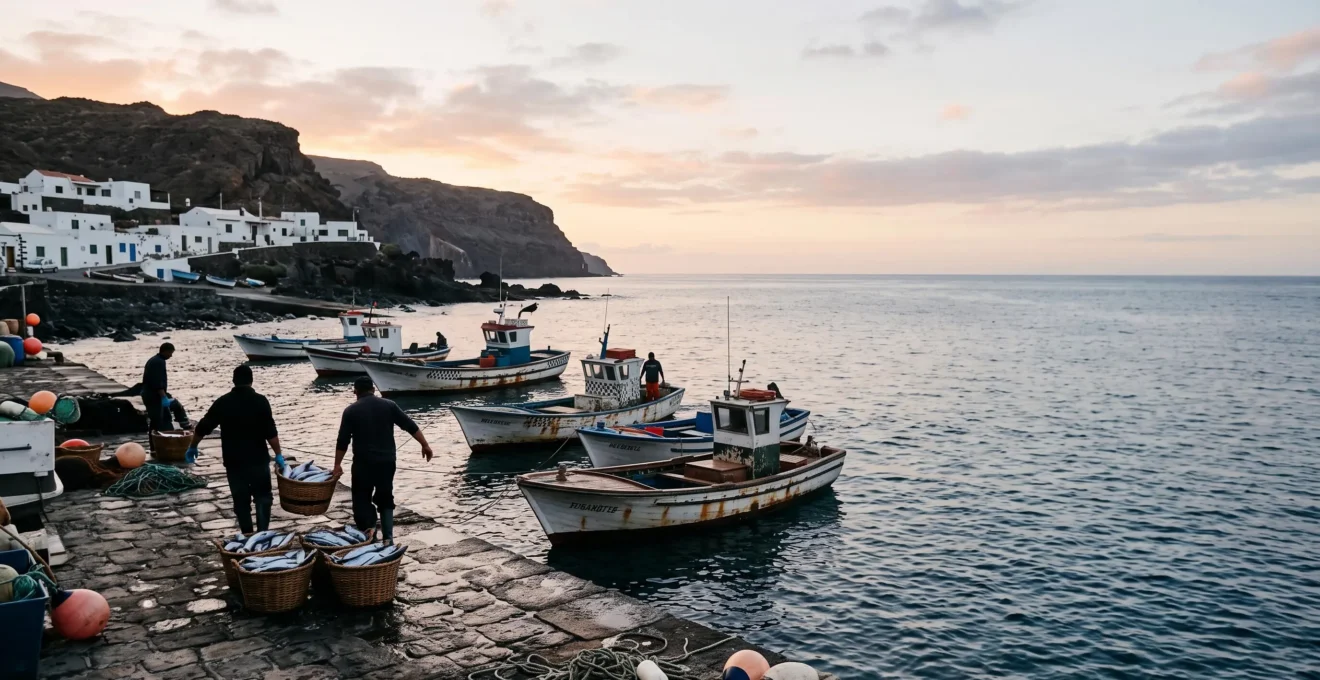
The ultimate guarantee of fresh fish isn’t a label, but the time between the catch and the plate—a window the Canarian artisanal fleet masters.
- Industrial trawlers freeze their catch for days or weeks at sea, destroying flesh texture, whereas Canarian day-boats land their catch within hours.
- Verifiable freshness is found at local `Cofradías de Pescadores` (fishing guilds) which source directly from morning landings.
Recommendation: Bypass generic “fresh fish” claims by asking for the specific port of origin and fishing method (line or trap), rewarding truly sustainable local fleets.
For the conscious consumer, the term “fresh fish” has become almost meaningless. It’s a vague promise plastered on menus from industrial port cities to tourist-trap coastal restaurants. Most of what is sold under this banner is, in fact, a product of large-scale trawling operations, frozen at sea for days or even weeks before being thawed and presented as fresh. This common practice not only deceives the palate but also supports an unsustainable fishing model. The alternative, however, isn’t just a fantasy; it’s a daily reality in places like the Canary Islands, but only for those who know how to look for it.
The true measure of freshness is time. The secret lies in a logistical reality that separates small-scale artisanal fleets from their industrial counterparts: the ability to get fish from the ocean to the market in under six hours. This isn’t a marketing gimmick; it’s a fundamental principle that dictates everything from flesh texture and flavour to the economic vitality of coastal communities. This guide moves beyond the platitudes of “look for clear eyes” and provides a framework for genuine traceability. We will explore the science behind why a day-boat catch is texturally superior, how to verify morning landings, and the specific questions to ask to dismantle the fiction of industrial ‘freshness’.
But a truly conscious approach to travel extends beyond the plate. To fully appreciate the unique ecosystem of the Canaries, a mindful mindset should guide your entire itinerary. This means understanding how your choices impact the environment, from where you swim and how you travel to your awareness of over-tourism. This article will therefore also equip you with the knowledge to make better decisions for the entire ecosystem—choosing snorkelling spots for maximum clarity with minimal impact, understanding the real carbon footprint of your transport options, and seeking out the quiet beauty the islands offer away from the crowded 10%.
Summary: The Conscious Traveller’s Guide to Canarian Traceability and Sustainability
- Why Day-Boat Catches Preserve Superior Flesh Texture Versus Trawler Freezing
- How to Verify Morning Landings at Coastal Village Fish Markets
- Line-Caught Species vs Net-Caught Bycatch: What Fishing Methods Ensure Sustainability?
- How to Ask Restaurant Staff About Daily Catch Provenance and Fishing Zone
- The “Fresh Fish” Labelling Deception Fooling 85% of Restaurant customers
- Pebble Coves vs Sandy Hideaways: Which Offers Better Snorkelling Clarity?
- Why Shared Transport per Passenger-Kilometre Outperforms Electric Car Rentals
- Why 90% of Beachgoers Concentrate on 10% of Available Coastline
Why Day-Boat Catches Preserve Superior Flesh Texture Versus Trawler Freezing
The difference between a truly fresh fish and one that has been frozen is not just a matter of taste; it is a profound structural degradation at the cellular level. When a fish is landed, it undergoes a process called rigor mortis, the stiffening of muscles after death. The speed and intensity of this process are critical for final flesh quality. According to research on fish rigor timing, this onset can occur in under two hours or take much longer, depending on species and how it was handled. Fish caught by small day-boats are typically landed well before rigor mortis fully sets in, allowing the flesh to rest and develop its firm, succulent texture naturally.
This contrasts sharply with the industrial trawler model. These large vessels spend weeks at sea, and their catch is flash-frozen on board, often while the fish is in a state of stress or pre-rigor. When ice crystals form during freezing, they expand and rupture the muscle cells. Upon thawing, these damaged cells can’t retain water, leading to a mushy, dry, and flavourless product. The texture integrity of the fish is permanently compromised. A day-boat fish, delivered within the crucial 6-hour window, never undergoes this destructive freeze-thaw cycle.
Furthermore, the stress of the catch method has a significant impact. Line-caught fish from a small boat experience far less stress than fish crushed in a massive trawler net. As the EWASH Editorial Team notes, “Minimizing stress during harvesting is crucial for optimal fish quality.” High stress releases lactic acid into the muscles, lowering the pH and negatively affecting texture and shelf life. The gentle handling and speed of the artisanal fleet are not just romantic notions; they are scientific prerequisites for superior culinary quality.
How to Verify Morning Landings at Coastal Village Fish Markets
Identifying a genuinely fresh, daily-landed fish requires moving beyond simple visual cues and adopting a more investigative approach. The most reliable sign of a direct supply chain in a Canarian coastal village is the presence of a Cofradía de Pescadores. These are fishing guilds, often with an attached restaurant or market, that are owned and operated by the local fishermen themselves. They are the heart of the local fishing economy, and their entire reputation rests on the authenticity of their catch. When you eat at a cofradía, you are often consuming fish landed just a few hundred metres away, only hours earlier.
This direct connection is the ultimate guarantee of freshness, a sentiment echoed by those who experience it. One visitor to the Cofradía de Pescadores in Candelaria shared their experience:
Guaranteed freshness: Fish arrives daily directly from the local fish market, tasting exactly as fresh sea fish should — the Canarian ocean on the plate.
– Islas24.info, Guest account of guild-run freshness
Beyond finding a cofradía, you can perform your own checks. Observe the clientele: establishments that cater primarily to Canarios or a healthy mix of locals and visitors are far more likely to serve authentic, high-quality local fish than those targeting tourists exclusively. These businesses rely on repeat local customers who can instantly spot an inferior, thawed-out product. Your vigilance directly supports these honest purveyors and the sustainable fishing practices they represent.
Action Plan: How to Identify Genuinely Fresh, Locally Landed Fish
- Find the Local `Cofradía`: Look for a Cofradía de Pescadores in the village; these fishing-guild-run restaurants are the most reliable source for truly local fish.
- Observe the Clientele: Prioritize restaurants that cater to a mix of locals and visitors, as their quality standards are typically higher than tourist-only spots.
- Perform the Resilience Test: Gently press the flesh of a whole fish. A truly fresh fish landed hours earlier will spring back instantly, while a thawed or older fish will remain indented.
- Check the Gills and Eyes: While basic, this is still a valid check. Gills should be bright red (not brown), and eyes should be clear and bulging (not cloudy or sunken).
- Ask About Morning Landings: Directly ask if the fish came from that morning’s landing. A confident ‘yes’ from a local purveyor is a good sign.
Line-Caught Species vs Net-Caught Bycatch: What Fishing Methods Ensure Sustainability?
The sustainability of a fishery is defined not just by what is caught, but how. In the Canary Islands, a clear distinction exists between the traditional, low-impact methods of the artisanal fleet and the indiscriminate nature of industrial netting. The very structure of the local fleet is a testament to its sustainable scale. The Canarian artisanal fleet is made up of around 600 fibre or wooden boats averaging nine metres in length that land catches reaching markets within hours. This “fleet-scale asymmetry” means they simply do not have the capacity for the large-scale environmental damage associated with industrial trawlers.
These small boats employ highly selective, traditional fishing gear designed to target specific species while minimizing harm to the marine ecosystem. This commitment to sustainability is not just a modern trend but a deeply ingrained cultural value, as exemplified by the fishermen of El Hierro.
Case Study: El Hierro’s Proactive Fishermen
On the island of El Hierro, the local fishing community took a leading role in conservation. Local fishers cared so much about sustainability that they drove the creation of the now-famous La Restinga Marine Reserve, a hotspot of biodiversity. Furthermore, the Canary Islands’ “one-by-one” tuna fishers, who catch tuna individually with poles and lines, work directly with international policy bodies to ensure the long-term health of their fishery. This demonstrates a proactive stewardship that is impossible in anonymous, large-scale operations.
The choice of gear is paramount. Traditional methods are inherently more sustainable and result in a higher quality product. Understanding the difference helps the conscious consumer make an informed choice.
The following table outlines the traditional gear used by the Canarian artisanal fleet, showcasing the difference between selective, low-impact methods and less discriminate net-based fishing.
| Traditional Gear | Method Type | Typical Target Species |
|---|---|---|
| Nasa (traps) | Passive, selective | Sticklebacks, parrot fish, moray eels |
| Curricán (trolling line) | Active, one hook | Horse mackerel, migratory pelagics |
| Longline | Passive, hook-based | Red porgy, conger eels |
| Traíña / cazonal nets | Net-based | Shrimps, octopus, mixed bycatch |
How to Ask Restaurant Staff About Daily Catch Provenance and Fishing Zone
Engaging with restaurant staff is your final and most crucial step in provenance verification. However, a generic question like “Is the fish fresh?” will almost always yield a generic “Yes.” To get a meaningful answer, you must ask specific, knowledgeable questions that signal you understand the local supply chain. This approach not only gets you the truth but also shows respect for restaurants that make a genuine effort to source locally and sustainably. The conversation should be a polite inquiry, not an interrogation.
Start by asking about the “pescado del día” (catch of the day). Then, follow up with targeted questions that are difficult to invent answers for. A waiter at a restaurant with a truly local supply chain will be able to answer confidently and specifically. Vague, evasive, or annoyed responses are a major red flag, suggesting the “fresh” fish likely came from a freezer.
Here are the key questions to help you discern truth from fiction:
- “From which port or cofradía did today’s catch come?” This is the most important question. A specific answer like “It’s Sama from the cofradía in Mogán” is a sign of authenticity. A vague “from the island” is not.
- “How was it caught? With a line (`línea`), trap (`nasa`), or net (`red`)?” Staff connected to their suppliers will know this. An answer of “line” or “trap” is a strong indicator of both quality and sustainability.
- Observe the environment: As mentioned before, notice the clientele. A restaurant full of locals is a strong sign that the establishment is trusted for its authenticity and quality, as they are the most discerning customers.
The “Fresh Fish” Labelling Deception Fooling 85% of Restaurant Customers
The misleading use of the term “fresh fish” is not just a local issue in tourist areas; it’s a global problem of seafood fraud. The title’s claim that this deception fools 85% of customers reflects a widespread consumer trust that is often betrayed. While that specific number is a generalisation, hard data confirms the prevalence of the issue. For instance, a major seafood fraud investigation found that 20 percent of the 449 fish tested were a different species entirely than what was on the label. This practice is known as species substitution.
The problem is particularly rampant in restaurants where the consumer cannot see the whole fish. The consequences go beyond simple disappointment. As one expert, Dr. Valentine, warned in an NBC Chicago investigation, the stakes can be high:
We can see tuna at a sushi restaurant can actually be Escolar.
– Dr. Valentine, NBC Chicago – Seafood fraud investigation
Escolar, often fraudulently sold as “white tuna,” is known to cause significant digestive distress. This highlights how seafood fraud is not only an economic and conservation issue but also a potential public health risk. Consumers with allergies or sensitivities are put in danger by mislabelling.
Case Study: UCLA’s Findings on Persistent Fish Fraud
A multi-year study by UCLA researchers revealed the stubborn nature of this problem. The study found consistent mislabeling in both Los Angeles restaurants and grocery stores year after year. This indicates that despite stricter regulations and increased public awareness, the issue is not improving. The UCLA study highlights that fish fraud thwarts consumers trying to buy sustainably and can pose health threats. The only effective countermeasure is a knowledgeable consumer who can perform their own verification.
Pebble Coves vs Sandy Hideaways: Which Offers Better Snorkelling Clarity?
As a conscious traveller, seeking out pristine natural environments is a priority. When it comes to snorkelling, water clarity is paramount for a rewarding experience. In volcanic archipelagos like the Canary Islands, the choice between a pebble cove and a sandy beach has a direct and significant impact on underwater visibility. The clear winner for snorkelling clarity is almost always the pebble cove.
The reason is simple physics. Sandy beaches are composed of fine, lightweight particles. Wave action, currents, and even the movement of swimmers easily churn up this sediment, suspending it in the water column. This creates a cloudy, murky environment that drastically reduces how far you can see. Even on a calm day, the fine sand can obscure the vibrant marine life and underwater landscapes you came to see.
Pebble coves, on the other hand, are made of heavier, larger stones and volcanic pebbles. These materials are too heavy to be easily disturbed and suspended by typical wave action. The water remains significantly clearer, as there is little to no sediment to cloud your view. This stability allows for exceptional visibility, revealing the intricate details of rock formations, the movements of fish, and the subtle colours of the seabed. For the snorkeler seeking an immersive and clear view of the underwater world, choosing a sheltered pebble cove over a popular sandy beach is the most effective strategy.
Why Shared Transport per Passenger-Kilometre Outperforms Electric Car Rentals
A core tenet of conscious travel is minimizing your environmental impact, and transportation is one of the biggest factors in a trip’s carbon footprint. While renting an electric vehicle (EV) seems like a green choice, a closer look at the data reveals that for many scenarios, shared public transport is the superior option, especially when comparing emissions on a per passenger-kilometre basis.
The fundamental advantage of shared transport lies in its efficiency of scale. A single bus or train journey transports dozens of people, distributing the vehicle’s total emissions across all passengers. According to research from the World Resources Institute, buses and trains can reduce greenhouse gas emissions by up to two-thirds per passenger-kilometre compared to private vehicles. As the Climate Tally Editorial Team points out, the effect on congestion and emissions is profound:
A full bus replaces approximately 40 cars on the road.
– Climate Tally Editorial Team, Climate Tally – Carbon Footprint of Transportation
Even a modern EV, while having zero tailpipe emissions, still carries a significant carbon footprint from its manufacturing process (especially the battery) and the electricity used to charge it, which may not be 100% renewable. When an EV is used by only one or two people, its per-passenger footprint can be surprisingly high.
The following table, based on UK data, illustrates how occupancy levels affect the per-passenger carbon footprint, showing that even a shared EV struggles to compete with high-occupancy public transport.
| Occupancy Scenario | Public Transport (per passenger) | Shared EV (per passenger) |
|---|---|---|
| High occupancy | ≈560 kg CO₂e | ≈470 kg CO₂e |
| Low occupancy (off-peak) | Roughly double the high-occupancy figure | Relatively stable, less occupancy-dependent |
While the table shows a shared EV can be better in some high-occupancy scenarios, public transport remains a powerful tool for mass emission reduction. The conscious traveller should therefore prioritize using the local bus (`guagua`) and tram systems whenever feasible, reserving a rental car only for reaching remote areas inaccessible by public transit.
Key Takeaways
- True freshness is time-dependent; prioritize fish from day-boats that land their catch in under 6 hours.
- Verify authenticity by seeking out local `Cofradías de Pescadores` and asking specific questions about port of origin and fishing method.
- Support sustainability by choosing fish caught with selective gear like lines and traps over indiscriminate nets.
Why 90% of Beachgoers Concentrate on 10% of Available Coastline
The final pillar of a conscious itinerary is actively avoiding the pitfalls of over-tourism. A strange but consistent phenomenon in travel is the concentration of crowds: a vast majority of visitors will flock to a tiny fraction of the available natural attractions, such as beaches. This 90/10 rule is not an exaggeration but a reflection of human psychology and logistical convenience. Understanding why this happens is the first step toward breaking the cycle and discovering the untouched beauty that lies beyond the hotspots.
Several factors contribute to this intense concentration. First is the power of social proof and marketing. Guidebooks, travel blogs, and social media influencers tend to feature the same handful of “must-see” beaches, creating a feedback loop where popularity breeds more popularity. Visitors see photos of a specific beach, assume it’s the “best,” and go there, reinforcing its status. Second is accessibility and amenities. The most popular beaches are often the easiest to get to, with large car parks, direct bus routes, and a full suite of services like restaurants, sunbeds, and toilets. This convenience acts as a powerful magnet, especially for families or less adventurous travellers.
Finally, there is a simple fear of the unknown. Venturing off the beaten path requires more effort and carries a small risk of disappointment. It’s easier to follow the crowd to a guaranteed “good” experience than to explore a remote cove that might be difficult to access or less picturesque than advertised. The conscious traveller, however, sees this as an opportunity. By intentionally seeking out the other 90% of the coastline, you not only escape the crowds but also distribute the tourist footprint more evenly, reducing the strain on overwhelmed locations. You discover secluded gems and experience a more authentic, peaceful version of the destination, which is the ultimate reward for a mindful approach.
Now that you are equipped with the knowledge to see beyond the tourist trail and the “fresh fish” façade, the next step is to put it into practice. Apply this mindset of verification and conscious choice to every aspect of your trip. By doing so, you not only guarantee yourself a more authentic and higher-quality experience but you also become a positive force in the local economy and environment, rewarding the artisans, fishermen, and communities that prioritize sustainability over mass-market convenience.