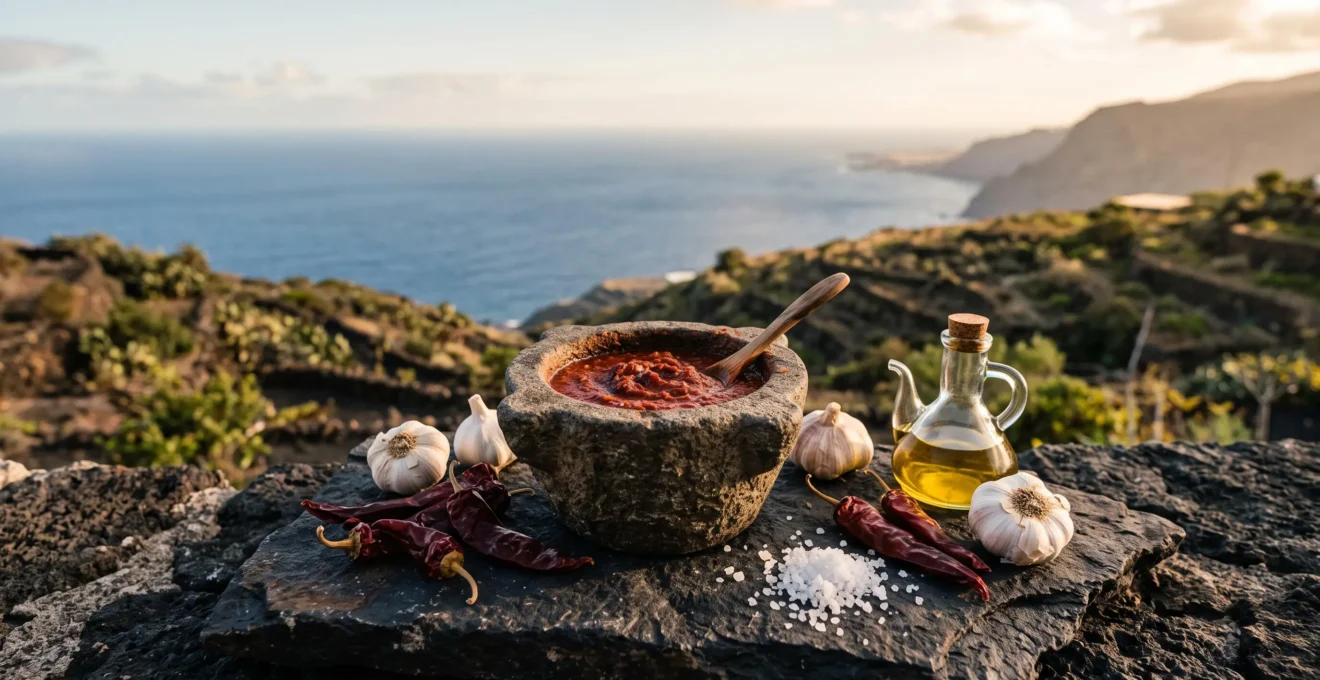
Contrary to popular belief, authentic Mojo Picón cannot be replicated with supermarket substitutes; its signature flavour is a direct expression of the Canary Islands’ unique volcanic geochemistry.
- Endemic peppers and local salt possess a complex mineral load, derived from basaltic soil and Atlantic waters, which is absent elsewhere.
- Traditional preparation methods, like using a mortar and pestle, are scientifically designed to preserve this unique chemical fingerprint, not just for texture.
Recommendation: To experience true mojo, focus on sourcing ingredients by their origin, not just their name, or appreciate the complexity when you taste it on the islands.
For condiment enthusiasts, Mojo Picón is a familiar name—a vibrant, piquant sauce that promises a taste of the Canary Islands. Countless recipes circulate online and in cookbooks, each suggesting that a handful of peppers, garlic, cumin, and oil is all that stands between you and this Atlantic delight. This leads many home cooks to believe that authentic mojo can be whipped up in any kitchen, anywhere in the world. They follow the steps, source the closest available chili, and produce a sauce that is often spicy, certainly red, but invariably lacking the profound, resonant flavour they remember from a trip to Tenerife or Lanzarote.
The disappointment is palpable, but it isn’t a failure of technique. It’s a misunderstanding of origin. The common wisdom ignores a fundamental truth: Mojo Picón is not merely a recipe, but a form of liquid terroir. Its soul is not found in a list of ingredients, but in the very land from which they spring. From the endemic peppers nourished by volcanic soil to the salt harvested from the powerful Atlantic, each component carries a unique geochemical fingerprint. Even adjacent culinary traditions, like the preparation of papas arrugadas, are intrinsically linked to this specific island environment.
But what if the secret to authentic mojo has less to do with the *what* and more to do with the *why* and *where*? This guide abandons the myth of simple substitution. Instead, we will delve into the geology, botany, and chemistry that make these island ingredients irreplaceable. We will explore why the volcanic earth yields peppers with distinct heat profiles, how Atlantic salt transforms a simple potato, and why the traditional methods are not just for show but are essential for protecting the sauce’s true character. By understanding the source, you will finally understand the sauce.
This article explores the deep connection between the Canary Islands’ environment and its most famous condiment. Follow along as we break down the science and tradition behind creating a truly authentic flavour experience.
Summary: The Unmistakable Terroir of Canarian Mojo
- Why Endemic Pepper Varieties Deliver Heat Profiles Distinct From Mainland Chillies
- How to Source Authentic Mojo Ingredients From Local Weekly Markets
- Mojo Rojo vs Mojo Verde: What Ingredient Changes Create Colour and Flavour Shifts?
- How to Balance Acidity and Heat for Authentic Island Flavour Profile
- The Blending Shortcut That Destroys Traditional Texture in 60% of Attempts
- Why Basaltic Weathering Releases Trace Minerals Absent From Sedimentary Soils
- How to Prepare Papas Arrugadas at Home Replicating Island Salt Concentrations
- Why Papas Arrugadas Require Specific Atlantic Salt Concentrations
Why Endemic Pepper Varieties Deliver Heat Profiles Distinct From Mainland Chillies
The foundation of any Mojo Rojo is the pepper, but not just any pepper will do. The authentic flavour relies on endemic Canarian varieties, such as the ‘Pimienta Palmera’ or ‘Pimienta Picona’. These are not merely cultivars of common chillies; they are a direct product of the islands’ unique volcanic environment. Their distinctness isn’t just about the level of spiciness, or capsaicin, but about the complexity of their flavour, which is built from the soil up. The heat is rounder, less aggressive, and woven into a fabric of fruity and smoky notes that mainland peppers struggle to imitate.
This unique profile is a result of the mineral composition of the soil. As we’ll explore further, volcanic soils are rich in specific elements. This is reflected in the peppers themselves. According to research into Canarian pepper composition, the local varieties contain significant amounts of potassium, iron, and magnesium alongside their capsaicin. This mineral load contributes directly to the pepper’s metabolic processes, influencing not just its growth but the very flavour compounds it develops. A pepper grown in a different, less mineral-diverse soil simply cannot produce the same chemical makeup.
Therefore, when you taste an authentic mojo, you are not just tasting a pepper; you are tasting a specific geological history. The subtle salinity and earthy depth come from the unique nutrients the plant has absorbed. This is why substituting with a cayenne or a common bell pepper, while providing colour and heat, will always miss the essential character—the taste of the volcanic islands themselves.
How to Source Authentic Mojo Ingredients From Local Weekly Markets
For the purist living outside the Canary Islands, sourcing authentic ingredients is the ultimate challenge. The weekly markets (mercadillos) in towns like Teror or Teguise are a vibrant display of this principle, where local producers sell peppers, garlic, and salts harvested from the surrounding volcanic landscapes. This direct-from-the-source connection is the ideal. For those abroad, the pursuit becomes a matter of diligent sourcing and intelligent substitution, accepting that a perfect match is nearly impossible. The goal is to get as close as possible to the authentic geochemical fingerprint.
Case Study: Ingredient Transparency in Commercial Mojo
When buying pre-made mojo, the ingredient list is telling. Authentic Mojo Rojo ingredient lists typically read: red pepper, vegetable oil, garlic, wine vinegar, cumin, and salt. It is a declaration of simplicity. In contrast, other regional specialties like some cheese-based Almogrote blends might list additives such as lysozyme derived from egg and the preservative E-202. This detail reveals a departure from traditional simplicity towards industrial shortcuts, a critical factor for importers and travelers judging authenticity.
If you cannot acquire the true Pimienta Picona, a hierarchy of substitutes exists. The best alternative is to find a specialty importer who sources dried or fresh Picona peppers directly from Canarian small-batch producers. This maintains the direct link to the island’s terroir. A second-best, or “better,” option is to use ñora peppers, which provide a similar smoky-sweet base, augmented with a touch of cayenne for heat. The most accessible, or “good,” option is to use 2-3 small, hot peppers like cayenne, but this moves furthest from the original’s nuanced flavour, focusing on heat alone.
The key takeaway for sourcing is to think like a preservation specialist: prioritize origin. Look for products that name their pepper variety and its source. When substituting, aim to replicate the fruity-smoky profile first and the heat second. This honours the spirit of the original mojo far more than simply creating a generic spicy red sauce.
Mojo Rojo vs Mojo Verde: What Ingredient Changes Create Colour and Flavour Shifts?
While Mojo Rojo is often seen as the flagship sauce, its sibling, Mojo Verde, is just as fundamental to Canarian cuisine. The difference is far more than just colour; it represents a significant shift in the flavour profile and culinary application. This divergence is a perfect illustration of how a simple base formula can be adapted to express different aspects of the local produce. The core of garlic, oil, vinegar, and salt remains, but the primary flavouring agent changes entirely, creating two distinct sauces with unique personalities.
Mojo Rojo, the “red mojo,” derives its colour and robust, earthy flavour from dried red peppers (the aforementioned Pimienta Picona) and sometimes a touch of paprika for deeper colour. It carries a smoky depth and a varying level of heat, making it the classic accompaniment for roasted meats and, of course, papas arrugadas. Its flavour is of the dry, sun-baked volcanic earth.
Mojo Verde, the “green mojo,” by contrast, is fresh, herbaceous, and bright. Its vibrant green hue comes from a generous amount of fresh coriander (cilantro). Some recipes also incorporate green peppers to round out the flavour. The resulting sauce is zesty and pungent rather than spicy-hot, making it a perfect partner for delicate grilled fish and vegetables. Its flavour speaks of the greener, more humid corners of the islands. The table below, sourced from a comparative analysis of Canarian sauces, clarifies these distinctions.
| Sauce | Colour Source | Core Ingredients | Traditional Pairing |
|---|---|---|---|
| Mojo Rojo | Red peppers / paprika | Garlic, olive oil, vinegar, cumin | Grilled meats, potatoes |
| Mojo Verde | Fresh coriander | Green peppers, garlic, olive oil, vinegar | Fish, vegetables |
| Almogrote | Aged hard cheese | Cured cheese, garlic, olive oil, peppers | Bread, toast, potatoes |
A third regional specialty, Almogrote, is often grouped with mojos but is fundamentally different. It is a thick paste made from a base of aged, hard goat cheese, garlic, and peppers, creating a powerful, savoury, and piquant spread rather than a sauce.
How to Balance Acidity and Heat for Authentic Island Flavour Profile
Achieving the authentic mojo flavour profile is a masterclass in balance, particularly between the fiery heat of the peppers and the sharp tang of the vinegar. This is not simply a matter of taste; it is a chemical negotiation. The acidity from the wine vinegar does more than just add a bright note; it acts as a natural preservative and, crucially, it mellows the raw, aggressive bite of the garlic and peppers, allowing their more complex, fruity flavours to emerge. Too little vinegar, and the sauce is a blunt instrument of heat. Too much, and the delicate terroir-driven notes of the peppers are bleached away, leaving only a sour taste.
The traditional method involves a careful titration. A splash of vinegar is added, and the sauce is emulsified and tasted. More is added only if necessary. This careful process protects the integrity of the most volatile flavour compounds. This is especially important for the garlic. The pungent “bite” of garlic comes from allicin, a compound that is both powerful and fragile. Over-acidification or excessive processing can destroy it.
The Science of Preservation vs. Flavour
Industrial food production often relies on pH adjustment for shelf stability. However, this comes at a cost. Scientific analysis reveals that while thermal processing and significant pH changes in garlic products can maintain a good appearance, their pungent flavour and biological activities are often completely lost. This explains the fine line mojo makers walk: they add just enough acidity to preserve the sauce and round out its flavour, but not so much that it silences the characteristic allicin “bite” that gives the sauce its lively character.
For the home cook aiming for authenticity, this means using a good quality wine vinegar and adding it incrementally. The goal is not to create a vinaigrette, but to use the acid as a tool to unlock and balance the flavours already present. It should brighten the sauce, not dominate it. When the balance is right, the heat of the pepper becomes a warm glow rather than a sharp sting, and the full, earthy flavour of the cumin and garlic can be appreciated.
The Blending Shortcut That Destroys Traditional Texture in 60% of Attempts
In our modern quest for efficiency, the food processor or blender seems like a logical tool for making mojo. It is fast, easy, and requires minimal effort. However, this shortcut is perhaps the single biggest mistake a novice can make, one that fundamentally alters and often ruins both the texture and flavour of the sauce. Traditional mojo is made in a mortar and pestle (a mortero) for a reason that goes beyond simple nostalgia. The difference lies in the way the ingredients’ cell walls are treated.
A blender’s high-speed blades don’t crush; they shred and shear. This violent action creates a uniform, often frothy purée. It also generates heat and introduces a lot of air, which can lead to oxidation and a bitter taste, especially with garlic and olive oil. The mortar and pestle, by contrast, crushes and grinds. This process methodically breaks down the cells, releasing their essential oils and flavour compounds in a more controlled manner. The result is a sauce with a rustic, slightly coarse texture, where you can still perceive the individual components.
The impact on garlic flavour is particularly profound. As the editorial team at Groeat points out in their analysis of garlic’s properties, the chemistry of its pungency is directly linked to physical damage. They note that “The more cell damage that occurs, the more allicin is produced.” Crushing in a mortar creates widespread cell damage, leading to a complex, robust garlic flavour. The clean slicing action of a blender blade is less effective, often resulting in a raw, harsh, and one-dimensional garlic taste. This explains why so many blended mojos end up with an unpleasant bitterness or an overly aggressive garlic profile.
The more cell damage that occurs, the more allicin is produced.
– Groeat editorial team, How to Mellow Garlic’s Pungent Flavor
While using a mortar requires more time and effort, it is non-negotiable for achieving the authentic texture and nuanced flavour that defines traditional mojo. It is an act of respect for the ingredients, ensuring their unique, terroir-driven characteristics are expressed, not obliterated.
Why Basaltic Weathering Releases Trace Minerals Absent From Sedimentary Soils
To truly understand why a pepper from Lanzarote tastes different from one grown anywhere else, we must look beneath the surface—at the soil itself. The Canary Islands are volcanic in origin, and their soils are predominantly derived from basalt, a dark, fine-grained volcanic rock. This is fundamentally different from the sedimentary soils, rich in clay or sand, that cover much of the world’s agricultural land. The key process is basaltic weathering, which dictates the unique mineral profile available to any plant grown there.
Basalt is packed with minerals like magnesium, iron, and calcium. Over time, through the action of rain and wind (hydrolysis and oxidation), this rock slowly breaks down, releasing these elements into the soil in a form that plants can absorb. As a post-eruption study on lava weathering notes, this process releases soluble elements like Ca2+ and Mg2+ gradually over months and years. This slow, continuous mineral feeding is what enriches Canarian crops, from peppers to potatoes.
Furthermore, the nature of this soil creates a distinct chemical environment. Peer-reviewed soil science research indicates that volcanic soils in the Canaries are generally acidic, with a pH ranging from 5 to 7. This specific acidity level influences how well plants can absorb the trace minerals released by the weathering basalt. It creates a perfect storm for developing flavour complexity: a rich supply of unique minerals and the ideal conditions for plants to uptake them. This is the very foundation of the island’s terroir and the primary reason its produce has an inimitable character.
How to Prepare Papas Arrugadas at Home Replicating Island Salt Concentrations
Papas Arrugadas, or “wrinkly potatoes,” are the inseparable companion to mojo. Their preparation seems simple—boiling small potatoes in salty water—but achieving the authentic, intensely flavoured result with its signature fine salt crust is an art form rooted in a specific technique and, once again, specific ingredients. The method is a direct evolution of a historical, practical reality of island life.
Back when every home had a garden, cooks washed pots of potatoes in the ocean, then boiled them in sea water; the water would evaporate, leaving behind a white film of salt on the slightly wrinkled skins.
This historical practice of using seawater is the key. Modern recipes replicate this by using a very high concentration of coarse sea salt in the boiling water—around 250g of salt per 1kg of potatoes. The process is not just about salting the water, but about creating a brine that, through osmosis, draws moisture out of the potato skins, causing them to wrinkle, while simultaneously infusing the potato with a deep, savoury flavour. The final, crucial step is what creates the iconic salt crust.
Action Plan: The Two-Phase Boil-and-Dry Technique
- Initial Boil: Cover the potatoes (small, waxy varieties are best) with water in a pot. Add a generous amount of coarse sea salt and boil for 15 to 20 minutes, or until they are just tender when pierced.
- Drain and Dry: Carefully drain all the water from the pot. Return the pot with the drained potatoes to the stove over medium-low heat.
- Crust Formation: Gently shake the pot for a few minutes. The residual heat will evaporate any remaining moisture on the skins.
- The Sign of Success: As the water evaporates, a fine, white crust of salt will form on the wrinkled potato skins. This is the hallmark of authentic papas arrugadas.
- Serving: Serve the potatoes hot, allowing guests to generously spoon Mojo Rojo or Mojo Verde over them.
By following this two-phase method, you are not just cooking potatoes; you are recreating a process designed to concentrate flavour, mimic the effects of boiling in pure ocean water, and create the perfect vessel for the rich, complex flavours of mojo.
Key Takeaways
- Authentic mojo flavour is inseparable from the Canary Islands’ volcanic terroir and cannot be fully replicated with substitute ingredients.
- Endemic peppers and salts have a unique mineral complexity derived from basaltic soil and Atlantic water.
- Traditional preparation methods like using a mortar and pestle are scientifically superior for preserving the flavour and texture of these unique ingredients.
Why Papas Arrugadas Require Specific Atlantic Salt Concentrations
The final, critical element in the authentic Canarian flavour trinity is the salt. Just as the peppers are a product of the volcanic soil, the salt used for papas arrugadas is a product of the Atlantic Ocean and the intense island sun. Using standard, refined table salt will season the potatoes, but it will not create the same texture or impart the same depth of flavour as authentic Canarian sea salt. The difference, once again, lies in the mineral complexity.
Canarian salt is typically harvested in traditional salt pans (salinas), like those in Fuencaliente on La Palma or Janubio on Lanzarote. Here, seawater is channelled through a series of shallow pools, where the sun and wind work to evaporate the water, leaving behind the salt crystals. This solar-dried, unrefined process is key. Unlike industrial refining, it preserves the trace minerals naturally present in the Atlantic water.
As studies of regional saltworks confirm that Canarian salt has a smaller grain size and a higher content of elements like calcium, magnesium, potassium, and iodine compared to its refined counterparts. This rich mineral load delivers a cleaner, less harsh salinity and a more complex, ocean-fresh flavour. Furthermore, the unrefined crystal structure is what allows a thicker, more adherent crust to form on the skins of the papas arrugadas. Fine table salt would simply dissolve or fail to cling in the same way.
Therefore, the choice of salt is not a minor detail. It is a commitment to authenticity. Using coarse, unrefined sea salt—ideally from the Canaries themselves—is the only way to replicate the specific brine concentration and mineral-rich crust that makes this simple potato dish so extraordinary. It is the final piece of the terroir puzzle, connecting the dish directly to the ocean that surrounds the islands.
The journey to authentic Mojo Picón and its classic pairings is ultimately a lesson in respecting origin. It teaches us that some flavours are not portable, not because they are complex, but because they are intrinsically honest. They are the direct, unadulterated expression of a specific place on Earth. To chase that flavour with substitutions is to miss the point entirely. The true mastery for the home cook lies not in trying to replicate it, but in understanding why it is so unique, and appreciating it all the more when you have the chance to taste the genuine article. For your next culinary project, seek out ingredients that tell a story of their origin, and apply the principles of traditional preparation to honour that story.