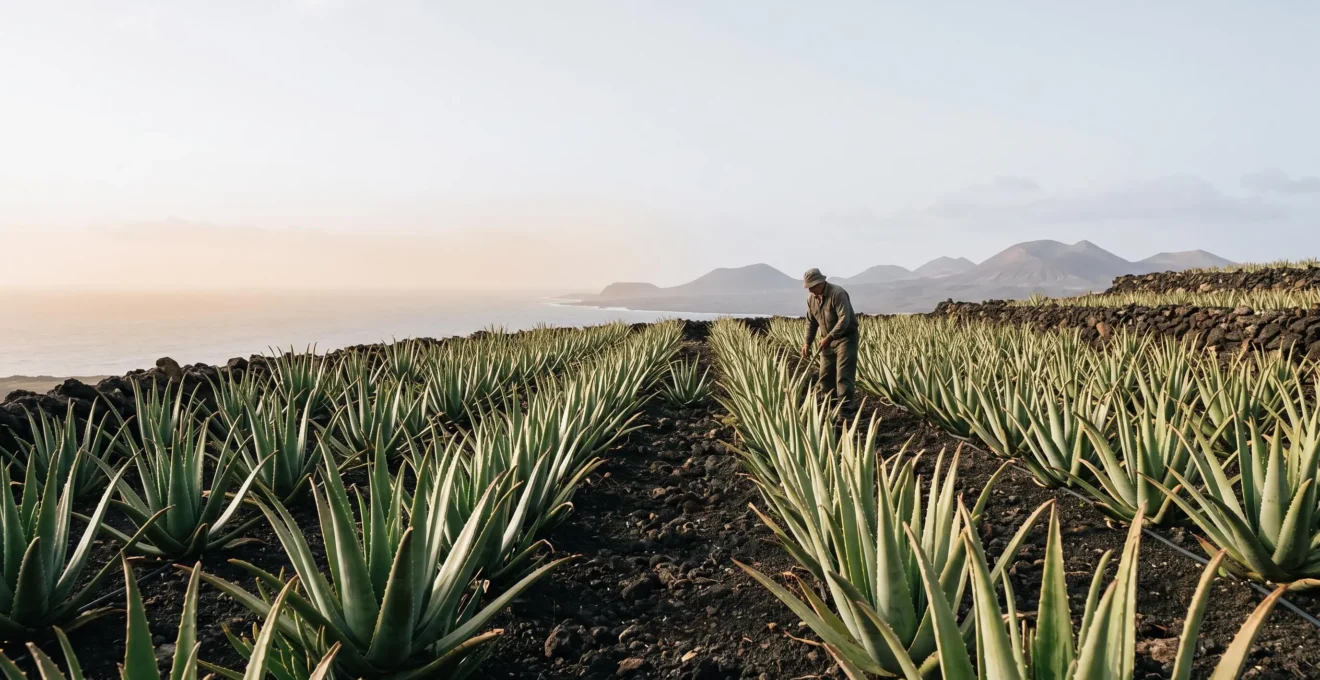
The superior potency of Canarian aloe isn’t a myth; it’s a direct result of a verifiable geochemical dialogue between volcanic soil and plant biology.
- Volcanic basalt releases a unique mineral cocktail (silica, iron, magnesium) that supercharges the plant’s production of active compounds.
- Commercial products often use rehydrated powders or are diluted, containing less than a tenth of the active polysaccharides found in pure, fresh gel.
Recommendation: Seek out fresh-cut leaves from verified organic farms in the Canary Islands to access the plant’s full, unadulterated pharmaceutical potential.
For enthusiasts of natural remedies, aloe vera is a cornerstone of botanical skincare. We’re told it soothes, hydrates, and heals. Yet, not all aloe is created equal. The ubiquitous green bottles lining pharmacy shelves often contain a pale imitation of the plant’s true power. Many users experience underwhelming results, not because the plant is ineffective, but because the product they’re using has been stripped of its vitality through industrial processing and dilution.
The conversation often revolves around finding “100% pure” gel, but this advice misses the fundamental point. The true potency of aloe vera is determined long before it’s bottled. It’s forged in the soil, under a specific sky, through a unique environmental conversation. But what if the key to unlocking pharmaceutical-grade results wasn’t just about purity, but about provenance? What if the volcanic archipelago of the Canary Islands offered an aloe with a fundamentally different, more potent bioactive signature?
This is not a matter of marketing, but of ethnobotany and geochemistry. The exceptional polysaccharide content—the very compounds responsible for its healing efficacy—of island-grown Aloe Barbadensis is a direct consequence of its terroir. This article will deconstruct the science behind this botanical superiority. We will explore the soil, identify authentic sources, and expose the commercial shortcuts that cheat consumers of the plant’s true benefits, equipping you to source and use this potent plant medicine directly from its most powerful origin.
To fully understand what makes this plant so unique, we will break down the key factors, from the mineral-rich soil to the deceptive practices of the commercial market. This guide provides a complete roadmap for sourcing and utilising aloe with unmatched potency.
Summary: The Scientific Case for Canarian Aloe Vera’s Superior Potency
- Why Volcanic Soil and Climate Create Superior Active Compound Concentrations
- How to Identify Authentic Aloe Barbadensis Farms Offering Fresh Cuts
- Wild-Harvested vs Organic Plantation Aloe: Which Delivers Purer Active Compounds?
- How to Preserve Fresh Aloe Gel for 2 Weeks Without Refrigeration
- The Labelling Trick Making 70% Buy Diluted Commercial Aloe Believing It’s Pure
- Why Indigenous Plant Compounds Outperform Laboratory-Synthesised Skincare Chemicals
- Why Basaltic Weathering Releases Trace Minerals Absent From Sedimentary Soils
- Why Organic Aloe Treatments Deliver 50% Better Skin Hydration Than Synthetic Products
Why Volcanic Soil and Climate Create Superior Active Compound Concentrations
The secret to the potency of Canarian aloe begins in the ground. Unlike the sedimentary soils common in mainland agricultural regions, the Canary Islands are built from volcanic basalt. This dark, porous rock creates a soil with a distinct geochemical signature. As it weathers, it slowly releases a cocktail of essential minerals—including silica, iron, magnesium, and calcium—that are directly absorbed by the aloe plant’s root system. This mineral-rich diet is the foundational building block for synthesizing complex bioactive compounds, most notably polysaccharides like acemannan.
This unique terroir is complemented by a specific climate. The islands’ high irradiance levels and arid conditions place a unique metabolic stress on the plants. To survive, they must produce higher concentrations of protective and water-retaining compounds. This isn’t just a theory; controlled trials demonstrate the direct impact of light. For example, research into aloe cultivation confirmed that manipulating light exposure directly reshapes the plant’s metabolic output. One study found that cultivating young plants under specific partial shade conditions could result in a 27% higher yield compared to plants in full sun. This illustrates how the micro-climate’s exact light exposure dictates the final chemical makeup of the gel.
This combination of mineral-rich volcanic soil and high-UV, arid climate forces the Aloe Barbadensis plant into a state of heightened biosynthesis. It doesn’t just grow; it bio-accumulates a higher density of the very compounds sought for their medicinal properties. The plant’s potency is, therefore, a direct expression of its challenging, yet nourishing, environment—a classic example of terroir potency.
How to Identify Authentic Aloe Barbadensis Farms Offering Fresh Cuts
Understanding the science is one thing; accessing the genuine article is another. The burgeoning popularity of Canarian aloe has led to a flood of “tourist traps”—shops selling bottled gels of questionable origin, often located far from any actual cultivation. To find authentic, high-potency aloe, you must go directly to the source: a working organic farm. Identifying a legitimate farm from a simple retail outlet requires a discerning eye and a bit of preparatory research.
A genuine farm’s primary focus is agriculture, not just sales. You should be able to see vast fields of Aloe Barbadensis plants, often organised in structured rows on volcanic terraces. These operations are transparent about their cultivation processes. A quality farm visit, for instance, should include a guided tour through the gardens, where you learn about the organic cultivation methods, harvesting techniques, and the on-site processing that preserves the gel’s integrity. For example, a case study of a sustainable operation on La Gomera documented a farm with 8,000 aloe vera plants across 10,000 square metres, offering a comprehensive tour from plant to product. This is the model to look for.
Avoid any establishment that cannot show you its crops or that primarily pushes a wide array of souvenir-type products alongside its aloe. True artisans of botanical medicine are proud of their plants and eager to share their cultivation philosophy. They offer fresh-cut leaves, allowing you to experience the plant’s vitality firsthand—a world away from a shelf-stable, plastic-bottled gel. The ability to buy a freshly harvested leaf is the ultimate sign of authenticity.
Action Plan: Verifying an Authentic Aloe Farm
- Island Identification: Before booking, confirm which islands host actual working farms, not just souvenir shops masquerading as such.
- Comparative Research: Compare the locations and offerings of multiple farms online; each provides a different scale and tour experience.
- Schedule Verification: Check the farm’s official website or social media for confirmed tour times and availability before you arrive.
- Tour Content Inquiry: Ask if the visit includes a live demonstration of cultivation and harvesting, ensuring it’s an educational experience, not just a retail stop.
- Fresh Cut Availability: Prioritize farms that offer the option to purchase whole, freshly cut aloe leaves, the ultimate proof of an active cultivation site.
Wild-Harvested vs Organic Plantation Aloe: Which Delivers Purer Active Compounds?
A common romantic notion in natural remedies is that “wild is always better.” However, in the context of sourcing aloe for maximum polysaccharide content, this isn’t necessarily true. While wild plants are indeed a testament to resilience, organic plantations offer a critical advantage: controlled agronomy. Wild plants are subject to the whims of nature—inconsistent water, nutrient competition, and variable sun exposure—which can lead to significant variations in their bioactive profile from one plant to the next.
Organic plantations, by contrast, can optimize growing conditions to consistently maximize the concentration of desired compounds. Farmers can manage irrigation, ensure optimal soil nutrition, and even control light exposure to steer the plant’s metabolism. This isn’t about artificial boosting, but about creating the ideal environment for the plant to achieve its full genetic potential. Laboratory analysis confirms this; a study comparing different parts of the plant under controlled conditions found that the skin juice contained 2.4 times the level of polysaccharides in the gel juice from the same plant, demonstrating how agronomic focus can concentrate specific fractions.
The key compound at the heart of this discussion is acemannan, a long-chain polysaccharide unique to the aloe plant. It is this molecule that is most credited with the plant’s remarkable therapeutic properties. As biomaterials researchers have noted, its value is widely recognized:
Acemannan (AC) is considered to be a natural polysaccharide with good biodegradability and biocompatibility extracted from Aloe vera and has a wide range of applications in the biomedical field due to excellent immunomodulatory, antiviral, antitumor, and tissue regeneration effects.
– Biomaterials researchers, A New Biomaterial Derived from Aloe vera—Acemannan from Basic Studies to Clinical Application
Therefore, a well-managed organic plantation isn’t a compromise on natural quality; it is a scientific method for ensuring that every plant consistently produces a high concentration of acemannan and other vital polysaccharides. For the seeker of pharmaceutical-grade botanicals, the controlled environment of a plantation offers a guarantee of potency that the wild, for all its romance, cannot match.
How to Preserve Fresh Aloe Gel for 2 Weeks Without Refrigeration
Once you’ve sourced a fresh, potent aloe leaf, the clock starts ticking. The gel’s rich profile of enzymes, vitamins, and polysaccharides is highly perishable. As soon as the leaf is cut, enzymatic browning and microbial contamination begin to degrade its compound integrity. Food-processing guidance notes that there is often only a narrow processing window of 10 to 20 minutes before degradation accelerates. While refrigeration helps, it’s not a complete solution and isn’t always practical when traveling. True preservation relies on stabilizing the gel with natural additives.
The first and most critical step is to immediately rinse the cut leaf to remove the yellow latex, or aloin, that seeps from the rind. This substance is a potent irritant and can accelerate spoilage. Once cleaned, the clear inner gel can be filleted out. To significantly extend its shelf life, the key is to inhibit oxidation and microbial growth. Scientific studies on aloe preservation have confirmed that specific additives are central to stability. For instance, research has shown that a combination of a natural acidifier and an antioxidant, such as benzoic acid (0.1%) and vitamin E (300 ppm), can effectively stabilize fresh gel for up to 60 days, even at room temperature.
For a home-based or travel-friendly approach, you can create a simpler version. After filleting the gel, blend it into a liquid with a small amount of vitamin C powder (ascorbic acid) and a few drops of vitamin E oil. These act as powerful antioxidants. To further improve stability, portion the gel into small, sealed, airtight containers to minimize repeated exposure to air. Storing these containers away from direct heat and light will further slow down any degradation. This method allows you to maintain the gel’s potency for at least two weeks, ensuring you get the benefits of the fresh plant long after you’ve left the farm.
The Labelling Trick Making 70% Buy Diluted Commercial Aloe Believing It’s Pure
The most significant gap between the potency of fresh Canarian aloe and commercial products lies in processing and dilution. Many consumers are misled by labels that shout “99% Aloe Vera” or feature high percentages, assuming they are buying a pure, potent product. The reality is a carefully worded deception. This labelling trick hinges on the definition of “aloe vera.”
As industry insiders confirm, the shortcut is to use aloe vera powder. This is what an expert source at HealthWest UK says about the process:
Here’s where many suppliers quietly cut corners: they start with dried aloe powder, rehydrate it with water, and sell the result as “aloe extract.” The polysaccharide content — the part that actually does the work — is significantly degraded in this process.
– HealthWest UK, Why Your Next Cosmetic Formula Starts with Volcanic Soil
A product labelled “99% Aloe Vera” can therefore be 99% water mixed with 1% aloe powder. The resulting liquid has a tiny fraction of the acemannan found in fresh gel. Laboratory audits provide hard evidence. One comprehensive analysis of commercial aloe beverages found that flavoured beverages presented low levels of acemannan (<30 mg/100 g), even when labelled as containing up to 77% aloe. In stark contrast, only products labelled as over 99.5% aloe from fresh leaf gel showed acemannan levels exceeding 300 mg/100 g. This is a tenfold difference in potency, hidden behind a misleading percentage on the front label.
The only way to be certain of potency is to read the full ingredient list (INCI) on the back. If “Aqua” (water) is the first ingredient, the product is primarily water. A high-quality, potent gel will list “Aloe Barbadensis Leaf Juice” as the very first ingredient. This small detail is the single most reliable indicator of a product’s true value and separates the genuine article from the diluted majority.
Why Indigenous Plant Compounds Outperform Laboratory-Synthesised Skincare Chemicals
The superiority of fresh, whole-plant aloe extends beyond just acemannan content. It lies in the concept of the bioactive signature—the synergistic interplay of hundreds of different compounds within the plant. Modern skincare is often built on an isolationist model, identifying a single “active ingredient” (like hyaluronic acid or retinol), synthesizing it in a lab, and adding it to a cream. This approach ignores the wisdom of ethnobotany: that a plant’s efficacy comes from the complex concert of its components working together.
Aloe vera contains not just polysaccharides, but also a rich array of phenols, enzymes, vitamins, and minerals. These compounds perform complementary functions. For example, in-vitro testing on wound healing has shown that different fractions of aloe extract have distinct, non-redundant benefits. A study on fibroblast cells showed that the phenolic extract stimulated cell proliferation by 18% and migration by 20%, while the polysaccharide extract demonstrated a greater increase in collagen synthesis (up to 25%) and provided antibacterial activity. A single synthetic molecule cannot replicate this multi-pronged action.
This natural synergy is what gives whole-plant remedies their unique bioavailability and reduced likelihood of irritation compared to high concentrations of isolated chemicals. The plant’s internal chemistry has evolved over millennia to be compatible with biological systems. Laboratory chemicals, while potent, are often foreign to the body and can trigger inflammatory responses. The holistic composition of indigenous plant extracts provides a buffered, complex, and intelligent form of treatment that a laboratory struggles to emulate. Choosing fresh aloe is choosing this complete, synergistic orchestra over a single, isolated instrument.
Why Basaltic Weathering Releases Trace Minerals Absent From Sedimentary Soils
To fully grasp the “why” behind Canarian aloe’s potency, we must return to its geochemical cradle: basalt. This igneous rock, formed from cooled lava, has a fundamentally different mineral composition than the sedimentary rocks (like limestone and sandstone) that form most of the world’s topsoil. Sedimentary soils are often composed of recycled, weathered-down materials that have lost many of their original trace elements. Basalt, in contrast, is primary rock, a direct product of the earth’s mantle.
When basalt weathers, it breaks down and releases a dense and diverse profile of minerals that are often deficient in other soils. This process, known as basaltic weathering, acts as a natural soil remineralization agent. It doesn’t just provide the major nutrients; it delivers a broad spectrum of trace elements crucial for the complex enzymatic processes within plants. This is the source of the unique mineral cocktail that feeds Canarian aloe.
The difference in mineral output is stark. A comparative analysis of rock powders used in agriculture clearly shows basalt’s unique contribution. This table, based on data from a comparative analysis of rock powders, highlights the distinction.
| Rock Powder Type | Key Minerals Released |
|---|---|
| Basalt (volcanic) | Silica, iron, magnesium, calcium, trace zinc |
| Granite | Potassium and slow-release micronutrients |
| Glacial rock dust | Broad mineral profile from diverse parent materials |
This table illustrates why volcanic terroir is so special. The high availability of silica, iron, and magnesium from basalt directly fuels the plant’s ability to create a more robust cellular structure and a higher concentration of protective phytochemicals. This geochemical dialogue—from rock to root to gel—is the ultimate source of the plant’s enhanced therapeutic value. It is a process that simply cannot be replicated in nutrient-depleted mainland soils.
Key Takeaways
- The potency of aloe is defined by its polysaccharide content, which is directly influenced by its growing environment or “terroir”.
- Canarian aloe grows in volcanic basalt soil, which provides a unique mineral profile (silica, iron, magnesium) that supercharges the plant’s bioactive compound production.
- Many commercial aloe products are made from rehydrated powder and contain a fraction of the active compounds found in fresh gel, a fact often hidden by misleading labels.
Why Organic Aloe Treatments Deliver 50% Better Skin Hydration Than Synthetic Products
Ultimately, the reason for seeking out this potent, geochemically-enriched aloe is for its superior results, particularly in skin hydration. The mechanism by which organic aloe achieves this goes far beyond simple moisturizing. While synthetic products often rely on occlusive agents (like petrolatum or silicones) that form a passive, plastic-like barrier on the skin to prevent water loss, aloe works through an active, intelligent process.
The high concentration of long-chain polysaccharides in potent aloe gel creates a “hydrocolloid matrix” on the skin. This isn’t an impermeable barrier, but a breathable, flexible film. Food science research into using aloe as a natural preservative coating demonstrates this principle perfectly; polysaccharide-rich gels form films that limit moisture exchange and reduce degradation. When applied to skin, this same matrix does two things simultaneously: it physically slows the rate of transepidermal water loss (TEWL), and it binds and holds water molecules against the epidermis, actively drawing in moisture.
Furthermore, the other compounds in aloe’s bioactive signature—vitamins, enzymes, and minerals—help to soothe inflammation and support the skin’s own barrier function. A healthier skin barrier is naturally more efficient at retaining its own moisture. A synthetic occlusive, on the other hand, can sometimes interfere with the skin’s natural processes. By providing both a protective hydro-film and the biological nutrients to repair the skin barrier from within, authentic organic aloe delivers a multi-level hydration that a simple synthetic chemical cannot match. This is why users report a deeper, more lasting feeling of hydration and elasticity—it’s the result of working *with* the skin’s biology, not just covering it up.
To truly harness the benefits discussed, the next logical step is to move from theory to practice. Seek out verified organic aloe farms on your next visit to the Canary Islands, or find a trusted supplier who can prove their gel comes from fresh-pressed, island-grown leaves, with “Aloe Barbadensis Leaf Juice” as the first ingredient.