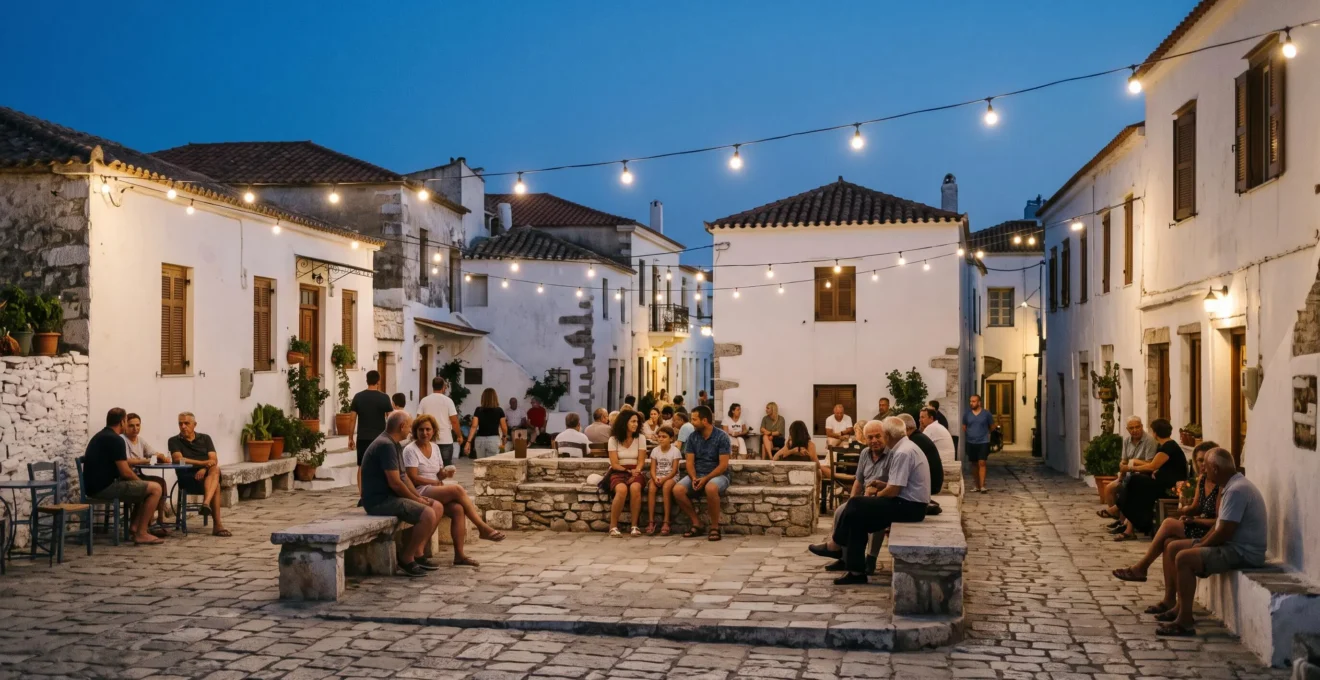
Contrary to the belief that late-night socialising is merely due to hot weather or siestas, the vibrant outdoor evening culture in places like the Canary Islands is a deeply rooted social ritual. It stems from a cultural prioritisation of the ‘third place’—a communal space distinct from home and work—that fosters community and connection. Understanding this principle is the key for any traveller wishing to move beyond observation and authentically participate in local life.
As a visitor from a culture where evenings are often a private affair, the first encounter with a Mediterranean plaza at 11 p.m. on a weekday can be a profound sensory shock. Children dart between tables, elderly couples hold court on familiar benches, and groups of friends share laughter over drinks, all bathed in the warm glow of streetlamps. The immediate questions are almost universal: Why is everyone outside? Don’t they have work tomorrow? The easy answers—the warm climate, the afternoon siesta—are tempting but ultimately incomplete. They are platitudes that scratch the surface without revealing the intricate cultural machinery operating just beneath.
These surface-level explanations fail to capture the essence of a tradition that values collective presence over private retreat. But what if the key wasn’t about optimising a schedule or reacting to the weather? What if this nightly ritual was a conscious, albeit unspoken, act of community building? This perspective shifts the question from “Why are they out so late?” to “What fundamental purpose does this public gathering serve?” This is the lens of a cultural anthropologist, seeking the ‘why’ behind the ‘what’.
This guide will deconstruct the phenomenon of the late-night plaza. We will explore the foundational theory of ‘third places’ that gives these gatherings their meaning, provide a practical framework for distinguishing authentic spaces from tourist traps, and offer guidance on how to respectfully participate. By understanding the rhythm and rules of this outdoor life, you can transform your experience from that of a passive spectator to an engaged, albeit temporary, member of the community.
Summary: The Anthropology of the Evening Stroll
- Why Mediterranean Evening Culture Prioritises Collective Presence Over Private Retreat
- How to Participate in Village Plaza Rituals Without Causing Cultural Offence
- Tourist-Oriented Terraces vs Local Neighbourhood Plazas: Where Authentic Life Happens?
- When Evening Routines Begin Across Different Island Regions
- The Dinner Timing Mistake That Closes 80% of Authentic Restaurants Before You Arrive
- Why Mediterranean Cultures Prioritise Social Connection Over Schedule Optimisation
- Why Spanish Plaza Culture Creates Stronger Neighbourhood Bonds Than Privatised Leisure
- Why Village Squares Remain Social Epicentres for 80% of Local Residents
Why Mediterranean Evening Culture Prioritises Collective Presence Over Private Retreat
The magnetic pull of the plaza after dark is not an accident; it is the manifestation of what sociologist Ray Oldenburg famously termed the “third place”. These are the vital anchors of community life, public spaces that host regular, informal gatherings of individuals beyond the realms of home (the first place) and work (the second place). Oldenburg described third places as “a great variety of public places” that are essential for civil society and a sense of belonging. The Mediterranean plaza is a quintessential example, a space designed for lingering, interaction, and the simple act of being seen together.
This cultural preference for collective presence challenges the simple binary of individualistic versus collectivistic societies. In fact, a 2023 study in the Journal of Personality and Social Psychology found that members of Mediterranean societies exhibit a distinct combination of independent and interdependent traits. This nuance is key: the plaza is not about suppressing individuality for the group. It is a space where individuals voluntarily come together, maintaining their personal autonomy while contributing to a shared, public tapestry of life. It’s a dynamic equilibrium where personal space is smaller, but communal space is vastly larger and more significant than in many other Western cultures.
Therefore, the choice to socialise outdoors is less a reaction to external factors like weather and more a proactive expression of a core cultural value: that life, in its most vibrant form, is lived in common. The private home is for rest, but the public square is for living.
How to Participate in Village Plaza Rituals Without Causing Cultural Offence
For a traveller, the desire to connect can be coupled with a fear of intrusion. How does one cross the invisible line from tourist to participant without causing offence? The answer lies in a strategy of observational participation, a gradual process of earning your place at the edge of the circle. It requires patience and the ability to read social cues, treating the plaza not as a backdrop for a photo, but as a living room with unwritten rules.
The first step is always to observe. Notice the rhythm of the space. Where do the old men sit every night? Which table is implicitly reserved for a family that arrives at 9:30 p.m. like clockwork? Rushing in and claiming a prime spot is a common mistake. Instead, a respectful approach involves a series of small, deliberate actions that signal you understand you are a guest.
As the image suggests, a gentle and tentative engagement is often the most successful. A traveller’s journey from the periphery to acceptance can be seen as a ladder of interaction. Before attempting a full conversation, one must perform the small rituals that grant you a social license to be there. This ladder includes:
- Level 1 – Observe First: Stand at the edge of the square. Note where locals sit, and avoid occupying a bench clearly claimed by regulars. Your first role is to be a quiet, unobtrusive presence.
- Level 2 – Contribute Economically: The easiest way to legitimise your presence is to become a patron. Order a coffee, a beer, or a glass of wine at the nearest bar-terrace. This purchase is your ticket to linger without loitering.
- Level 3 – Ease into Interaction: Once you are settled, your body language is crucial. A simple nod, a shared smile at a child’s antics, or a basic greeting in the local language (“Buenas noches”) to those at a nearby table is a powerful signal of respect and openness.
This approach shows you are not there to merely consume the atmosphere, but to appreciate and, eventually, contribute to it in a small way.
Tourist-Oriented Terraces vs Local Neighbourhood Plazas: Where Authentic Life Happens?
Not all bustling outdoor spaces are created equal. The ability to distinguish a genuine local hub from a well-disguised tourist trap is a critical skill for the seeker of cultural immersion. The choice you make directly impacts the quality of your experience; a finding supported by research showing that 85% of travelers enjoy their meals more when they adapt to local dining times and venues. The authentic plaza offers a window into the soul of a place, while the tourist terrace often reflects a distorted, monetised version of it.
The difference is not always obvious at first glance, but it can be felt through a series of sensory cues. Learning to read these signs is like developing an anthropological superpower. The authentic plaza speaks in the local dialect, while the tourist terrace shouts in multiple foreign languages. It’s a difference in sound, sight, and behaviour. To help you hone this skill, here is a sensory checklist comparing the two environments.
| Sensory Cue | Tourist-Oriented Terrace | Authentic Local Plaza |
|---|---|---|
| Sound | Multiple foreign languages, staff greeting in English/German by default | Local language dominant, regional accents overheard |
| Menu display | Glossy photo menus, multilingual boards, no visible prices | Handwritten or simple printed menu, clear posted prices |
| Staff behaviour | Hosts actively soliciting passersby from the sidewalk | Staff remain inside, rely on reputation and regulars |
| Clientele | Homogenous age group, mostly visitors with luggage or cameras | Multi-generational mix, children, elderly regulars, few tourists |
Ultimately, the most telling sign is the intergenerational mix. An authentic plaza is a space for the entire community, from infants to nonagenarians. If everyone around you looks like they are also on holiday, chances are you are in a bubble created for visitors, not in a place where real life happens.
When Evening Routines Begin Across Different Island Regions
Understanding *why* people gather is only half the story; knowing *when* is the practical key that unlocks the experience. Across Spain, including the Canary and Balearic Islands, the daily clock is shifted. The evening does not gently fade in; it arrives with a second wind, long after many northern Europeans have finished their dinner and settled in for the night. This temporal shift is one of the biggest hurdles for visitors to overcome.
The period between the end of the standard workday (around 6-7 p.m.) and the true start of the evening (after 9 p.m.) is a kind of ‘dead zone’ in many local neighbourhoods. Shops may be open, but the social energy has not yet converged on the plazas. This is the quiet before the delightful storm. The atmosphere begins to build as the sun sets, but the critical mass is slow to gather. For locals, the evening is just beginning when tourists, conditioned by their own schedules, might be thinking of heading home.
The ‘blue hour’ is a time of transition, a visual cue that the social machinery is about to whir to life. As celebrated restaurateur Dani Garcia explains, this is not just a feeling but a commercial reality. He notes that in Spain, the local crowd isn’t coming in for their tables until 10 p.m. This single data point is a powerful lesson: to experience authentic evening life, you must adjust your internal clock and embrace the art of waiting. The reward for your patience is arriving just as the plaza reaches its social and atmospheric peak.
The Dinner Timing Mistake That Closes 80% of Authentic Restaurants Before You Arrive
The most common error a visitor makes is to apply their home country’s dinner schedule to a Mediterranean destination. Arriving at a restaurant at 7:00 p.m. for dinner is not ‘eating early’; in many local contexts, it is eating during a time when the kitchen is either just reopening after the afternoon break or is solely catering to tourists. The authentic restaurants, the ones cherished by locals, often don’t fill up properly until around 9 p.m. or even later. By showing up too early, you inadvertently filter yourself out of the best culinary experiences.
This timing mistake channels you directly into the arms of tourist traps. These establishments are economically designed to capture the early-bird crowd. They set their tables, station their hosts on the sidewalk, and thrive on the custom of those who don’t know any better. An empty, formally set dining room at 7:30 p.m. is not a sign that you’ve discovered a hidden gem; it’s a giant red flag that you’re about to have a mediocre, overpriced meal in the company of other tourists.
To avoid this fate, you must learn to recognise the tell-tale signs of the early-bird trap. It’s a skill that combines observation with the confidence to walk away and return later. If a place seems too eager for your business at an hour when locals are still enjoying a pre-dinner stroll, it’s almost certainly not where you want to eat.
Your Action Plan: Spotting the Early-Bird Tourist Trap
- Check for sidewalk solicitation: Be wary of restaurants with staff stationed outside at 7 PM actively waving down passersby. Authentic places rely on reputation, not hawkers.
- Scan the menu display: Prominent, glossy, multi-language photo menus displayed on the street are a classic warning sign. A simple, local-language menu is a mark of confidence.
- Assess the clientele: If the dining room is fully set but the only people inside are other tourists, you’re in the wrong place. Look for places where locals are booking tables for later.
- Observe the kitchen rhythm: A truly local kitchen is just beginning its prep at 7 p.m., not sending out main courses. The smell of frantic cooking at this hour is often for the tourist service.
- Embrace the “walk-on-by”: If in doubt, keep walking. Make a note of the place and return after 9:30 p.m. If it’s now bustling with a local crowd, you’ve found a winner.
Why Mediterranean Cultures Prioritise Social Connection Over Schedule Optimisation
The late evenings are not a sign of poor time management or a lack of professional diligence. This is a common misconception. Data from the European Commission shows that, despite their famously late evenings, Spaniards work close to the EU average of 37.8 hours per week. The difference lies not in the amount of work, but in the cultural philosophy of what time is *for*. In many Northern cultures, the schedule is a master to be served; time is a resource to be optimised for maximum productivity. In the Mediterranean context, time is more fluid, a medium for human connection.
The day is structured to accommodate life, not the other way around. The long midday break (which is less about napping and more about a substantial family meal) and the late start to the evening’s social activities are deliberate choices that place a premium on relationships. It’s a system that inherently values a shared coffee that lasts an hour, a conversation that interrupts a schedule, and a communal meal that stretches late into the night. It is, in essence, a culture that has not fully surrendered to the tyranny of the clock.
The third place is at the centre of our search for a better way to live.
– Ray Oldenburg, The UNESCO Courier
Oldenburg’s sentiment captures this perfectly. The prioritisation of the plaza and the café is a conscious investment in a “better way to live,” where the primary measure of a day’s success is not what was accomplished, but who it was shared with. This is the profound logic that underpins the entire social structure. Social connection is not a leisure activity; it is the fundamental work of building a life.
Why Spanish Plaza Culture Creates Stronger Neighbourhood Bonds Than Privatised Leisure
The public plaza functions as a social incubator in a way that privatised, single-purpose venues rarely can. A cinema, a shopping mall, or a theme park are transactional spaces; you pay for a specific experience and then you leave. A plaza is a relational space. Its value is not in a single activity, but in its capacity for unplanned, spontaneous, and repeated interactions among a diverse cross-section of the community. As Ray Oldenburg noted, third places are “parent to other forms of community affiliation”, meaning the simple act of gathering in a square can lead to the formation of clubs, support networks, and deeper friendships.
This seemingly organic process is, in fact, a form of protected cultural infrastructure. The social mixing that occurs is not a byproduct of the space; it is its primary function. This is so vital that the concept has been formally recognised on an international level.
Case Study: UNESCO’s Recognition of Conviviality
The importance of shared social eating and gathering in this region is not just a quaint custom; it is a protected part of the global cultural legacy. In 2013, conviviality—the quality of being friendly and lively, especially in the context of shared meals—was formally recognized by UNESCO as an intangible cultural heritage of Spain, Greece, Italy, and Morocco, as a key component of the Mediterranean Diet. This designation elevates the daily plaza gathering from a simple leisure activity to a vital cultural practice that fosters social cohesion and ensures the transmission of customs between generations.
Unlike privatised leisure, which often segregates people by age and interest, the plaza is inherently inclusive. It is free to access, open to all, and requires no special equipment or status. This low barrier to entry ensures that it remains a true melting pot, strengthening the social fabric of the neighbourhood with every chance encounter and nightly greeting. It is the communal ground where bonds are forged not through scheduled events, but through the steady, reliable rhythm of daily life.
Key Takeaways
- The late-night social scene is driven by the cultural importance of the “third place,” not just the climate.
- Authentic experiences hinge on adapting to local rhythms; the social evening doesn’t truly begin until after 9 p.m.
- Participation is a skill learned through observation and respect, starting from the periphery and slowly moving inward.
Why Village Squares Remain Social Epicentres for 80% of Local Residents
In an age of digital isolation and privatised entertainment, the enduring centrality of the village square can seem anachronistic. Yet, for a vast majority of residents in these communities, the plaza remains the undisputed social epicentre. This is not due to a lack of alternatives, but a deep-seated understanding that this shared space performs a function that no private venue or virtual forum can replicate. It is the stage for democratic life, a place of social levelling where the mayor and the street sweeper can share the same bench. Historically, as Oldenburg asserts in The Great Good Place, such informal gathering spots have been crucial for fostering community and civility, serving as the breeding ground for everything from neighbourhood gossip to revolutionary ideas.
The rituals of the plaza—the evening paseo (stroll), the spontaneous conversations, the watchful eyes of the elders—are the threads that weave the social fabric of the village. This daily, low-stakes interaction builds a reservoir of social capital and trust that is essential for a community’s resilience. It ensures that neighbours are not strangers and that there is a collective sense of ownership and responsibility for the public realm.
This is why local communities often fiercely protect the character of their squares. They understand, intuitively, what Ray Oldenburg warned: that the “neglect of the informal public life can make a jungle of what had been a garden.” The village square is a meticulously tended garden of social relations, and its nightly bloom is a testament to a culture that actively chooses connection over isolation, community over commodity. For the 80% of residents for whom this is their primary social hub, it is not just a place; it is an irreplaceable part of their identity.
Your next step as a culturally curious traveller, therefore, is not simply to find a busy plaza, but to see it through this new lens. View it as a complex social ecosystem, practise the art of patient observation, and feel the profound difference between being a consumer of a place and a respectful guest in its public living room.