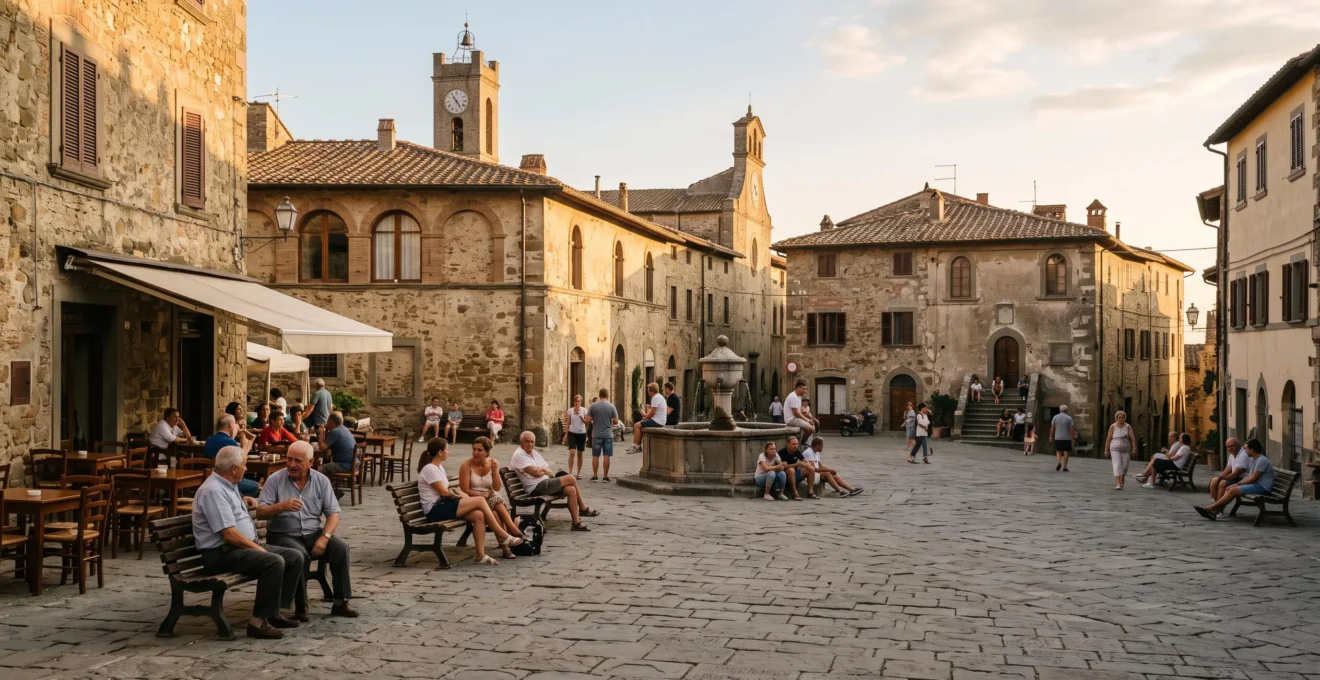
Most travellers believe that simply sitting in a village square is enough to witness local life. The reality is that the plaza is a complex social organism, not a mere backdrop. To truly understand its role, one must move beyond passive observation and learn to decode the unspoken rules of time, space, and human connection that prioritise collective presence over the rigid schedules that govern modern, privatised leisure.
For the sociologically curious traveller, the Mediterranean village square, or *plaza*, holds an almost magnetic allure. It’s the scene we picture: elderly residents on benches, children chasing pigeons, the murmur of conversation spilling from a café. The common advice is to simply go, sit, and watch. But this reduces a complex social stage to a mere spectacle. This approach often leaves us on the outside, observing a performance without understanding the script. We see the *what* but miss the crucial *why*.
The real value isn’t in just being there; it’s in learning to *see*. It’s about recognising the plaza not as a static landmark, but as a living social organism with distinct, purposeful rhythms. This perspective shifts the traveller’s role from a passive spectator to a temporary, respectful ethnographer. The key lies in a fundamental cultural difference often overlooked: a prioritisation of human transaction and collective presence over the optimisation of a personal schedule. Understanding this principle is the difference between watching people and truly observing a community’s heart in action.
This guide moves beyond the surface to provide a framework for decoding these public spaces. We will explore why these squares forge such strong bonds, how to position yourself as a mindful observer, and how to interpret the different social dramas that unfold from the morning market to the evening *paseo*. Ultimately, you will learn to read the plaza as a text, revealing the deep-seated cultural values that make it the enduring epicentre of community life.
Summary: Why Village Squares are the Key to Understanding Community
- Why Spanish Plaza Culture Creates Stronger Neighbourhood Bonds Than Privatised Leisure
- How to Position Yourself as a Respectful Observer Without Intruding
- Morning Markets vs Evening Paseos: Which Plaza Moments Reveal True Community Character?
- The Photography Mistake That Alienates Locals in 70% of Village Squares
- When Weekly Village Events Transform Plazas Into Celebration Spaces
- Why Mediterranean Cultures Prioritise Social Connection Over Schedule Optimisation
- Why Mediterranean Evening Culture Prioritises Collective Presence Over Private Retreat
- Why Islanders Socialise Outdoors Until Midnight Regardless of Weekday
Why Spanish Plaza Culture Creates Stronger Neighbourhood Bonds Than Privatised Leisure
The power of the village square lies in its role as what urban sociologist Ray Oldenburg termed a “third place”. Distinct from the first place (home) and the second place (work), third places are neutral grounds where people can gather, interact, and build community bonds informally. Unlike privatised leisure—a scheduled cinema trip, a booked restaurant table, a members-only gym—the plaza is open, unscheduled, and accessible to all. This lack of structure is not a weakness; it is its greatest strength.
This open-ended nature facilitates the constant, low-stakes social interactions that are the bedrock of a strong community. It’s where neighbours cross paths without planning to, where chance encounters become regular conversations, and where social barriers can dissolve. As Oldenburg himself noted, these are the spaces essential for a functioning civil society. In his analysis of what makes these spaces thrive, he argues they are the incubator for community life.
Third places have been parent to other forms of community affiliation and association that eventually coexist with them. There must be places in which people can find and sort one another out across the barriers of social difference.
– Ray Oldenburg, Project for Public Spaces
This isn’t just theory. Travellers consistently observe this dynamic in action. An American journalist reflecting on life in a Spanish plaza noted how the constant, informal contact created a sense of community that felt entirely absent from the structured, privatised leisure spaces common in the U.S. The plaza’s function as a communal living room means that social life is not an event to be scheduled, but a constant, ambient state of being.
How to Position Yourself as a Respectful Observer Without Intruding
To transition from a mere tourist to a mindful observer, your primary tool is subtlety. The goal is not to be invisible, but to become a neutral, non-disruptive part of the background scenery. The most effective strategy is to adopt the local customs of lingering. This means finding a legitimate reason to be stationary and quiet, such as sitting at a café with a small drink, reading a book on a bench, or simply resting near a fountain. This grants you a “social passport” to be present without raising suspicion or making others feel watched.
The key is low-key repetition. Visiting the same plaza at the same time over several days builds a subtle familiarity. Local shopkeepers and residents will begin to recognise you, and your presence will shift from “stranger” to “that person who often reads here.” It’s through this gentle consistency that the social fabric becomes more transparent. A study-abroad student in Madrid described this exact process, noting how repeated visits to the same café turned quiet observation into a genuine sense of belonging, eventually leading to small greetings and conversations.
This method mirrors the natural way community members themselves participate. As noted by Australia’s Cultural Atlas in its analysis of Spanish culture, observation is a valid form of social participation. It states that for many, especially the elderly, a healthy social life can be maintained simply by being present in a public space, watching the world go by and being available for spontaneous conversation. Your role as a temporary ethnographer is to emulate this: be present, be patient, and be approachable.
Action Plan: Becoming a Mindful Plaza Observer
- Anchor Point Selection: Choose a single, low-traffic spot (a specific café, a particular bench) as your observational base. Avoid central, high-visibility locations.
- Adopt a Prop: Carry an item that justifies your stillness, such as a book, a newspaper, or a sketchbook. This signals a purpose beyond just watching people.
- Practice Short, Repeated Visits: Instead of one long five-hour session, make two or three shorter visits over a few days. This builds familiarity without creating an intense presence.
- Master the ‘Glance and Look Away’: Observe in short, natural glances. Avoid prolonged staring at any one person or group, which can be perceived as intrusive or aggressive.
- Listen More, Record Less: Focus on absorbing the ambient sounds and conversational rhythms of the plaza. Keep your phone and camera put away to avoid creating a barrier.
Morning Markets vs Evening Paseos: Which Plaza Moments Reveal True Community Character?
A plaza is not a static environment; its character shifts dramatically throughout the day, dictated by deep-seated social rhythms. To decode its true nature, you must observe it during its two most vital moments: the morning market and the evening *paseo*. Each reveals a different facet of the community’s personality. The morning is often task-oriented and transactional, while the evening is presence-oriented and relational. This reflects a cultural mindset that values human interaction, a concept the anthropologist Edward T. Hall identified when noting that in many cultures, there is more emphasis on completing human transactions than on adhering to schedules.
The morning market is the plaza in its most practical guise. The pace is efficient and purpose-driven. You’ll see elderly residents and household managers on errands, exchanging practical news about prices, quality, and daily life. The conversations are focused, yet they are still critical social touchpoints that reinforce neighbourhood ties. In contrast, the evening *paseo*—a leisurely, aimless stroll—is the plaza at its most purely social. Entire multi-generational families emerge to see and be seen. The pace is unhurried, the conversations are about building relationships, and the primary goal is simply to be together in public space.
Understanding the distinction between these two moments is crucial for the temporary ethnographer. Neither is more “authentic” than the other; they are two sides of the same community coin. This table breaks down the contrasting social functions of these two key plaza moments.
| Dimension | Morning Market | Evening Paseo |
|---|---|---|
| Primary orientation | Task-oriented, transactional | Presence-oriented, relational |
| Dominant demographic | Elderly residents and household managers | Multi-generational mix, families together |
| Pace | Efficient, purpose-driven | Fluid, unhurried, aimless by design |
| Information exchanged | Practical news, prices, errands | Relationship-building conversation |
The Photography Mistake That Alienates Locals in 70% of Village Squares
For a traveller focused on observation, the camera can feel like a natural extension of the eye. However, it is also the single fastest way to shatter the trust you’ve carefully built and to alienate the community you wish to understand. The most common and damaging mistake is photographing local people without clear, enthusiastic consent. This act instantly transforms you from a respectful observer into an extractive tourist, and it can turn a welcoming space into a hostile one. It fundamentally changes the dynamic from shared space to a spectacle where residents are unpaid, unwilling performers.
This feeling of being objectified is a common complaint in communities frequented by tourists. Travel etiquette guides for destinations like Japan often highlight that local residents express deep frustration at being treated like “living exhibits”. This sentiment is universal. The moment a long-lens camera is pointed at someone, the natural, authentic behaviour you came to see vanishes, replaced by self-consciousness, discomfort, or resentment. You are no longer observing life; you are documenting your own intrusion upon it.
Case Study: The Ethics of Photographing Locals
A study involving tourists in Peru explored the complex ethical terrain of travel photography. Through interviews, researchers found that while tourists often felt they were capturing a moment of authentic culture, local communities frequently expressed fear and discomfort at being photographed without consent. They felt they were being reduced to objects or exotic props for a travel photo, rather than being seen as human subjects with a right to privacy. The act of being photographed without permission was an act of taking, not of exchange, which created a significant barrier between the visitor and the host community.
The rule for the temporary ethnographer is simple: put the camera away when observing people up close. Your primary tools are your eyes, ears, and memory. If you feel compelled to take a portrait, you must be prepared to engage directly, ask for permission clearly (and be prepared for a ‘no’), and build a moment of human connection first. Photographing people from a distance with a zoom lens is not a clever workaround; it is often perceived as even more intrusive.
When Weekly Village Events Transform Plazas Into Celebration Spaces
Beyond the daily rhythms of markets and *paseos*, plazas serve as the primary stage for a community’s collective celebrations. It is during weekly markets, seasonal festivals, and local holidays that the square’s role as a social epicentre reaches its zenith. On these occasions, the space transforms from an area for passive gathering into an active venue for cultural preservation and collective expression. The ambient social energy consolidates into a focused, shared experience.
These events are not just for entertainment; they are rituals that reaffirm a town’s identity and strengthen its social bonds. A weekly farmers’ market, for example, is far more than a commercial enterprise. It is a predictable, recurring touchstone for the entire community, a reliable point of mass social contact. Similarly, a saint’s day festival or a seasonal celebration like a wine harvest festival turns the plaza into a vibrant theatre of local traditions, music, and food. It’s in these moments that the “outdoor living room” becomes a “community ballroom.”
For the observer, these events offer a condensed and heightened view of the community’s values. You can see how different generations interact, what traditions are most cherished, and how social hierarchies might play out in a public setting. As noted by the language and culture site SpanishStep, it is during these celebrations that the plaza truly fulfills its function as the heart of the town, drawing everyone together for a shared purpose. Watching a community celebrate together is watching its social bonds being actively renewed in real-time.
While a quiet Tuesday afternoon reveals the subtle, everyday interactions, a bustling Saturday market or a festival night reveals the community’s personality at its most animated and expressive. Both are essential for a complete picture.
Why Mediterranean Cultures Prioritise Social Connection Over Schedule Optimisation
At the heart of the unhurried, seemingly aimless activity in a Mediterranean plaza is a fundamentally different conception of time. Many travellers, hailing from what anthropologist Edward T. Hall called monochronic cultures, view time as linear, tangible, and something to be managed, saved, or wasted. Schedules are paramount, and tasks are completed one at a time. In contrast, many Mediterranean and Latin cultures operate on a polychronic time system. Here, time is more fluid and elastic. The focus is not on rigid adherence to a schedule but on the completion of human transactions and the nurturing of relationships.
This is not a sign of inefficiency; it is a different set of priorities. A planned meeting might be delayed because a more important, unplanned social interaction is taking place. An errand might take three times as long because it involves catching up with three different acquaintances along the way. As Hall’s work, analysed in guides on cross-cultural communication, points out, polychronic individuals stress the importance of relationships over preset timetables. An academic study on time perception confirmed this, finding that participants from polychronic-oriented settings consistently favoured informal, relationship-building communication over rigid, schedule-first interactions.
For the temporary ethnographer in a plaza, this is the master key to decoding what you see. The two-hour coffee, the conversation that lingers for half an hour after a “goodbye,” the stroll with no destination—these are not instances of “wasted time.” They are investments in the social fabric. People are not killing time; they are cultivating connections. Understanding this frees you from the monochronic impulse to ask, “What is the point of this?” and allows you to see the point is simply *being together*.
This cultural approach values presence over productivity. The success of a day is not measured by the number of tasks completed, but by the quality of the social connections maintained and reinforced.
Why Mediterranean Evening Culture Prioritises Collective Presence Over Private Retreat
As dusk settles, a cultural preference for public life over private isolation becomes beautifully apparent. In many Western, suburban cultures, the evening is a time for retreat into the private sphere of the home. In contrast, in many Mediterranean towns, the evening prompts an expansion into the public sphere. The plaza effectively becomes an “outdoor living room,” a concept highlighted by cultural observers. This is not just a quaint metaphor; it is a literal description of the space’s function. The community collectively moves its social life outdoors.
Several factors drive this phenomenon. Historically, indoor living spaces were often small and poorly ventilated, making the cooler evening air of the plaza a practical comfort. But the practice has evolved into a deeply ingrained social ritual. It represents a prioritisation of collective presence and ambient socialisation. Being in the plaza in the evening is to be available for community life, to see and be seen, and to reaffirm your place within the group. It is an antidote to the isolation that can define modern life.
The social benefits of this model are significant. While it’s difficult to draw a direct causal link, it’s telling to contrast this with trends in more privatised societies. For instance, a widely cited study found that 36% of Americans reported feeling serious loneliness. While many factors contribute to this, the lack of accessible, informal “third places” like a thriving evening plaza undoubtedly plays a role. The Mediterranean evening culture provides a built-in, daily mechanism for low-stakes social connection, acting as a powerful buffer against social isolation.
Key Takeaways
- True observation goes beyond watching; it requires decoding the plaza’s function as a “third place” for informal community building.
- Respectful observation is a skill built on subtlety, repetition, and adopting local customs of lingering, not on intrusive photography.
- A plaza has distinct rhythms: the task-oriented morning and the relationship-oriented evening reveal different facets of community life.
Why Islanders Socialise Outdoors Until Midnight Regardless of Weekday
Nowhere is this commitment to outdoor public life more pronounced than on Mediterranean islands. Here, the cultural tendencies we’ve observed are amplified by climate, architecture, and a strong, self-contained community ethos. It is not uncommon to see plazas bustling with multi-generational groups of residents until midnight, even on a Tuesday. This is not a special occasion; it is the normal, predictable rhythm of life. This phenomenon is the ultimate expression of a culture that prioritises collective presence and social well-being.
The reasons are a synthesis of everything discussed. The warm climate makes outdoor living comfortable for much of the year. Traditional island architecture often features smaller indoor living areas, making the plaza a natural and necessary extension of the home. But most importantly, the polychronic and collectivist values are deeply embedded. The day’s work is finished, but the day itself is not over until the vital “work” of socialising is also complete. This is not seen as leisure, but as an essential daily activity, as important as eating or sleeping.
For island communities, the plaza is the primary arena for information exchange, social support, and identity reinforcement. To retreat indoors is to cut oneself off from the lifeblood of the community. Therefore, children, parents, and grandparents all coexist in the same space, creating a constant, fluid social environment. The late hours are simply a natural consequence of a day structured around human connection rather than a 9-to-5 work schedule followed by private rest. It is the social organism in its most complete and vibrant form.
By learning to decode these spaces, the curious traveller can move past the role of a passive onlooker and gain a genuine, ethnographic insight into the heart of a community. The next step is to find a bench, take a patient seat, and begin to read the living story unfolding before you.