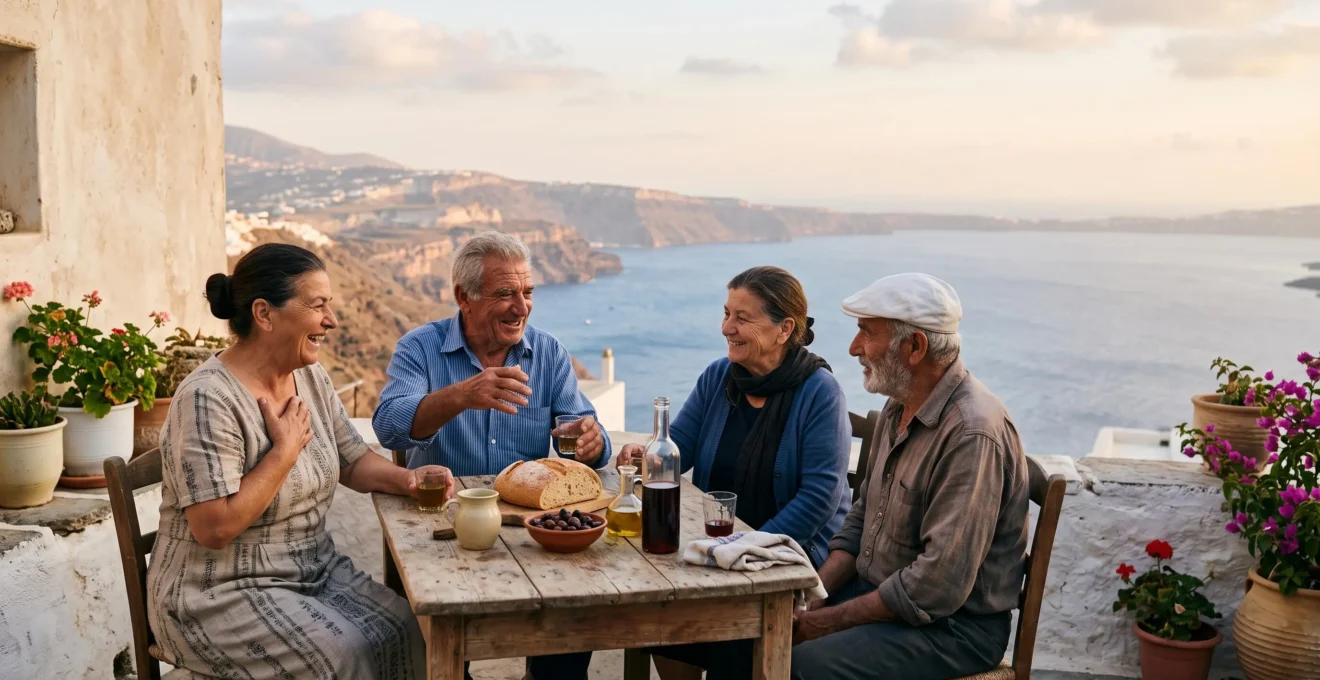
The secret to island longevity isn’t a better diet or more exercise; it’s a fundamentally different relationship with time itself.
- Mainland cultures operate on ‘Chronos’—the relentless, quantitative ticking of the clock, which fuels productivity culture and chronic stress.
- Island cultures prioritise ‘Kairos’—the qualitative, opportune moments for connection, presence, and rest, which is physiologically protective.
Recommendation: To begin this shift, stop trying to schedule ‘relaxation.’ Instead, practice a 48-hour ‘temporal decompression’ by letting your environment, not your calendar, dictate your day.
For the modern urban professional, time is the ultimate scarce resource. We are caught in a paradox: armed with unprecedented productivity tools, we feel more time-poor than ever. The constant pressure to optimise, schedule, and measure every minute of our day leads to a pervasive state of “Chronos Anxiety,” a low-grade stress born from the relentless ticking of the clock. We try to combat this with scheduled “digital detoxes,” wellness apps, and meticulously planned holidays, attempting to solve a problem of the clock by using the clock’s own logic.
This approach fundamentally misunderstands the issue. The persistent longevity gap between island dwellers and their mainland counterparts offers a profound clue. It’s not simply about sunshine or diet; it’s about a completely different cultural operating system for life. While we on the mainland try to cram more “life” into our time, island cultures cultivate more “time” in their lives.
But what if the key to a longer, more fulfilling life isn’t about better time management, but about escaping the tyranny of managed time altogether? What if the solution lies not in optimising our schedules, but in understanding a different dimension of time, one that prioritises presence over productivity? This is the central premise of island life—a lesson in shifting from the quantitative time of clocks (Chronos) to the qualitative time of moments (Kairos).
This article explores the anthropological and cultural mechanics behind this “time dividend.” We will deconstruct the islander’s relationship with time, understand the science of how it impacts our biology, and provide a practical framework for you to begin your own transition from the rush of the mainland to the rhythm of the island, even without changing your address.
To navigate this exploration of time and well-being, we will examine the core principles that distinguish island life from the mainland’s pace. The following sections break down this cultural shift into its essential components, from social structures to personal habits.
Summary: The Island Time Dividend: Unpacking the Longevity Secret
- Why Mediterranean Cultures Prioritise Social Connection Over Schedule Optimisation
- How to Adopt “Mañana Culture” Without Guilt During Your Stay
- Chronos vs Kairos Time: What Island Rhythms Teach About Presence
- How to Transition From Rush Mode to Island Pace in Your First 48 Hours
- The Scheduling Mistake That Prevents 80% of Visitors From Truly Slowing Down
- Why Chronic Screen Exposure Disrupts Circadian Rhythms Within 3 Weeks
- Why Mediterranean Evening Culture Prioritises Collective Presence Over Private Retreat
- Why Islanders Socialise Outdoors Until Midnight Regardless of Weekday
Why Mediterranean Cultures Prioritise Social Connection Over Schedule Optimisation
In the productivity-driven mainland world, social interaction is often another item on a to-do list—a scheduled coffee, a networking event, a planned family dinner. It’s an activity to be fit into the gaps between work and personal obligations. In many island and Mediterranean cultures, this logic is inverted. Social connection is not an activity; it’s the very medium in which life happens. These are high-context cultures, where people rely on indirect, nonverbal communication and emphasize relationships and social bonds over rigid agendas.
This isn’t just a romantic notion; it’s a structural reality. The “piazza” or village square is not just a location but a social engine, a shared outdoor living room where chance encounters are not just possible, but expected. This environment fosters a state of social synchronicity, where the community’s rhythm is governed by a collective flow rather than individual calendars. The need to “schedule a catch-up” disappears when you know you will inevitably cross paths with friends and neighbours during the evening passeggiata.
The health implications are profound. This constant, low-stakes social engagement acts as a powerful buffer against stress and loneliness. In the “Blue Zone” of Ikaria, Greece—an island famed for its residents’ longevity—this is a cornerstone of daily life. A peer-reviewed study of the island’s oldest residents found that over 77.9% have daily social contact, a figure that highlights a deep integration of community into the fabric of existence. They don’t need to “work on” their social lives; their environment is structured to provide it effortlessly.
This cultural priority demonstrates that strong relationships are not a product of efficient scheduling but a natural outcome of a society that values presence over productivity.
How to Adopt “Mañana Culture” Without Guilt During Your Stay
For the urban professional, the word “mañana” often carries a negative connotation of procrastination and inefficiency. We are programmed to see a delay as a failure, a deviation from the plan. However, within island cultures, the concept is not about putting things off indefinitely; it’s about prioritising the present moment over an arbitrary deadline. It is a tacit acknowledgement that the “right time” for a task is determined by energy, readiness, and circumstance, not just the clock. This is the essence of valuing Kairos moments over the relentless march of Chronos.
As writer Enuma Okoro notes, “Kairos is the qualitative time of life.” It is the opportune moment, the unexpected conversation that unfolds, the sudden urge to watch the sunset. To live in Kairos is to trust that the most important things will happen when the time is right, not when the calendar reminder pops up. Adopting this mindset requires releasing the guilt associated with not being “productive” in the conventional sense. The Blue Zones research on Ikaria’s clock-free daily rhythm perfectly illustrates this. Researchers describe how Ikarians enjoy strong red wine and late-night domino games, living with a relaxed pace that largely ignores clocks. This demonstrates that their “mañana” lifestyle is a deliberate cultural choice for well-being, not a sign of laziness.
For a visitor, this means consciously giving yourself permission to be “inefficient.” It means starting the day without a fixed itinerary and letting curiosity lead. It means lingering over a meal because the conversation is good, even if it means missing a planned activity. The goal is to shift your internal metric of a “successful day” from “tasks completed” to “quality of presence achieved.”
By embracing this perspective, the visitor can transform a potentially frustrating delay into a welcome opportunity for genuine connection and rest.
Chronos vs Kairos Time: What Island Rhythms Teach About Presence
The ancient Greeks had two words for time, a distinction that is arguably the single most important concept for understanding the islander longevity phenomenon. The first is Chronos: the time we know best. It is chronological, quantitative, and linear. It is the time of clocks, calendars, and deadlines—a resource to be managed, saved, or wasted. Modern mainland life is a relentless worship of Chronos.
The second word is Kairos. This is qualitative, opportune, and non-linear time. It is the “right” time, the supreme moment for action or being. Kairos is the tear in the fabric of Chronos—the spontaneous heart-to-heart, the flash of inspiration, the perfectly still moment of watching a sunset. You cannot schedule Kairos. You can only create the conditions for it to emerge by being present and open. Island life is, at its core, a cultivation of Kairos.
This division between the mechanical time of the sundial and the organic time of the tides captures the essence of this concept. The clock measures, but nature reveals. As Vladimir Lenin is often quoted, “There are decades where nothing happens; and there are weeks where decades happen.” This speaks to the power of Kairos—moments of profound significance that defy the steady ticking of the clock. By constantly optimising for Chronos, we fill our lives with activity but starve ourselves of these transformative Kairos moments. Island cultures, by leaving space in their days, by prioritising being over doing, create a fertile ground for Kairos to flourish.
This is the fundamental lesson of island rhythms: a full life is not measured by a packed schedule, but by a wealth of meaningful, opportune moments.
How to Transition From Rush Mode to Island Pace in Your First 48 Hours
The transition from the high-octane pace of mainland life to the gentle rhythm of an island is not automatic. Many visitors spend the first few days of their holiday in a state of agitated withdrawal from “Chronos Anxiety,” checking emails and trying to impose a schedule on a culture that resists it. The key to avoiding this is to engage in a conscious process of temporal decompression. This requires shifting your focus from your mind (plans, thoughts, worries) to your body and senses.
A sensory deceleration ritual can be a powerful tool for this. It is about intentionally engaging your senses with the new environment. It is about grounding yourself in the physical reality of the here and now, which acts as an anchor against the pull of mental urgency. This is not about seeing the sights; it is about feeling the place. The first 48 hours are crucial for resetting your internal clock away from an artificial grid and onto a natural, more human pace.
As the image suggests, this process is about tactile connection. It’s about feeling the texture of a sun-warmed stone, the grain of a weathered piece of wood, the cool silkiness of the water. It’s about listening to the sound of the waves instead of your notification tone, and smelling the salt and herbs in the air. By focusing on these simple, direct sensory inputs, you pull your awareness out of the abstract world of schedules and into the tangible present. This is the first, most critical step in learning to move with “no rush to get from one place to another,” as the islanders do.
Your 48-Hour Temporal Decompression Plan
- Ditch the Clock: Upon arrival, take off your watch and move it out of sight. Turn off all non-essential notifications on your phone. Your goal is to rely on the sun and your own body for time cues.
- Go for a “Pointless” Walk: Walk for 30 minutes without a destination. Your only task is to notice five things you can see, four things you can hear, three things you can feel (the breeze, the ground), two things you can smell, and one thing you can taste (the salt on the air).
- Engage in a Single-Task Meal: Eat one meal with no distractions. No phone, no book, no planning the rest of your day. Focus solely on the flavours, textures, and aromas of the food. Notice the act of eating itself.
- Sync with the Sun: Make a point to consciously observe the sunrise or sunset. Don’t just photograph it. Watch the entire event, noticing the slow change of light and colour. This connects you to a powerful, natural rhythm.
- Initiate One Unscheduled Conversation: Talk to a local—a shopkeeper, a cafe owner—without an agenda other than simple human connection. Ask a question not found in a guidebook. This opens the door to Kairos.
This intentional deceleration is not passive; it is an active choice to recalibrate your nervous system to the pace of your new surroundings.
The Scheduling Mistake That Prevents 80% of Visitors From Truly Slowing Down
The ultimate irony for the over-achieving urban professional is attempting to “win” at relaxation. We take the same optimising mindset that governs our work life and apply it to our holidays. The single biggest mistake visitors make is creating a detailed, back-to-back itinerary. They schedule the 8:00 AM yoga class, the 10:00 AM museum visit, the 1:00 PM lunch reservation, and the 4:00 PM boat tour, effectively recreating their mainland work week in a more scenic location.
This approach is a trap. It treats relaxation and connection as tasks to be completed and ticked off a list. It reinforces the very “Chronos Anxiety” they are trying to escape. Every scheduled event creates a soft deadline, a subtle pressure to wrap up the current moment to get to the next one. You can’t fully immerse yourself in a conversation if you’re glancing at your watch, worried about being late for your next “leisure activity.” This is the core of the mistake: trying to schedule spontaneity. It is a contradiction in terms.
True island pace is about creating empty space in the day. It is this unstructured time that allows for Kairos—the unexpected nap, the spontaneous detour down a charming alley, the conversation that stretches for hours. As observers of Blue Zone cultures note, simple acts like “taking breaks, napping, and not rushing, helps reduce stress and its harmful effects on the body.” These are not scheduled events; they are natural responses to the body’s needs, which can only be heard when the noise of the schedule is turned down. The real goal is not to “do” all the relaxing things, but to do nothing long enough that genuine relaxation finds you.
The most profound travel experiences are rarely the ones you plan; they are the ones that happen when your plans fall apart.
Why Chronic Screen Exposure Disrupts Circadian Rhythms Within 3 Weeks
The islander’s life is tethered to the great, predictable rhythms of nature: the rising and setting of the sun, the turning of the tides, the cycles of the seasons. The modern mainlander’s life is tethered to the flickering, unpredictable rhythm of a screen. This is more than a poetic difference; it is a profound biological one. Our circadian rhythm, the internal 24-hour clock that governs sleep, hormone release, and metabolism, evolved to sync with the natural light-dark cycle. Chronic screen use is a form of circadian uncoupling—it severs this ancient connection.
The blue light emitted by our phones, tablets, and computers is particularly disruptive. It tricks the brain into thinking it’s still daytime, suppressing the production of melatonin, the hormone that signals it’s time to sleep. This doesn’t just delay sleep; it degrades its quality. The impact is measurable and swift. For instance, a large cross-sectional cohort study of adults found that daily screen use before bed was associated with approximately 50 minutes less sleep per week.
The consequences go beyond simple tiredness. This desynchronisation creates a state known as “social jetlag,” where your body’s clock is out of sync with your social and work obligations. As a study on adolescents published in the *Journal of Affective Disorders* found, this screen-induced shift towards a later chronotype can amplify emotional problems. By constantly exposing ourselves to artificial light and the stimulating, time-agnostic world of the internet, we are placing our bodies in a state of perpetual, low-grade jetlag. Re-syncing with the island pace is therefore as much about disconnecting from artificial rhythms as it is about connecting with natural ones.
Escaping to an island, then, offers not just a change of scenery, but a precious opportunity to recalibrate our most fundamental biological clock.
Why Mediterranean Evening Culture Prioritises Collective Presence Over Private Retreat
On the mainland, the evening often signals a retreat. After a long day of work and commuting, we close our front doors, retreating into the private bubbles of our homes. The evening is for unwinding, for individual or small family unit consumption of entertainment—binge-watching a series, scrolling through social media. It is a time of private recovery from the pressures of public life. In many Mediterranean island communities, the cultural script for the evening is precisely the opposite: it is a time for expansion, not retreat. It is a move into the collective.
The entire village or neighbourhood becomes an extension of one’s living room. As dusk falls, the streets and squares don’t empty; they fill up. This is the time for the “volta” or “passeggiata,” a gentle, aimless stroll where seeing and being seen is the main event. It is a masterful piece of social design that engineers effortless community connection. This practice isn’t about a specific event or destination; it’s about the act of being present together in a shared space.
This cultural habit reinforces the idea that life is to be lived in common. As Blue Zones researchers have consistently found, Ikarians and other long-lived populations actively “foster social connections, which have been shown to benefit overall health and longevity.” The evening stroll is not exercise; it is social maintenance. It’s not networking; it’s community weaving. For the visitor, observing or even joining this ritual is to witness a profound truth: these communities don’t have to “schedule” social time because their entire evening culture is built around creating and sustaining collective presence.
It redefines the evening from a time of passive consumption to one of active, communal participation.
Key Takeaways
- Island longevity stems from a cultural shift from clock-time (Chronos) to event-time (Kairos), which reduces chronic stress.
- Social connection is not a scheduled activity but an ever-present foundation, woven into the fabric of daily life through effortless, spontaneous encounters.
- True deceleration requires actively uncoupling from digital clocks and schedules, and recoupling with natural rhythms (sun, sea) and social flows.
Why Islanders Socialise Outdoors Until Midnight Regardless of Weekday
The image of islanders dining and talking late into the night, even on a Tuesday, is often puzzling to the mainland observer who is conditioned by the “work week” rhythm. For us, a late night implies a weekend or a special occasion, followed by a price to be paid in grogginess the next morning. This difference reveals the final piece of the longevity puzzle: islanders are not beholden to the same rigid, industrial-era time structures. Their day is not defined by a 9-to-5 block followed by a short period of “free time.”
Life is more fluid, often integrating afternoon naps (“siestas”) which break the day into two halves and naturally push evening activities later. This rhythm is more aligned with our natural biology than the monolithic 8-hour workday. The late-night socialising is not a reckless indulgence; it’s the logical conclusion of a day structured around human needs rather than corporate clocks. It is the time when the heat of the day has subsided, work is done, and the entire community can come together. It is the peak of social synchronicity, a time for what one observer called the essence of community: “Shared laughter, collective grief, prayer, music, even arguments.”
This is the ultimate expression of a life lived in Kairos. The “right time” to go home is not when the clock strikes a certain hour, but when the conversations have reached a natural conclusion and the energy of the gathering wanes. This deep, daily reinforcement of social bonds has a powerful, cumulative effect on health, forming the bedrock of the incredible longevity seen in these places. In Ikaria, for example, research shows that residents live on average 10 years longer than their American counterparts, with significantly lower rates of chronic disease. This is the ultimate dividend of a life rich in time and connection.
The first step towards this healthier pace isn’t to book a flight, but to audit your own relationship with the clock. Begin by identifying one ‘Kairos moment’ in your day—a moment you choose to be present in, without an agenda or a deadline.