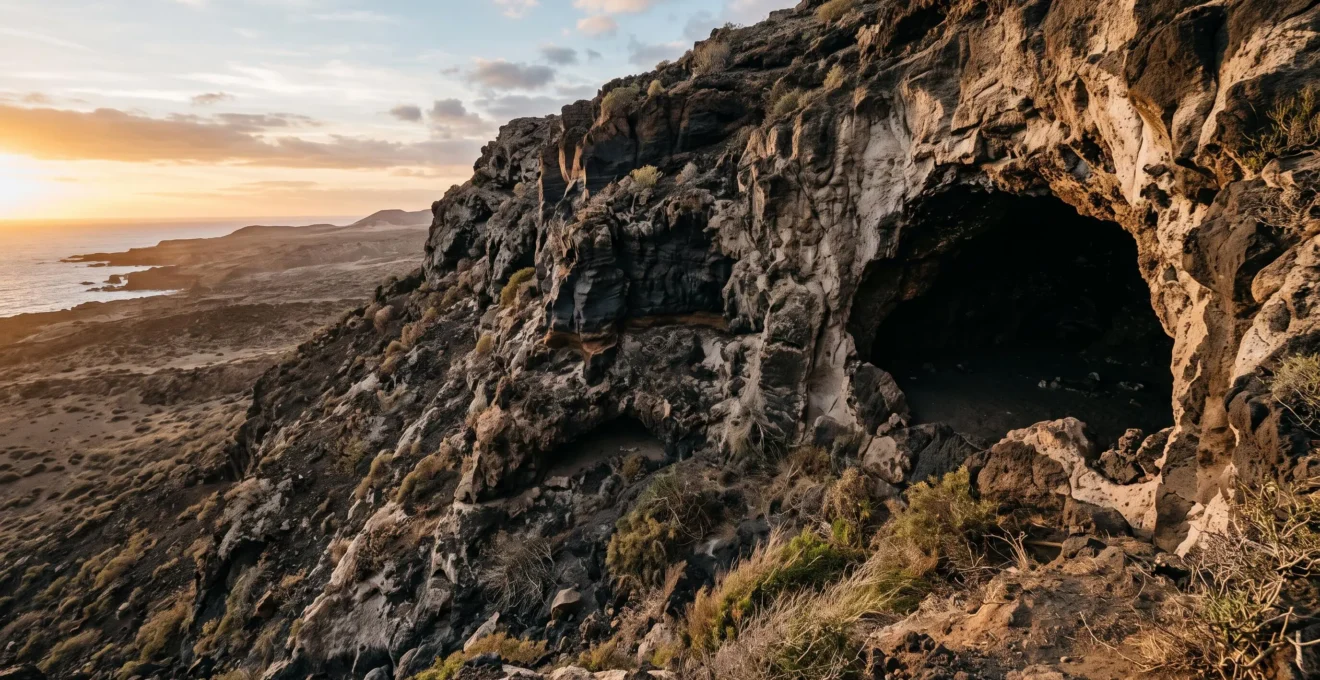
While the comparison to Ancient Egypt is common, it often misses the point. The story of Guanche mummification is not one of simple technical rivalry, but of a unique cultural practice deeply woven into the volcanic landscape of the Canary Islands. This article reframes the narrative, moving beyond preservation techniques to explore the Guanche people’s true origins, their worldview, and the modern ethical duty to honour their ancestral remains not as museum objects, but as a direct link to a resilient, pre-colonial civilization.
The image of a mummy almost invariably conjures the gold-laden sarcophagi of Egypt’s Nile Valley. It’s a powerful, millennia-old paradigm of funerary rites and the quest for permanence. Yet, on the volcanic archipelago of the Canary Islands, another, less-known civilization perfected its own form of preservation, creating ancestral mummies of such remarkable quality that they continue to challenge scientific understanding. These are the mummies of the Guanches, the Indigenous Berber people who inhabited the islands long before the Spanish conquest. Their methods were not a lesser imitation of Egyptian practices but a distinct and sophisticated cultural response to their unique environment.
Too often, discussions about the Guanches are framed by colonial-era mystery or reduced to a checklist for tourists. This perspective overlooks the profound meaning behind their funerary customs. To truly understand Guanche preservation is to engage in an act of civilization-recovering. It requires us to look past the wrappings and see the people: their North African origins confirmed by modern genetics, their connection to the land etched in the placement of their sacred caves, and their voices, nearly silenced by conquest, now re-emerging through linguistic traces and a powerful movement for repatriation.
This journey moves beyond a simple comparison of techniques. It is an exploration into the heart of a civilization, tracing the thread of ancestral continuity from ancient remains to the contemporary identity of the Canary Islands. By examining the science, the sites, and the sensitive ethics of display and return, we can begin to appreciate the Guanche legacy on its own terms—as a testament to a culture that mastered the art of permanence against all odds.
Table of Contents: The Enduring Legacy of Guanche Preservation
- Why Genetic Studies Reveal North African Berber Origins of Island Populations
- How to Visit Archaeological Sites and Museums Preserving Guanche Artefacts
- Preservation vs Repatriation: What Ethical Debates Surround Guanche Mummy Displays?
- How to Recognise Cave Dwelling Sites and Megalithic Structures During Hikes
- The Colonial Erasure That Eliminated 95% of Indigenous Language and Customs
- How to Visualise Geological Timescales Using Island Age Comparisons
- How to Trace Cultural Influences Through Linguistic Borrowings in Local Dialect
- Why Island Identity Reflects 5 Distinct Cultural Tributaries
Why Genetic Studies Reveal North African Berber Origins of Island Populations
For centuries, the origins of the Guanches were shrouded in myth, with romanticized theories suggesting connections to Celts or even survivors of Atlantis. However, the field of restitutive archaeology, powered by modern genetics, has definitively replaced colonial fiction with scientific fact. The Guanche people were not a mysterious anomaly but were closely related to the Indigenous Amazigh (Berber) populations of North Africa. This connection, long suspected through linguistic and cultural similarities, is now written in their very DNA, offering a powerful tool for restoring their historical narrative.
Case Study: The First Genome-Wide Sequencing of Guanche Remains
A landmark study published in Current Biology provided the first genome-wide data from pre-conquest Guanche individuals. Researchers analysed remains from Gran Canaria and Tenerife, dating from the 7th to 11th centuries, and found their closest genetic relatives to be modern Northwest Africans. This bio-archaeological dialogue also revealed the enduring legacy of this ancestry, estimating that Guanches contributed between 16% and 31% of the autosomal ancestry of modern inhabitants on Gran Canaria, directly linking the islands’ first people to those living there today.
Further analysis has deepened this understanding. A 2023 genomic data refinement shows the Guanche population had ~73% of their ancestry from Late Neolithic North Africans, with smaller contributions from Bell Beaker-era Europe and Sub-Saharan Africa. This data confirms a migration from North Africa around the first millennium BCE. This scientific validation is more than an academic exercise; it is a crucial act of reclaiming identity, grounding the Guanche story in its rightful historical and geographical context.
By generating the first autosomal genetic data from these populations we can conclusively demonstrate that the Guanches were most closely related to modern North Africans of Berber ancestry than to any other population we included for comparisons, supporting previous studies but adding more detail and nuance.
– Dr. Ricardo Rodríguez Varela, Stockholm University, as reported by Sci-News
This genetic evidence serves as the bedrock of Guanche identity, dismantling colonial myths and affirming a heritage that is both uniquely Canarian and part of a broader North African cultural tapestry.
How to Visit Archaeological Sites and Museums Preserving Guanche Artefacts
Engaging with Guanche history requires a shift in perspective from that of a tourist to that of a respectful observer. The artefacts and ancestral remains housed in museums are not mere curiosities but are the tangible legacy of a civilization and the direct ancestors of many modern Canarians. Visiting these collections is an opportunity to learn and pay respect. The primary institution for this is the acclaimed Museo de Naturaleza y Arqueología (MUNA) in Santa Cruz de Tenerife, where the largest single collection of Guanche mummies is held and interpreted with increasing sensitivity.
When observing these artefacts, look beyond their form to appreciate their function and the craftsmanship they represent. The intricate patterns on pottery (pintaderas), the sharpness of obsidian tools (tabonas), and the textures of woven palm leaves speak to a deep understanding of local materials. These were not primitive objects but the products of a sophisticated material culture adapted perfectly to the volcanic environment.
This tactile connection to the past reveals a people who lived in intimate dialogue with their surroundings. The materials they chose—volcanic stone, goat hide, dragon tree sap—tell a story of resourcefulness and ingenuity. Viewing these objects is a chance to honour the skilled artisans and daily life of the Guanche people, moving beyond a singular focus on their famous mummies to appreciate the richness of their entire civilization. A mindful visit is an act of acknowledging this complete and complex history.
Preservation vs Repatriation: What Ethical Debates Surround Guanche Mummy Displays?
The display of Indigenous human remains is one of the most contentious issues facing museums worldwide, and the Guanche mummies are at the heart of this debate in Spain. For decades, they were presented as scientific specimens or colonial trophies, objects of study detached from their human identity. Today, a growing movement led by Canarian cultural authorities and indigenous rights advocates calls for a new ethic, one centred on respect, dignity, and repatriation. This perspective argues that these are not objects to be owned but ancestors who deserve to return to their homeland.
The tension lies between the traditional museum mandate of preservation and scientific access, and the ethical imperative of restitution. While displaying mummies can educate the public, many Canarians feel it is a violation of the ancestors’ final rest. The sentiment that these individuals should be returned to the islands, and perhaps even re-interred in a respectful manner, is gaining significant political and social traction. Viewing their public display as ” an offence to all Canarians,” as stated by Rosa Dávila, President of Tenerife’s Cabildo, captures the deep emotional and cultural significance of this issue.
Case Study: The Repatriation Negotiations for the Erques Mummy
A pivotal moment in this debate occurred in 2025 when Spain’s National Archaeological Museum in Madrid removed its best-preserved Guanche mummy from public view. This action, however, did not immediately lead to its return. Instead, it initiated formal repatriation negotiations between the Canary Islands’ government and the Spanish Ministry of Culture. This case highlights the shift from a colonial model of acquisition to a modern framework of negotiated return, acknowledging the Guanche mummies as subjects of cultural sovereignty rather than objects of a national collection.
This ongoing dialogue is a crucial part of restitutive archaeology. It forces a reckoning with the colonial past and asks a fundamental question: who has the right to be the custodian of a people’s ancestors? For the visitor, understanding this debate is as important as seeing the artefacts themselves; it contextualizes the visit within a living struggle for cultural justice.
How to Recognise Cave Dwelling Sites and Megalithic Structures During Hikes
The Guanche civilization did not build pyramids or grand temples; their sacred architecture was the landscape itself. They lived in and utilized the natural volcanic formations of the islands, primarily lava tubes and natural caves. For the archaeologically-minded hiker, the Canary Islands offer a unique opportunity to witness this cultural cartography firsthand. Recognizing potential sites is not about treasure hunting, but about learning to read the subtle human interventions on the natural environment. These were not just shelters but homes, granaries, and, most sacredly, burial sites (necrópolis).
When hiking, especially in the rugged barrancos (gorges) of Tenerife or Gran Canaria, look for tell-tale signs. These include clusters of caves with evidence of human modification, such as enlarged entrances or flattened floors. You might spot remnants of stone walls used to enclose a cave opening or create interior divisions. Another key indicator is the presence of cazoletas—cup-like hollows carved into rock surfaces, believed to be for ritual offerings. Finding pottery shards or fragments of obsidian tools is also a strong sign of a former settlement. However, it is imperative to remember these are protected archaeological zones.
The guiding principle must be one of absolute respect: look, but do not touch. Never enter a cave that appears to be an archaeological site, and never, under any circumstances, remove an artefact. The best practice is to photograph the site from a distance, note its GPS coordinates if possible, and report it to the local Cabildo’s heritage department. By doing so, you transform from a passive tourist into an active participant in the preservation of Guanche history, ensuring that these fragile links to the past can be properly studied and protected.
Your Action Plan for Ethical Site Observation
- Identify Potential Signs: Look for clusters of caves, man-made terraces on steep slopes, carved channels (cazoletas) in rock, or remnants of dry-stone walls near cave openings.
- Maintain Distance: Once you spot a potential site, do not approach or enter. Observe from the trail to avoid disturbing fragile archaeological layers.
- Document, Don’t Disturb: Take photos and note the location. Do not touch, move, or remove any objects, including pottery shards or stones that look like tools.
- Assess for Mémorabilité: Note any unique features (e.g., a large number of caves, specific carvings) that distinguish the site from the surrounding natural landscape.
- Report Responsibly: Contact the local island council (Cabildo) or a local archaeological museum with your findings, providing photos and location data to aid in official preservation efforts.
The Colonial Erasure That Eliminated 95% of Indigenous Language and Customs
The story of Guanche preservation techniques is inseparable from the narrative of their destruction. The Spanish conquest of the Canary Islands, completed in the late 15th century, was not just a military takeover but the beginning of a systematic process of ethnocide. This colonial project aimed to erase the indigenous culture to impose a new European, Christian order. Within a few generations, the Guanche language—a variant of the Amazigh (Berber) tongues—ceased to be spoken, and their complex spiritual beliefs were suppressed and forced to syncretize with Catholicism.
The figure of a 95% elimination of language and customs is an estimation of this cultural loss. It represents the near-total disappearance of the Guanche language as a living tongue, the loss of their unique social structures (like the matrilineal succession documented on some islands), and the eradication of their religion, which involved the worship of deities linked to nature and the sky. The mummification process itself, the sophisticated practice of *mirlado*, was abandoned as it was tied to this “pagan” belief system. The knowledge of the embalmers, a specialized and respected class, was lost forever.
This erasure was not accidental; it was policy. The Guanches were subjected to forced baptism, enslavement, and marriage into the colonist population. While this led to the genetic mixing we see today, it came at the cost of their cultural sovereignty. The colonizers wrote the history, often depicting the Guanches as primitive savages to justify their own actions. It is this distorted, colonial-era narrative that modern Canarian scholars and activists are working so hard to dismantle. The recovery of every lost word, every archaeological site, and every piece of ancestral DNA is an act of defiance against this historical erasure.
Key Takeaways
- Guanche origins are not mysterious; genetic science confirms they were Indigenous Amazigh (Berber) people from North Africa.
- The quality of Guanche mummification was exceptional, often rivalling Egyptian examples due to a combination of intentional techniques and the islands’ arid environment.
- Modern debates focus on the ethical imperative of repatriating Guanche ancestral remains from museums back to the Canary Islands, reframing them as ancestors, not objects.
How to Visualise Geological Timescales Using Island Age Comparisons
The remarkable preservation of Guanche mummies is a story of both human ingenuity and geological luck. To understand why their techniques were so successful, one must visualize the Canary Islands not just as a place, but as a specific environment in time. The Guanche practice of *mirlado* involved evisceration and the use of desiccating substances like pine resin and absorbent minerals. However, the true genius of their method was leveraging the islands’ unique microclimates. The Guanches knew their land intimately and selected specific burial caves with the ideal conditions for preservation.
These were typically dry, well-ventilated caves, often located in the southern and western parts of the islands. The geology and climate of these areas created natural dehydrators. With annual rainfall of only 100-300 mm in the southern zones, the environment was exceptionally arid. This low humidity, combined with consistent temperatures and airflow within the volcanic caves, wicked moisture from the bodies, arresting decomposition far more effectively than in a damp or variable climate. This environmental partnership was the secret to their success.
The Guanche mummy was much better preserved than the Egyptian [ones].
– Javier Carrascoso, Associate Chief of Radiology, QuirónSalud University Hospital, in National Geographic
This statement from a medical imaging expert who studied the remains highlights the stunning outcome of this socio-environmental strategy. While Egyptian embalmers battled a humid river valley climate, the Guanches worked in concert with their arid volcanic landscape. It’s a powerful example of Indigenous science—a deep, empirical knowledge of the local environment used to achieve a sophisticated cultural goal. Visualizing the island’s geological character is therefore key to appreciating the mummies not as magical artefacts, but as the result of a masterful collaboration between culture and nature.
How to Trace Cultural Influences Through Linguistic Borrowings in Local Dialect
While the Guanche language was systematically suppressed, it was never completely silenced. Its ghost survives within the modern dialect of Canarian Spanish, offering one of the most powerful forms of ancestral continuity. These linguistic borrowings, known as Guanchismos, are living artefacts, passed down through generations. Tracing them is an act of listening to the islands’ deep history. They are most commonly found in toponymy—the names of places. Locations like Tegueste, Tacoronte, and Telde are echoes of the islands’ original inhabitants, mapping a pre-colonial geography onto the modern landscape.
Beyond place names, Guanchismos persist in the everyday vocabulary for endemic flora, fauna, and cultural concepts that had no Spanish equivalent. The word gofio, for the roasted grain flour that was a staple of the Guanche diet and remains so today, is perhaps the most famous example. Words like tabaiba (a native succulent plant) or perenquén (a type of gecko) are further evidence of this linguistic layering. These are not just quaint local terms; they are evidence of a culture’s resilience.
For the culturally curious traveller, paying attention to this unique vocabulary is a way to connect with the islands’ authentic identity. Ask locals about the meaning of a town’s name or the words they use for specific foods or natural features. This simple act of inquiry can open a window into the Guanche worldview and the process of cultural survival and syncretism. It demonstrates that while the conquest was devastating, the Indigenous soul of the islands was never fully extinguished. It adapted, it blended, and it persists in the very words people speak today, a subtle but undeniable link to the ancestral past.
Why Island Identity Reflects 5 Distinct Cultural Tributaries
To see the Canary Islands solely through the lens of their Guanche past is to miss the rich, complex, and layered identity that defines them today. The modern Canarian spirit is not a monolith but a confluence of distinct cultural tributaries that have flowed together over 500 years. Understanding these streams is key to appreciating the islands not as a simple holiday destination, but as a crossroads of Atlantic history. The first and most foundational tributary is, of course, the Indigenous Guanche heritage, the Berber bedrock that provides the islands’ unique cultural substratum.
The second, and most dominant, is the Spanish colonial influence that began in the 15th century. It brought the Spanish language, the Catholic religion, and European legal and social structures, reshaping the islands profoundly. However, the story doesn’t end there. The third tributary flows from the islands’ role as a vital hub in transatlantic trade. For centuries, they were a stopping point for ships sailing to the Americas and Africa, leading to a constant exchange of goods, people, and ideas, infusing the culture with Latin American and African elements.
A fourth stream is the influence of subsequent European migration, particularly from Britain and Ireland, which shaped commerce and agriculture. Finally, the fifth and most recent tributary is the age of global tourism, which has brought new economic realities and cultural interactions, further evolving the islands’ identity. Today, a powerful resurgence of interest in the Guanche past is a conscious effort to re-balance these streams, to assert that before the Canary Islands were a Spanish territory or a global destination, they were the homeland of a proud and resilient Indigenous people. This reclamation project is the final, crucial chapter in the story of Canarian identity.
To engage responsibly with this history is to become more than a visitor; it is to become a witness to a civilization’s enduring legacy. By supporting local museums, hiking with respect, and learning a few words of Guanchismo, you participate in the vital work of keeping this unique Atlantic culture alive.