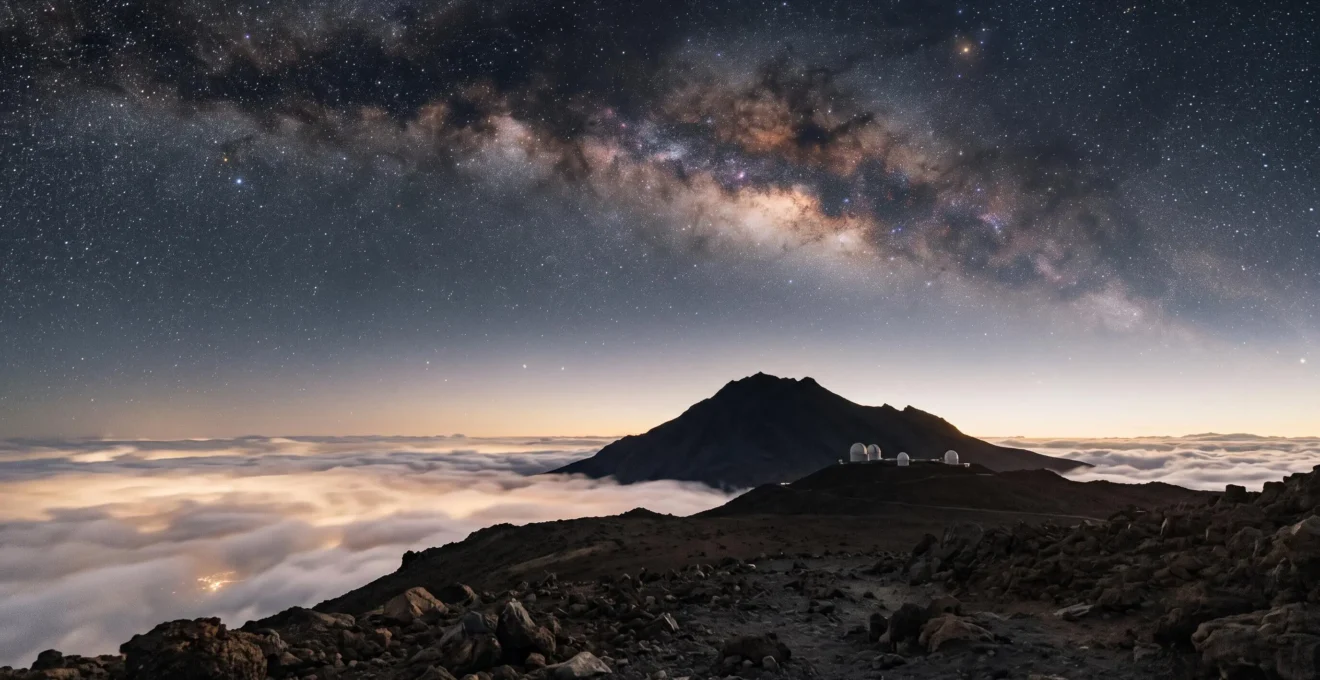
The world’s most pristine stargazing sites are not merely dark; they are the product of a rare convergence of stable atmospheric physics and rigorous, multi-layered legal protection.
- Celestial clarity depends on non-turbulent, dry air found at high altitudes, actively shielded from low-level humidity and light pollution by a consistent temperature inversion layer.
- Official designations from bodies like UNESCO and the Starlight Foundation are not just titles; they represent a legal framework that actively preserves sky quality, attracting a global scientific presence.
Recommendation: For truly exceptional stargazing, prioritize locations where atmospheric science and legal preservation intersect, as these are the only sites that guarantee professional-grade viewing conditions.
For any dedicated astrophotographer or astronomy enthusiast, the search for perfect darkness is a familiar quest. It often begins with the simple advice to escape city lights, seek higher ground, and wait for a new moon. While this is a valid starting point, it barely scratches the surface of what constitutes a truly world-class stargazing location. The ambient glow of urban sprawl is just one enemy; the real challenge lies in conquering a far more subtle foe: the instability of the atmosphere itself. Humidity, turbulence, and airborne particulates can blur a view of Saturn’s rings or wash out the faint arms of a distant galaxy, even in a location that seems perfectly dark to the naked eye.
This is why the Starlight Foundation, a global authority on dark-sky preservation, has designated only a handful of sites in the entire Atlantic region as worthy of its highest certification. But what if the key to this exclusivity isn’t just about finding a remote spot, but about understanding a delicate and rare convergence of factors? The truth is that these elite locations are born from a specific combination of oceanic isolation, stable atmospheric physics, and layered legal frameworks that actively engineer celestial clarity. They are not just found; they are scientifically and legally preserved masterpieces.
This article delves into the science behind this rarity. We will dissect the atmospheric phenomena that create unparalleled viewing conditions and explore the practicalities of accessing these unique sites. By understanding the ‘why’ behind their designation, you can better plan your next expedition to a sky that offers not just darkness, but true, crystalline transparency.
Summary: The Scientific and Legal Anatomy of an Elite Starlight Reserve
- Why Altitude and Oceanic Isolation Create the Clearest Atmospheric Conditions
- How to Reach Teide Observatory Viewpoints Using Night Bus Services
- Bortle Scale Explained: What Class 2 Skies Reveal to the Naked Eye
- When Moon Phases Create the Darkest Conditions for Astrophotography
- The Altitude Sickness Mistake Affecting 30% of Summit Stargazers
- Why Altitude and Ocean Exposure Create 6 Distinct Climate Zones in 50km
- Why UNESCO and EU Designations Layer Multiple Protection Levels
- Why High-Altitude Observatories Detect 40% More Stellar Detail Than Sea-Level Sites
Why Altitude and Oceanic Isolation Create the Clearest Atmospheric Conditions
The exceptional clarity of the skies above locations like the Canary Islands is not an accident of darkness, but a direct result of specific atmospheric physics. The primary factor is a phenomenon known as a temperature inversion layer, created by the interplay between cool oceanic trade winds and warmer, drier air above. This layer forms a stable ceiling that traps clouds, humidity, and aerosol pollution from sea level, keeping the upper atmosphere remarkably clean and dry. A study of the region found that the trade-wind inversion layer is present 78% of the time throughout the year, effectively placing the high-altitude observatories above the weather.
This inversion promotes a state of atmospheric laminar flow, where the air moves in smooth, parallel layers with minimal turbulence. As the UNESCO Portal to the Heritage of Astronomy notes for the Roque de los Muchachos and Teide Observatories, this means “the atmosphere, stabilised by the ocean, is clean and turbulence-free.” For an astronomer, this is the holy grail. Turbulence, or “bad seeing,” is what makes stars twinkle; its absence allows for incredibly sharp, steady images, enabling telescopes to resolve fine details in celestial objects that would be hopelessly blurred elsewhere. A site-testing campaign confirmed this, finding a mean seeing of just 0.76 arcseconds, a figure that places the site among the world’s most stable for astronomical observation.
Ultimately, it is this combination of a natural “lid” on pollution and the calming influence of a vast ocean that creates a uniquely stable column of air, ideal for peering deep into the cosmos.
How to Reach Teide Observatory Viewpoints Using Night Bus Services
Accessing the pristine dark-sky zones within Teide National Park presents a unique logistical challenge, particularly for those unfamiliar with high-altitude mountain driving at night. While renting a car offers flexibility during the day, the winding, unlit roads like the TF-21 can be intimidating and hazardous for the uninitiated after sunset. The descent from over 2,000 meters in complete darkness, often with sharp hairpin turns and no guardrails, requires significant concentration and local knowledge, detracting from the peaceful experience of stargazing.
Recognizing this difficulty, a practical and safer alternative is to utilize organized night transport. Several companies in Tenerife offer dedicated “sunset and stargazing” tours that solve the transportation problem entirely. These services typically use buses or coaches to pick up visitors from major hubs in the south of the island, such as Costa Adeje, and handle the entire ascent and descent. As one commercial tour provider highlights, these packages bundle round-trip transport with professional guides and telescopes, completely removing the “last bus down” anxiety and the risks of self-driving. This approach allows astronomers to focus solely on the sky, without the stress of navigating a challenging mountain descent late at night.
Choosing a guided bus tour not only enhances safety but also enriches the experience. Guides are experts on the local night sky and often bring high-quality telescopes, offering insights and views that an independent visitor might miss. It transforms the journey from a logistical hurdle into an integral, educational part of the astronomical adventure.
For the serious enthusiast focused on observation or photography, offloading the burden of driving is a strategic decision that maximizes both safety and the quality of the stargazing session.
Bortle Scale Explained: What Class 2 Skies Reveal to the Naked Eye
The Bortle Scale is the standard metric used by astronomers to quantify the darkness of a night sky. Created by John E. Bortle, its purpose is “to help skywatchers evaluate and compare the darkness of night-sky observing sites.” The scale runs from Class 1, representing the darkest possible sky, to Class 9, found in the heart of a major city. Elite Starlight Reserves, such as the high-altitude zones of Teide National Park, typically fall into the Bortle Class 2 category. This is a level of darkness almost unimaginable to most of the world’s population.
But what does a Bortle Class 2 sky actually reveal? It’s a profound, immersive experience. Under these conditions, the Milky Way is not a faint, hazy band but a brilliantly structured entity with visible dark lanes and complex star clouds, casting faint but discernible shadows on the ground. Faint celestial objects like the Triangulum Galaxy (M33) become visible to the naked eye, a feat impossible in even typical rural skies (Class 4). The sky is so saturated with stars that the familiar constellations can be difficult to pick out from the dense background. This corresponds to a naked-eye limiting magnitude of around 6.5-7.0, meaning stars that are four to five times fainter than what is visible from a suburb can be easily seen.
The fact that a public national park can achieve this rating is remarkable. These sites are considered to be in the same league as professional observatory locations, offering a quality of darkness that is rapidly vanishing. It is this quantifiable, exceptional darkness that separates a designated Starlight Reserve from simply a “dark place.”
For an astrophotographer, this translates to images with higher contrast, less noise, and the ability to capture incredibly faint deep-sky objects with shorter exposure times.
When Moon Phases Create the Darkest Conditions for Astrophotography
For any deep-sky astrophotography, the single biggest source of natural light pollution is the Moon. As a guiding principle, the darkest skies are always found during the New Moon phase, when the Moon is not visible in the night sky. The two-week window surrounding the New Moon—about seven days before and seven days after—provides the optimal conditions for capturing faint nebulae, distant galaxies, and the intricate details of the Milky Way. During a Full Moon, the sky is so brightly illuminated that it can wash out all but the brightest stars, effectively raising a Bortle Class 2 sky to a Class 5 or 6.
However, the Moon is not always the enemy. For landscape astrophotographers who wish to include the dramatic volcanic terrain in their compositions, a completely dark sky can leave the foreground as a black, featureless silhouette. In this scenario, a thin crescent moon can be a powerful tool. When the Moon is a sliver (typically 1-4 days after the New Moon or before the next one), it provides just enough gentle light to illuminate the landscape without significantly polluting the sky. This technique, known as “moonlight fill,” adds depth, texture, and a sense of place to an image that would otherwise be dominated by the stars alone.
As seen in the image, this delicate balance between a dark sky and a subtle light source on the terrain is key to creating compelling nightscapes. The ideal timing is often when a thin crescent moon is low on the horizon, either setting shortly after sunset or rising just before sunrise. This minimizes its impact on the darkest part of the sky while still bathing the foreground in a soft, ethereal glow.
Action Plan: Preparing Your High-Altitude Stargazing Night
- Acclimatization: Spend at least an hour at an intermediate altitude (1,500-1,800m) before ascending to the final viewpoint to help your body adjust.
- Timing: Check the moon phase calendar. Plan your trip within the week before or after the New Moon for the darkest conditions.
- Lighting: Bring a headlamp with a red-light mode. Red light preserves your night vision, which takes at least 20-30 minutes to fully adapt.
- Clothing: Dress in multiple layers. Temperatures at 2,200m can drop to near freezing, even in summer. Include a windproof outer layer, hat, and gloves.
- Sustenance: Bring warm fluids like tea or soup in a thermos, and high-energy snacks. Avoid alcohol, as it can worsen the effects of altitude.
Therefore, planning a trip requires a careful check of the lunar calendar, aligning your visit with the New Moon for deep-sky work or a crescent moon for dramatic landscape shots.
The Altitude Sickness Mistake Affecting 30% of Summit Stargazers
While the high altitude of sites like Teide National Park is a primary reason for their superb sky quality, it also presents a significant physiological challenge: the risk of acute mountain sickness (AMS), or altitude sickness. Many visitors make the critical mistake of ascending too quickly from sea level to over 2,200 meters (7,200 feet) in the late afternoon. The rapid drop in oxygen pressure can lead to symptoms like headaches, dizziness, nausea, and shortness of breath, which can severely detract from or even ruin a stargazing session.
The most common error is underestimating the body’s need for acclimatization. The body requires time to adjust to the lower oxygen levels. A sudden ascent for an evening’s observation doesn’t provide this window. The effects are often subtle at first—perhaps a mild headache or slight fatigue—but can worsen as the night progresses, especially in the cold. This is compounded by dehydration, as the dry mountain air increases fluid loss through respiration. Many people also fail to dress warmly enough, underestimating how quickly temperatures plummet after sunset at high elevations, which adds further stress to the body.
To mitigate the risk, the key is a gradual ascent. If possible, spend an hour or two at an intermediate elevation (around 1,500m) before continuing to your final viewing spot. This simple pause can make a significant difference. Furthermore, it is crucial to stay well-hydrated throughout the day, drinking plenty of water and avoiding alcohol and caffeine, which can exacerbate dehydration. Taking it easy upon arrival—avoiding strenuous activity like running around to set up equipment—also allows your body to better adapt.
Ignoring these simple precautions is the fastest way to turn a potentially breathtaking astronomical experience into a miserable, headache-filled night.
Why Altitude and Ocean Exposure Create 6 Distinct Climate Zones in 50km
The same volcanic geography that grants access to high, clear skies also creates a startling diversity of microclimates. An island like Tenerife is a continent in miniature, with up to six distinct climate zones stacked vertically from the coast to the summit. This is a direct consequence of the island’s steep altitude profile and its interaction with the prevailing north-easterly trade winds, which carry moisture from the Atlantic.
This journey through climates is most evident on the northern slopes. It begins with a warm, subtropical coastal zone. As you ascend, you enter the path of the moist trade winds, creating a cool, humid zone between 600 and 1,200 meters. This is where the famous “mar de nubes” or “sea of clouds” forms. A scientific study using satellite data determined that the cloud bank normally lies at between 1,200-1,600 meters, forming a dense layer of stratocumulus. This cloud sea is the physical manifestation of the temperature inversion layer that is so crucial for good stargazing.
Once you drive through this cloud layer, you emerge into a completely different world. Above 1,800 meters, you enter the high mountain climate zone. Here, the air is intensely dry, the sun is powerful, and the influence of the inversion layer below means you are above almost all weather. This stark, arid landscape, dominated by the Teide volcano, experiences huge temperature swings between day and night and receives snowfall in winter, all while the coast below remains balmy. It is this dramatic stratification that allows one to go from a beach to an alpine desert in under an hour.
For the astronomer, this means that while the lower and middle elevations are often shrouded in cloud, the summit remains an island of perfect clarity, floating above the turmoil of the lower atmosphere.
Why UNESCO and EU Designations Layer Multiple Protection Levels
The pristine quality of the night sky in designated Starlight Reserves is not maintained by chance; it is the result of a robust and intentionally layered system of legal protections. A single designation, like being a National Park, is often not enough to combat the pervasive creep of light pollution. The world’s premier astronomical sites are shielded by a combination of local, national, and international regulations that work in synergy.
At the local level, the foundation is often a specific piece of legislation. As Star Register highlights, “the Canarian Sky Law has protected these skies by regulating light pollution.” Enacted in 1988, this pioneering law—formally known as the “Law for the Protection of the Astronomical Quality of the Observatories of the Canarian Astrophysics Institute”—imposes strict controls on outdoor lighting, including direction (must be shielded and point downwards), spectral output (restricting blue-rich light), and curfews on non-essential illumination. This local law provides the teeth for day-to-day enforcement.
This is then reinforced by national and international designations. Being a UNESCO World Heritage Site, as Teide National Park is, adds a layer of global prestige and a mandate for preservation. It obligates the managing authority to protect the “Outstanding Universal Value” of the site, which increasingly includes its natural darkness. Finally, certifications from bodies like the Starlight Foundation act as a third layer, providing a scientific benchmark and an internationally recognized standard of quality. This powerful combination of legal frameworks ensures that the protection is comprehensive, creating a safe haven for astronomy that attracts significant global investment. The two main Canary Islands observatories are currently home to telescopes and instruments belonging to 60 scientific institutions from 19 countries, a testament to the trust in these long-term protections.
When choosing a stargazing destination, the presence of these multiple layers of certification is a guarantee that the quality of the sky is not a temporary condition but a fiercely guarded asset.
Key takeaways
- Exceptional sky clarity is not just about darkness; it’s a product of stable, non-turbulent atmospheric conditions created by high altitude and oceanic inversion layers.
- The best sites are shielded by multiple, overlapping legal protections (local laws, national parks, UNESCO) that actively regulate light pollution.
- Practical logistics like night-time mountain driving and altitude acclimatization are critical factors to consider for a successful and safe stargazing trip.
Why High-Altitude Observatories Detect 40% More Stellar Detail Than Sea-Level Sites
The primary advantage of a high-altitude observatory is its position above the thickest and most turbulent part of the Earth’s atmosphere. One of the most significant components that obscures our view of the universe is water vapour. Water molecules in the air absorb and scatter light, particularly in the infrared spectrum, and contribute to atmospheric instability. By ascending to altitudes of over 2,000 meters, astronomers place themselves above a significant portion of this atmospheric water vapour.
The scientific measure for this is Precipitable Water Vapour (PWV), which quantifies the total amount of water in a column of atmosphere overhead. While sea-level sites might have a PWV of 20 mm or more, high-altitude desert locations are dramatically drier. For example, a statistical analysis of measurements above Roque de los Muchachos Observatory found a median column of precipitable water vapour of just 3.8 mm. This extreme dryness is what makes the sky so transparent, allowing fainter objects to be seen and enabling more light from every star to reach the telescope’s sensor.
This reduction in atmospheric interference has a direct impact on image resolution, or the ability to discern fine detail. With less atmospheric “seeing” (turbulence) and less absorption from water vapour, the light from a star or galaxy arrives at the telescope as a much more focused, stable point. This allows for sharper images and the detection of subtle structures, such as the gaps in Saturn’s rings or the individual stars in a globular cluster, that would be completely smeared out by the atmospheric soup at lower elevations.
For any astrophotographer or observer seeking the highest level of detail, accessing these rare, high, and dry locations is not just a preference—it is an absolute necessity to push the boundaries of what is possible to see from the ground.